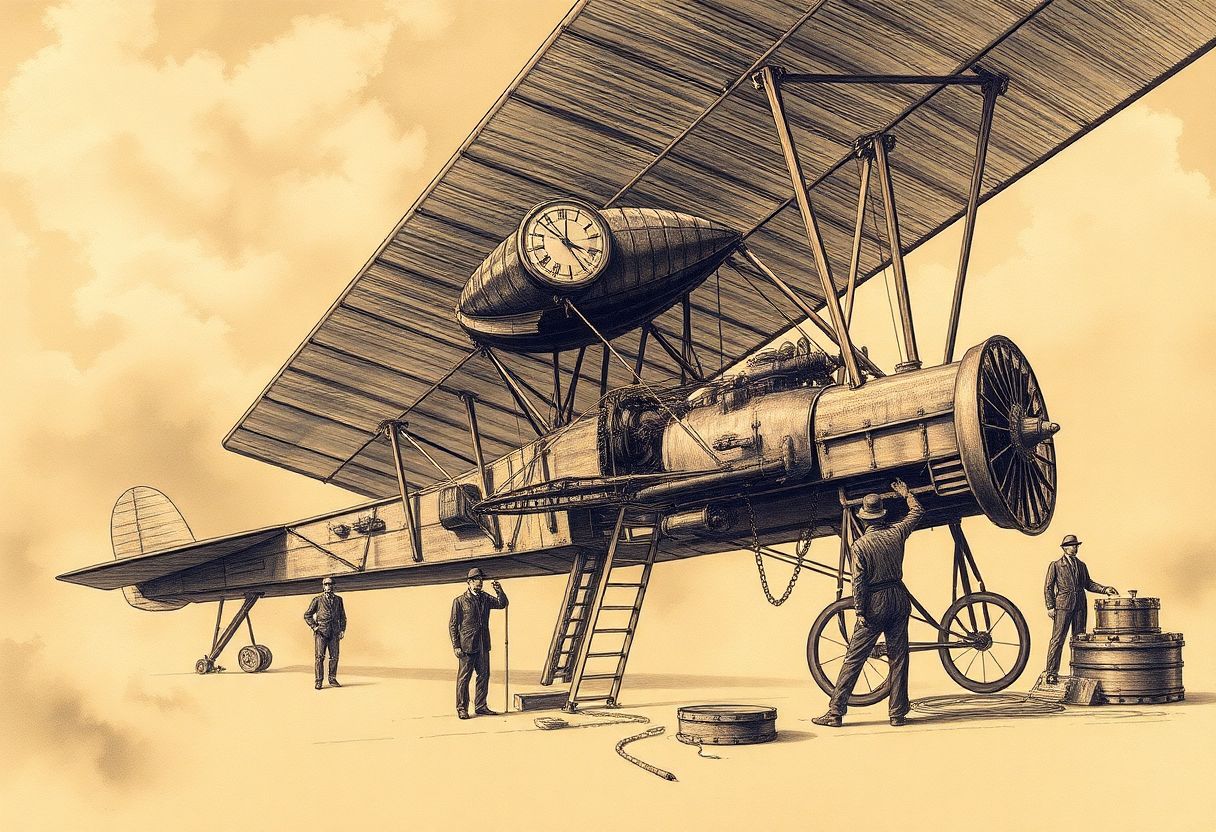
The Ascent of Aviation: Why Steam Engines Failed to Take Flight
The dream of human flight has captivated our imagination for millennia. From ancient myths to modern marvels, our journey to conquer the skies is a testament to human ingenuity and perseverance. This article explores the fascinating history of flight, with a particular focus on why steam engines, despite their transformative impact on land and sea transportation, proved unsuitable for powering aircraft.
The Early Dreams of Flight
Long before the Wright brothers took to the skies, humans envisioned soaring among the clouds. Ancient tales and myths from various cultures reflect this universal aspiration. The Greek myth of Icarus, who flew too close to the sun with wax wings, serves as both a cautionary tale and an embodiment of our lofty ambitions. Similarly, Persian epics spoke of the flying throne of Kay Kāvus, while Arabian folklore regaled us with tales of magic carpets.
These mythical accounts were more than mere fantasies; they represented the human desire to break free from earthly constraints. As civilization progressed, this desire manifested in increasingly practical attempts to achieve flight.
Balloon Flight: The First Taste of the Skies
The first successful human flights didn't involve wings at all, but rather relied on the principle of buoyancy discovered by Archimedes over two millennia ago. The late 18th century saw a significant breakthrough with the Montgolfier brothers' creation of the first practical hot air balloon in 1783. This marked the beginning of the era of lighter-than-air flight.
The development of balloon technology rapidly progressed. Hydrogen-filled balloons soon followed, offering greater lift but at the cost of increased flammability. By the mid-19th century, pioneers like Henri Giffard were developing steerable airships, or dirigibles. These advancements culminated in the late 19th and early 20th centuries with Count Ferdinand von Zeppelin's rigid airships, which for a time seemed to be the future of air travel.
However, while balloons and airships represented a significant leap forward in human flight, they had inherent limitations. They were slow, difficult to control in adverse weather conditions, and, in the case of hydrogen-filled craft, posed significant safety risks. The quest for heavier-than-air flight continued unabated.
The Quest for Powered Flight
As balloon technology advanced, another group of inventors and engineers focused on achieving flight with fixed-wing aircraft. This pursuit would ultimately lead to the development of the airplane as we know it today. Pioneers like Sir George Cayley (1773-1857) established the basic principles of fixed-wing flight, while Otto Lilienthal (1848-1896) conducted over 2,000 glider flights, greatly advancing our understanding of aerodynamics.
These early experiments with gliders were crucial in understanding the physics of flight and wing design. However, to achieve sustained, controlled flight, a reliable source of propulsion was needed. Enter the steam engine – a technology that had already revolutionized transportation on land and sea.
The Steam Engine: A Tempting but Flawed Solution
In the 19th century, as inventors sought to power their flying machines, the steam engine seemed like an obvious choice. After all, it had transformed railways and shipping, propelling the Industrial Revolution forward at an unprecedented pace. Several ambitious attempts were made to harness steam power for flight:
-
William Henson's "Aerial Steam Carriage" (1842): Although it never flew, Henson's design was remarkably prescient, featuring a fixed-wing configuration and propellers.
-
Clément Ader's steam-powered "Éole" (1890): This bat-like aircraft allegedly achieved a short hop of 50 meters, though this claim is disputed.
-
Sir Hiram Maxim's massive steam-powered flying machine (1894): Built more like a locomotive than an aircraft, Maxim's creation managed to lift off briefly before being restrained by safety rails.
Despite these valiant efforts, steam engines proved ill-suited for powered flight. Let's delve deeper into why:
Weight: The Achilles' Heel of Steam Power in Aviation
The primary obstacle to steam-powered flight was the sheer weight of the engines. A typical steam engine of the late 19th century had a power-to-weight ratio of around 0.033 horsepower per pound (hp/lb). In contrast, the Wright brothers' custom-built gasoline engine achieved a ratio of 0.14 hp/lb, more than four times as efficient.
The weight issue wasn't just about the engine itself. The entire steam power system – including the boiler, water supply, and fuel – added significant mass to the aircraft. For example, Maxim's behemoth weighed over 3.5 tons, with its boilers alone weighing nearly a ton. This excessive weight made it incredibly difficult to generate enough lift for sustained flight.
Power-to-Weight Ratio: A Critical Metric
While steam engines could produce substantial power, they couldn't match the efficiency of internal combustion engines in terms of power produced per unit of weight. This metric, known as the power-to-weight ratio, is crucial in aviation.
To put this in perspective, by the early 20th century, some of the best steam engines could achieve power-to-weight ratios of around 0.5 hp/lb. However, internal combustion engines of the same era were already reaching ratios of 1-2 hp/lb, with some specialized aircraft engines achieving even higher ratios.
Complexity: A Maintenance Nightmare
Steam engines required a complex system of boilers, pipes, and valves. This intricate machinery was difficult to maintain and operate, especially in the dynamic and space-constrained environment of an aircraft. The complexity also increased the likelihood of mechanical failures, a particularly dangerous prospect in aviation.
Moreover, the steam engine's many components made it challenging to streamline the aircraft's design for optimal aerodynamics. This added complexity not only increased weight but also created additional drag, further hindering flight performance.
Response Time: The Need for Speed
Aircraft require engines that can quickly adjust power output to manage takeoffs, landings, and in-flight maneuvers. Steam engines, however, took time to build up pressure and couldn't respond quickly to the need for rapid power changes during flight.
For instance, changing the power output of a steam engine might take several seconds or even minutes, as pressure needed to build or dissipate in the boiler. In contrast, internal combustion engines could change their power output almost instantaneously, providing the responsiveness crucial for controlled flight.
Fuel Efficiency: A Limiting Factor
Steam engines consumed fuel at a rapid rate, limiting flight duration and range. The process of converting water to steam and then to mechanical energy is inherently less efficient than the direct conversion of chemical energy to mechanical energy in internal combustion engines.
To illustrate, early steam engines had a thermal efficiency of about 3%, meaning only 3% of the heat energy from burning fuel was converted into useful mechanical work. By the late 19th century, this had improved to around 10-15%. In comparison, early internal combustion engines achieved efficiencies of 20-25%, with modern engines reaching up to 40% efficiency.
Safety Concerns: A Dangerous Combination
The combination of high-pressure steam and the open flames needed to heat the boiler presented significant risks in an aircraft. A rupture in a steam pipe or boiler could be catastrophic, releasing scalding steam and potentially causing structural failure of the aircraft.
Furthermore, the use of combustible fuels in close proximity to heat sources increased the risk of fire – a particularly terrifying prospect in an airborne vehicle.
The Internal Combustion Engine: A Breakthrough in Powered Flight
The development of lightweight, powerful internal combustion engines in the late 19th century provided the breakthrough needed for sustained powered flight. These engines offered several key advantages over steam power:
-
Higher power-to-weight ratio: As mentioned earlier, internal combustion engines could produce more power per unit of weight, crucial for achieving lift.
-
Quicker response to power adjustments: The ability to rapidly change power output was essential for controlling an aircraft in flight.
-
Greater fuel efficiency: Internal combustion engines could extract more useful energy from fuel, allowing for longer flight times and greater ranges.
-
Simpler and more compact design: Without the need for boilers and extensive piping, internal combustion engines were easier to integrate into aircraft designs.
It was this technology that the Wright brothers harnessed for their historic flight in 1903, ushering in the age of powered aviation. Their engine, a custom-built 12-horsepower gasoline engine weighing only 170 pounds, was a marvel of engineering for its time.
The Wright Brothers and the Birth of Modern Aviation
Wilbur and Orville Wright's success where others had failed was due to their systematic, scientific approach to solving the problems of flight. They conducted extensive wind tunnel tests to optimize wing design, developed a lightweight, efficient engine specifically for their aircraft, created a propeller design that was far more efficient than previous attempts, and invented aircraft controls that allowed for stable, controlled flight.
Their breakthrough on December 17, 1903, marked the beginning of the era of powered, controlled flight. The Wright Flyer's engine produced 12 horsepower and weighed just 170 pounds, giving it a power-to-weight ratio of 0.07 hp/lb – more than twice that of the best steam engines of the time.
The Rapid Evolution of Aircraft Technology
In the decades following the Wright brothers' first flight, aviation technology progressed at an astonishing rate. The advent of World War I drove rapid advancements in aircraft design and performance. By the end of the war in 1918, aircraft engines were producing over 400 horsepower, a massive increase from the Wright brothers' original 12 horsepower engine.
Key milestones in this period included:
- 1909: Louis Blériot crosses the English Channel in a monoplane powered by a 25-horsepower engine.
- 1914-1918: World War I sees the development of specialized fighter and bomber aircraft.
- 1919: Alcock and Brown complete the first non-stop transatlantic flight in a modified bomber.
- 1927: Charles Lindbergh completes the first solo non-stop transatlantic flight in the Spirit of St. Louis, powered by a 223-horsepower Wright J-5C engine.
During this period, aircraft engines became increasingly powerful and reliable, while airframe design improved to allow for greater speed, range, and payload capacity.
The Jet Age: Breaking the Sound Barrier and Beyond
The development of jet engines in the 1930s and 1940s revolutionized aviation once again, allowing for previously unimaginable speeds and altitudes. The concept of jet propulsion, first patented by Frank Whittle in 1930, offered several advantages over piston engines:
-
Higher thrust-to-weight ratio: Jet engines could produce more thrust per unit of weight than piston engines, allowing for faster speeds and higher altitudes.
-
Smoother operation: The continuous combustion in jet engines resulted in less vibration than piston engines, improving aircraft longevity and passenger comfort.
-
Better performance at high altitudes: Jet engines maintain their performance better than piston engines as air density decreases at higher altitudes.
-
Potential for supersonic flight: The high exhaust velocity of jet engines made supersonic flight possible.
Key developments in the jet age included:
- 1939: Hans von Ohain develops the first operational jet engine in Germany.
- 1947: The Bell X-1, piloted by Chuck Yeager, becomes the first aircraft to break the sound barrier.
- 1952: The de Havilland Comet becomes the world's first commercial jet airliner.
- 1976-2003: The Concorde operates as the world's first supersonic passenger airliner, cruising at Mach 2.
Jet propulsion opened up new possibilities in both military and civilian aviation, leading to the modern era of global air travel and advanced fighter aircraft.
The Space Age and Beyond
The principles of flight developed for aircraft within Earth's atmosphere were eventually adapted for travel beyond it. Rocket technology, which had its roots in ancient Chinese fireworks, was refined and scaled up to enable space exploration.
Key developments in space flight included:
- 1957: The Soviet Union launches Sputnik 1, the first artificial satellite.
- 1961: Yuri Gagarin becomes the first human to journey into outer space.
- 1969: Apollo 11 lands humans on the Moon for the first time.
- 1981-2011: NASA's Space Shuttle program demonstrates reusable spacecraft technology.
Today, we are witnessing the dawn of commercial spaceflight, with companies like SpaceX, Blue Origin, and Virgin Galactic pushing the boundaries of what's possible in space travel.
The Future of Flight: Sustainability and Innovation
As we look to the future, the focus of aviation technology is shifting towards sustainability and new forms of propulsion. Climate change concerns and dwindling fossil fuel reserves are driving innovation in aircraft design and propulsion systems.
Emerging technologies include:
-
Electric and hybrid-electric aircraft: Companies like Pipistrel and Eviation are developing all-electric aircraft for short-haul flights.
-
Hydrogen fuel cell propulsion: Airbus has announced plans to develop hydrogen-powered commercial aircraft by 2035.
-
Supersonic and hypersonic transport: Companies like Boom Supersonic are working on environmentally friendly supersonic passenger aircraft.
-
Urban air mobility: Companies like Joby Aviation and Lilium are developing electric vertical takeoff and landing (eVTOL) aircraft for urban transportation.
Conclusion: The Enduring Legacy of Early Flight Pioneers
While steam engines ultimately proved unsuitable for powered flight, the efforts of those early inventors were not in vain. Their work laid the foundation for understanding aerodynamics, aircraft design, and the challenges of powered flight. The story of aviation is one of continuous innovation, building upon the successes and learning from the failures of those who came before.
From the dreams of ancient myths to the reality of modern jet travel and space exploration, the history of flight is a testament to human ingenuity and perseverance. As we face new challenges in the 21st century, the spirit of innovation that drove the Wright brothers and their contemporaries continues to inspire new generations of aerospace engineers and inventors.
The journey from steam-powered experiments to solar-powered aircraft and beyond is a reminder that in aviation, as in all fields of human endeavor, progress often comes not from a single breakthrough, but from the cumulative efforts of countless individuals, each pushing the boundaries of what's possible just a little bit further. As we look to the skies and beyond, we carry with us the dreams and determination of all those who came before, propelling us towards an ever more exciting future in flight.