The Marvels of Modern Computing: From Binary to Quantum
In an age where computers permeate nearly every aspect of our lives, understanding how these remarkable machines function is both fascinating and essential. From the smartphones in our pockets to the supercomputers powering scientific breakthroughs, the world of computing is a testament to human ingenuity and technological progress. Let's embark on a journey through the intricate workings of computers, exploring everything from the fundamental principles to cutting-edge innovations.
The Foundations of Computing
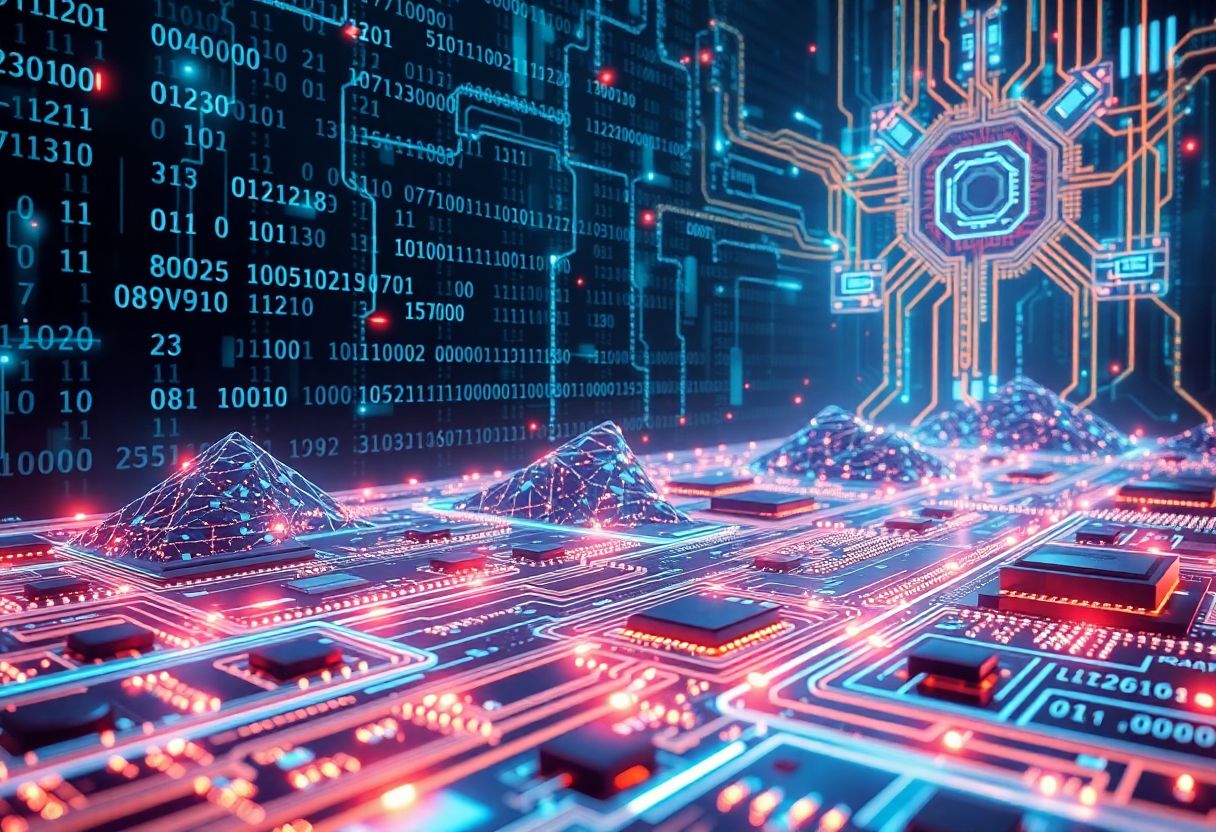
At its core, a computer is an information processor, taking in data, manipulating it according to a set of instructions, and producing a result. This process is built upon the foundation of binary code – a system of ones and zeros that forms the language of computers. But how do we get from simple on/off switches to the complex operations that drive modern technology?
The Binary Building Blocks
The concept of binary is central to computing. Each binary digit, or "bit," represents one of two states: on (1) or off (0). By combining these bits, we can represent increasingly complex information. For instance, a byte, which consists of 8 bits, can represent 256 different values (2^8), enough to encode all the letters of the alphabet, numbers, and basic symbols.
This binary system is implemented at the hardware level through transistors – tiny switches that can be either on or off. Modern processors contain billions of these transistors, each measuring only nanometers in size. The Intel Core i9-11900K, for example, packs 3.6 billion transistors into a chip smaller than a postage stamp, showcasing the incredible density of modern computing hardware.
Logic Gates: The Building Blocks of Computation
Transistors are combined to form logic gates, which perform basic logical operations. The three fundamental types of gates are:
- AND gates: Output 1 only if all inputs are 1
- OR gates: Output 1 if at least one input is 1
- NOT gates: Invert the input (0 becomes 1, 1 becomes 0)
By combining these simple gates, we can create more complex circuits capable of performing advanced calculations and operations. For instance, a full adder circuit, which adds two binary digits, is constructed using multiple AND, OR, and NOT gates.
The Computer's Brain: Central Processing Unit (CPU)
The CPU is often called the "brain" of the computer, and for good reason. It's responsible for executing instructions and performing calculations. Modern CPUs operate at mind-boggling speeds, with clock rates measured in gigahertz (billions of cycles per second).
The Fetch-Decode-Execute Cycle
The CPU's operation can be broken down into a cycle known as the fetch-decode-execute cycle:
- Fetch: The CPU retrieves an instruction from memory.
- Decode: The instruction is translated into actions the CPU can perform.
- Execute: The CPU carries out the instruction.
This cycle happens billions of times per second in modern processors. For example, a CPU with a clock speed of 3.5 GHz can theoretically execute 3.5 billion cycles per second, although real-world performance depends on many factors.
Multi-Core Processing and Parallel Computing
To increase performance, modern CPUs often incorporate multiple cores, each capable of executing instructions independently. This allows for parallel processing, where multiple tasks can be performed simultaneously. The AMD Ryzen Threadripper 3990X, for instance, boasts 64 cores and 128 threads, enabling incredible multitasking capabilities.
Memory and Storage: The Computer's Filing System
Computers use different types of memory and storage for various purposes, each with its own characteristics and use cases.
Random Access Memory (RAM)
RAM serves as the computer's short-term memory, providing fast access to data that the CPU needs for immediate processing. It's volatile, meaning it loses its contents when power is turned off. Modern computers typically have several gigabytes of RAM, with high-end systems boasting 32GB or more.
Storage Devices
For long-term storage, computers use devices like hard disk drives (HDDs) and solid-state drives (SSDs). HDDs use magnetic disks to store data, while SSDs use flash memory. SSDs are generally faster but more expensive per gigabyte. For example, a high-end NVMe SSD can achieve read speeds of over 7000 MB/s, while a typical HDD might reach 150 MB/s.
Cache Memory
Cache is a small amount of very fast memory used to store frequently accessed data for quick retrieval by the CPU. Modern CPUs have multiple levels of cache (L1, L2, L3), each with different sizes and speeds. The L1 cache is the smallest but fastest, often operating at the same speed as the CPU itself.
Input and Output: The Computer's Senses
Input and output devices are our primary means of communicating with computers, acting as its "senses" and means of expression.
Input Devices
Keyboards, mice, touchscreens, and microphones are common input devices. Each key press on a keyboard sends a specific code to the computer, while a mouse translates physical movements into X and Y coordinates. Touchscreens use various technologies, such as capacitive sensing, which detects changes in electrical properties when a finger touches the screen.
Output Devices
Displays, speakers, and printers are typical output devices. Modern displays use technologies like LCD (Liquid Crystal Display) or OLED (Organic Light Emitting Diode) to convert digital signals into visual output. High-end displays can refresh at rates of 144Hz or higher, providing smooth motion for gaming and video playback.
Networking: The Web of Connections
In our interconnected world, networking is a crucial aspect of computing. The internet, a global network of networks, connects billions of devices worldwide.
Packet Switching
Data transmitted over networks is broken into small packets, each given an address (like a mailing address). These packets are sent over the network and reassembled at their destination. This method, known as packet switching, allows for efficient use of network resources and enables the complex web of connections that make up the internet.
Network Protocols
Various protocols govern how data is transmitted over networks. The TCP/IP (Transmission Control Protocol/Internet Protocol) suite is the foundation of the internet. Other protocols like HTTP (Hypertext Transfer Protocol) and HTTPS (HTTP Secure) are used for web browsing, while protocols like SMTP (Simple Mail Transfer Protocol) handle email transmission.
Software: Instructing the Machine
Software is what tells a computer what to do. It's written by programmers in high-level languages like Python, Java, or C++, which are then translated into machine code that the CPU can understand.
The Software Development Process
- Writing source code: Programmers write human-readable code in a high-level language.
- Compiling or interpreting: The code is translated into machine code. Compiled languages like C++ are translated all at once, while interpreted languages like Python are translated line-by-line as the program runs.
- Linking: The code is combined with libraries and other resources.
- Creating an executable: The final program is packaged for distribution.
Operating Systems: The Computer's Manager
Operating systems (OS) manage hardware resources, provide a user interface, and create a platform for running applications. Popular desktop OSes include Windows, macOS, and Linux, while mobile devices typically run iOS or Android.
Key functions of an OS include:
- Process management: Allocating CPU time to different programs
- Memory management: Controlling how RAM is used
- File system management: Organizing and accessing stored data
- Device management: Controlling hardware components
- User interface provision: Providing a way for users to interact with the computer
Graphics and Sound: Bringing Computers to Life
Modern computers can produce rich visual and audio experiences, thanks to specialized hardware and software.
Graphics Processing Units (GPUs)
GPUs handle complex visual calculations, enabling everything from smooth desktop animations to realistic 3D games. Modern GPUs, like NVIDIA's RTX 3090, can perform over 35 trillion floating-point operations per second (35 TFLOPS), allowing for real-time ray tracing and other advanced graphics techniques.
Audio Processing
Sound cards convert digital audio data into analog signals that can be played through speakers or headphones. High-end audio systems can support sample rates up to 192 kHz and bit depths of 24 bits or more, providing studio-quality sound reproduction.
Security: Safeguarding Digital Assets
As computers have become more connected, security has become increasingly important. Key aspects of computer security include:
Encryption
Encryption scrambles data so it can only be read by authorized parties. Modern encryption algorithms like AES (Advanced Encryption Standard) use keys of 128, 192, or 256 bits, making them extremely difficult to crack through brute-force methods.
Firewalls and Antivirus Software
Firewalls monitor and control network traffic, while antivirus software detects and removes malicious software. These tools use various techniques, including signature-based detection and behavioral analysis, to identify and neutralize threats.
Artificial Intelligence and Machine Learning
Artificial Intelligence (AI) and Machine Learning (ML) represent some of the most exciting frontiers in computing. These technologies allow computers to learn from data, recognize patterns, and adapt to new situations without explicit programming.
Neural Networks and Deep Learning
Inspired by the structure of the human brain, neural networks are a key component of many AI systems. Deep learning, which uses neural networks with many layers, has achieved remarkable results in tasks like image recognition and natural language processing.
Applications of AI and ML
AI and ML are powering innovations in fields ranging from healthcare to autonomous vehicles. For example, AI-powered systems can analyze medical images to detect diseases, while machine learning algorithms optimize traffic flow in smart cities.
Quantum Computing: The Next Frontier
While traditional computers use bits, quantum computers use quantum bits or "qubits." These can exist in multiple states simultaneously, a property known as superposition. This allows quantum computers to perform certain calculations exponentially faster than classical computers.
Potential Applications
Quantum computing could revolutionize fields like cryptography, drug discovery, and financial modeling. For instance, quantum computers could potentially break current encryption methods, necessitating the development of quantum-resistant cryptography.
Current State of Quantum Computing
While still in its early stages, quantum computing is progressing rapidly. In 2019, Google claimed to have achieved "quantum supremacy," performing a calculation in 200 seconds that would take a classical supercomputer 10,000 years. However, practical, large-scale quantum computers are still years away from widespread use.
Conclusion: The Ever-Evolving Landscape of Computing
From the earliest mechanical calculators to today's quantum computers, the field of computing has come an incredibly long way. As we've explored, modern computers are complex systems built on the simple principles of binary logic and information processing. They've transformed nearly every aspect of our lives, from how we work and communicate to how we entertain ourselves and solve complex problems.
Understanding how computers work not only satisfies our curiosity but also empowers us to use these tools more effectively and to shape the technological future. As we look ahead, emerging technologies like neuromorphic computing, which aims to mimic the structure and function of the human brain, and advances in quantum computing promise to push the boundaries of what's possible even further.
Whether you're a casual user, an IT professional, or an aspiring computer scientist, having a grasp of these fundamental concepts opens up a world of possibilities. As technology continues to evolve at a rapid pace, one thing is certain: the future of computing holds endless potential for innovation and discovery. By understanding the foundations and staying informed about new developments, we can all play a part in shaping this exciting future.