The Magic of Antennas: Bridging the Gap Between Devices and the Electromagnetic World
In our increasingly wireless world, antennas play a crucial yet often overlooked role in keeping us connected. These remarkable devices act as the intermediaries between our gadgets and the invisible realm of electromagnetic waves, enabling everything from radio broadcasts to satellite communications. This comprehensive guide will delve into the fascinating world of antennas, exploring their inner workings, diverse types, and the cutting-edge developments shaping their future.
The Fundamentals of Antenna Technology
At its core, an antenna is a transducer – a device that converts one form of energy into another. In the case of antennas, this conversion occurs between electrical signals and electromagnetic waves. When transmitting, an antenna transforms electrical signals from a device into radio waves that propagate through space. Conversely, when receiving, it captures electromagnetic waves from the environment and converts them back into electrical signals that can be processed by our devices.
The Physics Behind Antenna Operation
To truly understand how antennas function, we must first grasp some key concepts from physics and electromagnetism:
-
Electromagnetic Waves: These are oscillations of electric and magnetic fields that travel through space at the speed of light. Radio waves, which antennas manipulate, are a type of electromagnetic radiation with wavelengths ranging from a few millimeters to hundreds of meters.
-
Resonance: Antennas are most efficient when their physical dimensions correspond to the wavelength of the radio waves they're designed to work with. This phenomenon, known as resonance, is crucial for optimal antenna performance.
-
Electrical Currents and Electromagnetic Fields: When an electrical current flows through a conductor, it generates an electromagnetic field around it. Conversely, when an electromagnetic wave passes over a conductor, it induces an electrical current within it. This reciprocal relationship forms the basis of antenna operation.
The Antenna in Action: Transmitting and Receiving
Let's examine the process of how an antenna works in both transmitting and receiving modes:
Transmitting:
- An electrical signal carrying information (such as audio or data) is fed into the antenna.
- This signal causes electrons in the antenna to oscillate.
- The oscillating electrons create an electromagnetic field around the antenna.
- This field radiates outward from the antenna in the form of radio waves.
Receiving:
- Incoming radio waves pass over the antenna.
- The electromagnetic fields of these waves induce a small electrical current in the antenna.
- This current is amplified and processed by the receiving device.
- The original information is extracted from the signal.
Diverse Antenna Designs for Various Applications
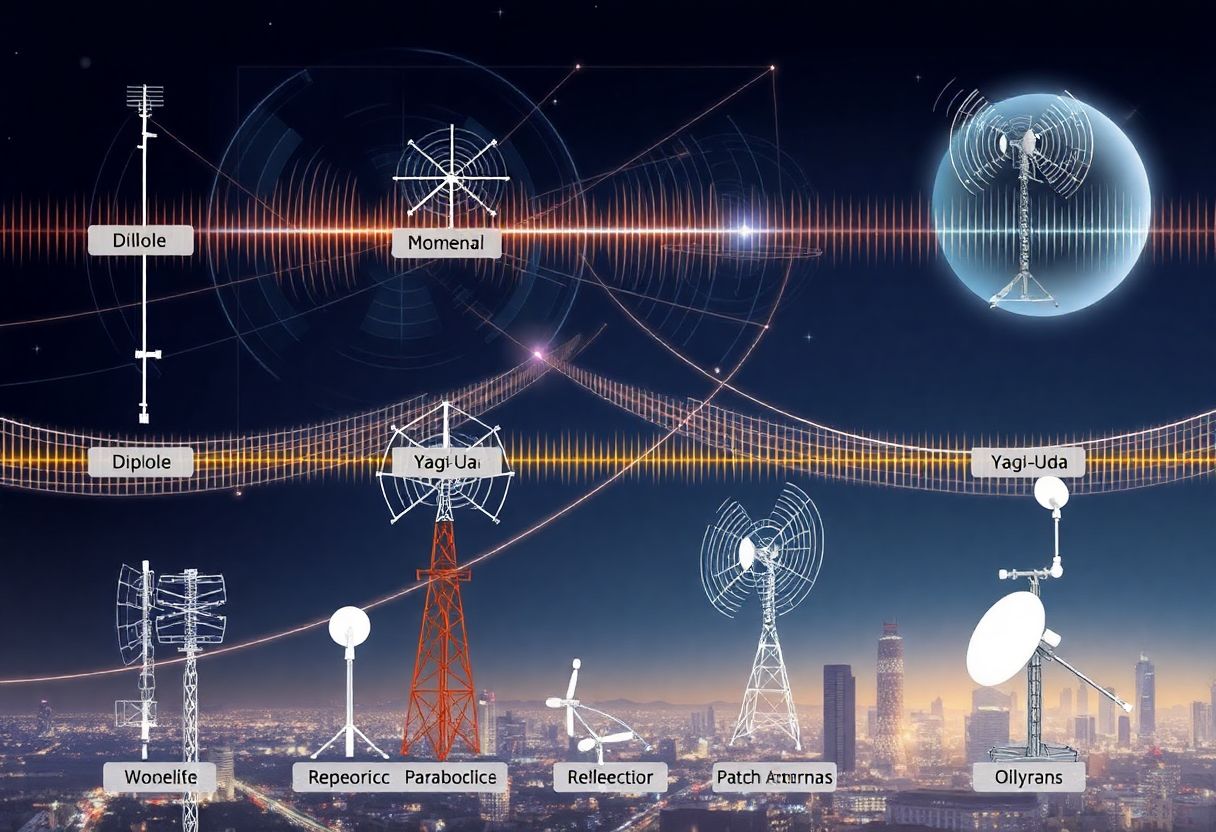
The world of antennas is incredibly diverse, with numerous designs optimized for specific frequencies, applications, and physical constraints. Here are some of the most common types:
1. Dipole Antenna
The dipole is one of the simplest and most widely used antenna designs. It consists of two identical conductive elements, typically metal rods or wires, arranged in a straight line. Dipoles are often used in radio and television broadcasting, as well as in many wireless communication systems.
Key characteristics:
- Omnidirectional radiation pattern in the plane perpendicular to the antenna
- Relatively wide bandwidth
- Easy to construct and inexpensive
2. Monopole Antenna
A monopole antenna is essentially half of a dipole, consisting of a single straight conductor often mounted over a ground plane. This design is commonly found in car radios, mobile devices, and some wireless routers.
Key characteristics:
- Similar radiation pattern to a dipole when used with a ground plane
- More compact than a full dipole
- Can be easily integrated into handheld devices
3. Yagi-Uda Antenna
Named after its Japanese inventors, the Yagi-Uda is a highly directional antenna consisting of multiple elements. It includes a driven element (typically a dipole), a reflector, and one or more directors. Yagi-Uda antennas are often used for television reception, point-to-point communication, and amateur radio.
Key characteristics:
- High directionality and gain in one direction
- Relatively narrow bandwidth
- Compact design for its gain
4. Parabolic Reflector Antenna
These antennas use a curved reflective surface to focus radio waves, much like a telescope focuses light. Parabolic antennas are commonly used in satellite communications, radio astronomy, and microwave links.
Key characteristics:
- Very high gain and directionality
- Effective for long-distance communication
- Large physical size, especially at lower frequencies
5. Patch Antenna
Also known as microstrip antennas, patch antennas consist of a flat rectangular sheet of metal mounted over a larger sheet of metal called a ground plane. These low-profile antennas are ideal for integration into mobile devices and wearable technology.
Key characteristics:
- Very low profile and lightweight
- Can be easily printed on circuit boards
- Relatively narrow bandwidth
Key Properties and Performance Metrics of Antennas
To evaluate and compare antennas, engineers consider several important characteristics:
1. Gain
Gain is a measure of how well an antenna concentrates energy in a particular direction compared to a theoretical isotropic antenna (which radiates equally in all directions). Gain is typically expressed in decibels (dB) and can be thought of as the antenna's ability to amplify the signal in a specific direction.
2. Directivity
Directivity describes how well an antenna focuses its energy in a specific direction. It's closely related to gain but doesn't account for the antenna's efficiency. High directivity is desirable for point-to-point communications but less so for broadcast applications.
3. Bandwidth
The bandwidth of an antenna is the range of frequencies over which it can effectively operate. Some antennas are designed for wide bandwidth to cover multiple frequency bands, while others are optimized for specific, narrow frequency ranges.
4. Polarization
Polarization refers to the orientation of the electromagnetic waves emitted by the antenna. It can be linear (vertical or horizontal), circular, or elliptical. Matching polarization between transmitting and receiving antennas is crucial for optimal signal strength.
5. Efficiency
Antenna efficiency is the ratio of power radiated by the antenna to the power input to the antenna. It accounts for losses within the antenna structure and is an important factor in overall system performance.
Antenna Design Considerations
Creating an effective antenna involves balancing various factors:
-
Frequency Range: The intended operating frequency largely determines the antenna's size and shape due to the principle of resonance.
-
Size and Form Factor: Physical constraints often limit antenna design, especially in mobile devices where space is at a premium.
-
Impedance Matching: Ensuring the antenna's impedance matches that of the transmitter or receiver is crucial for maximum power transfer and minimal signal reflection.
-
Environmental Factors: Antennas must be designed to withstand weather conditions, potential interference sources, and physical stresses.
-
Regulatory Compliance: Antenna designs must adhere to regulations governing radio frequency emissions and exposure limits.
Real-World Applications of Antennas
Antennas play a crucial role in numerous technologies we use every day:
Cellular Networks
Modern smartphones contain multiple antennas to support various cellular bands, Wi-Fi, Bluetooth, and other wireless technologies. The evolution of cellular networks from 1G to 5G has driven significant advancements in antenna design, including the use of MIMO (Multiple-Input Multiple-Output) systems to increase data throughput and reliability.
Wi-Fi and Bluetooth
Wireless local area networks (WLANs) and personal area networks (PANs) rely on carefully designed antennas to provide reliable coverage. Many modern routers use multiple antennas to support MIMO technology, improving speed and range.
Global Positioning System (GPS)
GPS receivers use specialized antennas to capture weak signals from multiple satellites simultaneously. These antennas must have a wide field of view to track satellites across the sky and reject multipath signals that can degrade positioning accuracy.
Satellite Communications
From television broadcasting to global internet coverage, satellite communications depend on high-gain antennas to establish reliable links over vast distances. Ground station antennas often use large parabolic reflectors to communicate with satellites in geostationary orbit, while newer low Earth orbit (LEO) satellite constellations may employ electronically steered phased array antennas.
Radio Frequency Identification (RFID)
RFID systems use small antennas in both the tags and readers to enable wireless identification and tracking of objects. The design of these antennas is crucial for achieving the desired read range and performance in various environments.
The Future of Antenna Technology
As our world becomes increasingly connected, antenna technology continues to evolve:
1. Massive MIMO and 5G
5G networks are leveraging massive MIMO (Multiple-Input Multiple-Output) systems, which use large arrays of antennas to dramatically increase wireless capacity and efficiency. These systems can support hundreds of antenna elements, enabling precise beamforming and spatial multiplexing.
2. Beamforming and Smart Antennas
Advanced antenna systems that can dynamically focus radio waves in specific directions are becoming increasingly important. Beamforming technology allows for improved signal quality, reduced interference, and more efficient use of the radio spectrum.
3. Metamaterials and Metasurfaces
Engineered materials with unique electromagnetic properties are opening up new possibilities in antenna design. Metamaterials can manipulate electromagnetic waves in ways that natural materials cannot, potentially leading to smaller, more efficient antennas with enhanced capabilities.
4. Adaptive and Cognitive Antennas
The future of antenna technology lies in smart, adaptive systems that can adjust their properties in real-time to optimize performance in changing environments. Cognitive antennas may use artificial intelligence to learn from their surroundings and autonomously reconfigure themselves for optimal performance.
5. Integration and Miniaturization
As devices continue to shrink and become more complex, antenna designs must adapt to fit into smaller spaces without sacrificing performance. This trend is driving innovations in material science and manufacturing techniques to create highly integrated, multi-functional antenna systems.
Conclusion: The Invisible Enablers of Our Connected World
From the simplest wire to the most advanced phased array, antennas are the silent enablers of our wireless world. They harness the invisible realm of electromagnetic waves, allowing us to communicate, navigate, and access information in ways that would have seemed like magic just a century ago.
As we've explored in this comprehensive guide, the principles behind antenna operation are rooted in fundamental physics, yet their applications are nearly limitless. From the radio pioneers of the early 20th century to the architects of tomorrow's 6G networks, antenna technology has been and will continue to be at the forefront of the communications revolution.
The next time you make a call, stream a video, or check your GPS location, take a moment to appreciate the intricate dance of electrons and electromagnetic waves that makes it all possible. The humble antenna, in its many forms, continues to shape our connected future, bridging the gap between the digital world and the airwaves that surround us.
As we look to the future, the field of antenna design promises exciting developments that will push the boundaries of what's possible in wireless communication. From enabling smarter cities and autonomous vehicles to facilitating space exploration and global internet access, antennas will undoubtedly play a pivotal role in shaping the technologies of tomorrow.