The Science and Engineering Behind Dishwashers: An In-Depth Exploration
Dishwashers have become an indispensable appliance in modern kitchens, revolutionizing the way we handle post-meal cleanup. But have you ever paused to consider the intricate mechanisms and scientific principles at work behind that innocuous-looking door? In this comprehensive guide, we'll delve into the fascinating world of dishwashers, uncovering the engineering marvels and physical processes that transform a load of dirty dishes into sparkling clean tableware.
The Evolution of Dishwashing Technology
Before we dive into the inner workings of modern dishwashers, it's worth taking a moment to appreciate the historical context of this ingenious invention. The journey from manual scrubbing to automated cleaning is a testament to human innovation and the relentless pursuit of efficiency.
The concept of a mechanical dishwasher first emerged in 1850 when Joel Houghton patented a wooden machine with a hand-turned wheel that splashed water on dishes. While revolutionary in concept, this early prototype was far from practical. It wasn't until 1886 that Josephine Cochrane, frustrated by her servants chipping her fine china, invented the first truly effective mechanical dishwasher. Cochrane's design, which used water pressure and a wheel to clean dishes, laid the foundation for modern dishwashers.
The 20th century saw rapid advancements in dishwasher technology. By the 1920s, models with electric motors began to appear, significantly improving efficiency. In the 1940s, William Howard Livens introduced a design that closely resembles today's dishwashers, featuring front-loading racks and rotating sprayers. The introduction of microprocessors in the 1970s ushered in a new era of sophisticated wash cycles and enhanced performance.
The Fundamental Principle: A Mechanical Shower for Dishes
At its core, a dishwasher operates on a beautifully simple principle: it's essentially a mechanical shower for your dishes. Unlike hand washing, where you move dishes through stationary water, a dishwasher keeps the dishes still and moves the water around them. This fundamental difference is key to understanding the efficiency and effectiveness of dishwashers.
The Dishwashing Cycle: A Step-by-Step Breakdown
Let's break down the dishwashing process into its constituent steps, examining the science and engineering behind each stage.
1. Water Intake
When you start your dishwasher, the first action it takes is to draw in cold water from your home's water supply. A typical dishwasher uses between 4 to 6 gallons (15 to 23 liters) of water for a normal cycle. This precise amount is controlled by an inlet valve and a float switch, ensuring optimal water usage.
2. Water Heating
Once the water is in the dishwasher, it needs to be heated. This is accomplished by an electric heating element, typically rated at around 1,200 watts, located at the bottom of the machine. The element works on the principle of electrical resistance, converting electrical energy into heat energy.
The heating process is crucial for effective cleaning. Most dishwashers heat water to temperatures between 30°C and 60°C (86°F to 140°F). At these temperatures, the water's molecules have increased kinetic energy, making them more effective at breaking down food particles and grease. Moreover, the heat helps to activate the chemical components in the detergent, enhancing its cleaning power.
3. Detergent Dispensing
After the water reaches the desired temperature, the detergent dispenser opens, releasing the cleaning agent into the hot water. Modern dishwasher detergents are complex formulations, each component playing a specific role:
- Alkaline salts (like sodium carbonate) raise the pH of the water, helping to break down food particles and grease.
- Enzymes act as biological catalysts, specifically targeting certain types of food residues. For example, protease enzymes break down proteins, while amylase enzymes tackle starches.
- Bleaching agents, such as sodium percarbonate, help remove tough stains and sanitize dishes.
- Surfactants reduce water tension, allowing the cleaning solution to spread evenly over the dishes.
- Anti-corrosion agents protect both the dishwasher components and your dishes from potential damage.
The precise combination of these ingredients is the result of years of research and development in chemical engineering, optimizing the cleaning process while minimizing environmental impact.
4. Water Distribution and Dish Cleaning
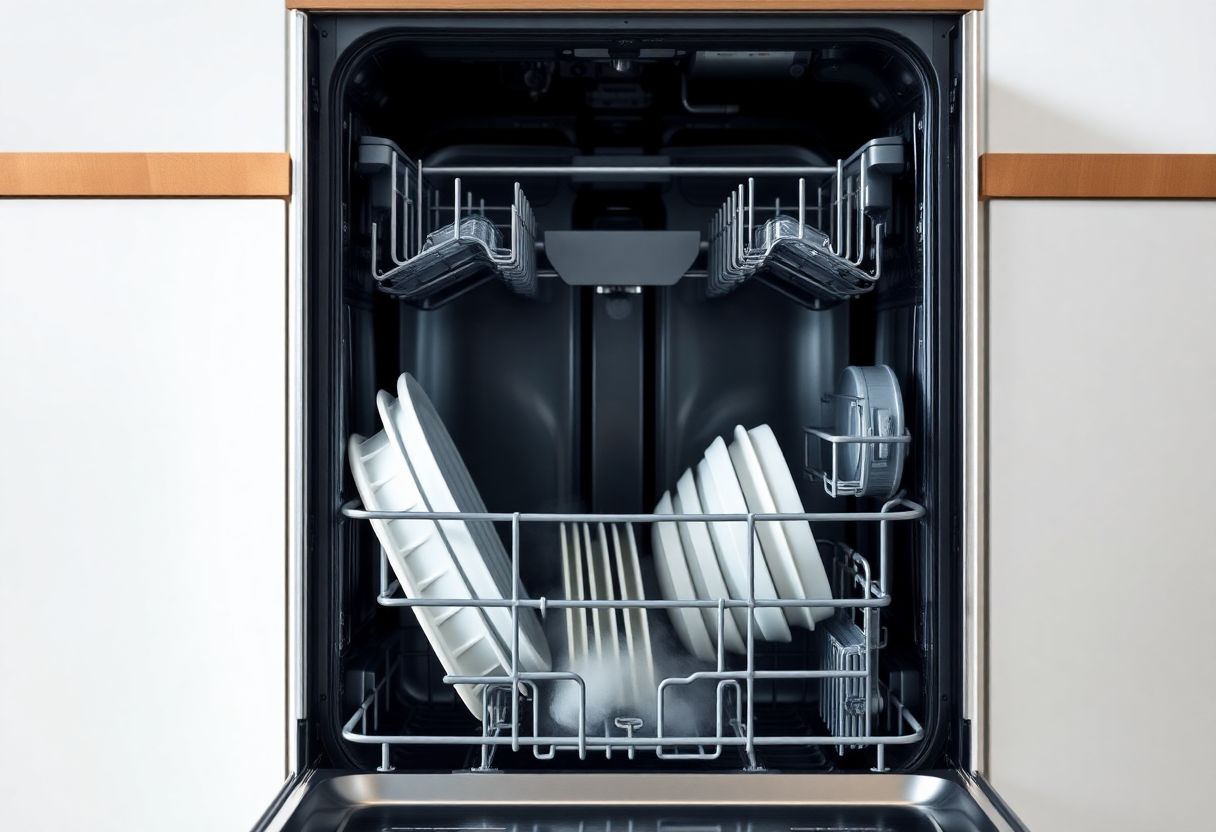
This stage is where the real cleaning action happens, and it's a testament to the elegant engineering of modern dishwashers. An electric pump, typically capable of moving around 100 gallons (378 liters) of water per minute, forces the hot, soapy water up through pipes in the sides of the machine. These pipes connect to spinning spray arms – usually one under the bottom rack and one under the top rack.
As water enters these spray arms, it creates a reactive force that causes them to spin, much like a garden sprinkler. The arms are designed with small holes or jets on their upper surface, creating high-pressure streams of hot water that spray upwards onto the dishes.
This design leverages several physical principles:
- Centrifugal force causes the water to move outwards as the arms spin, ensuring even distribution.
- The high-pressure jets create turbulence, which helps dislodge food particles.
- The upward angle of the jets ensures that water reaches all surfaces of the dishes, provided they're loaded correctly.
The bottom rack and its corresponding spray arm are closer to the heating element, resulting in hotter water in the lower part of the machine. This is why some items are marked "Top rack dishwasher safe" – they're designed to withstand the slightly cooler temperatures in the upper part of the dishwasher.
5. Water Filtration and Drainage
As the water falls back to the bottom of the machine after cleaning the dishes, it passes through a filtration system. This typically consists of several components:
- A coarse filter or sieve catches larger food particles to prevent clogging.
- A fine filter traps smaller debris.
- Some high-end models include a micro-filter that can capture particles as small as 0.1 microns.
Once the water has been filtered, it's either recirculated for further cleaning or pumped out of the machine. The drainage process is controlled by a pump and a check valve, which prevents the dirty water from flowing back into the dishwasher.
6. Rinse Cycle
After the main wash cycle, the dishwasher drains all the dirty water and takes in clean water for the rinse cycle. This cycle is similar to the wash cycle but without detergent. Its purpose is twofold:
- To remove any remaining soap residue from the dishes.
- To eliminate any lingering food particles or debris.
Some advanced dishwashers use a "final rinse" feature, where the water is heated to an even higher temperature (up to 70°C or 158°F) for enhanced sanitization.
7. Drying
The final step in the dishwashing process is drying the dishes. There are several methods dishwashers use for this:
- Heated drying: A heating element turns on to warm the air inside the dishwasher, promoting evaporation.
- Condensation drying: This method relies on the residual heat from the final rinse. The stainless steel interior of the dishwasher, being cooler than the dishes, causes moisture to condense on the walls rather than the dishes.
- Fan-assisted drying: Some models use a fan to circulate air and speed up the evaporation process.
Energy Efficiency and Water Conservation
Modern dishwashers are marvels of energy efficiency and water conservation. An average dishwasher uses about 6 gallons (23 liters) of water per cycle, while Energy Star certified models can use as little as 4 gallons (15 liters). Compare this to hand-washing, which can use up to 27 gallons (102 liters) per load, and the environmental benefits become clear.
Dishwashers achieve this efficiency through several means:
- Precision water intake: Dishwashers use only the amount of water necessary for effective cleaning.
- Water recirculation: Much of the water is reused during the wash cycle, rather than constantly drawing in fresh water.
- Efficient heating: Dishwashers heat only the water they need, rather than heating a large tank of water.
- Sensor technology: Many modern dishwashers use turbidity sensors to detect how dirty the water is, adjusting the cycle length and water usage accordingly.
The Future of Dishwasher Technology
As we look to the future, dishwasher technology continues to evolve. Some exciting developments on the horizon include:
- Smart connectivity: Integration with home automation systems and smartphones for remote operation and monitoring.
- Advanced sensors: Improved detection of soil levels and types for more precise, customized cleaning cycles.
- New cleaning technologies: Possibilities include ultrasonic cleaning or the use of UV light for sanitization.
- Self-cleaning features: More advanced self-maintenance capabilities to keep the dishwasher itself clean and operating at peak efficiency.
- Sustainability improvements: Further reductions in water and energy usage, and the use of more environmentally friendly materials and detergents.
Conclusion
From its humble beginnings as a hand-cranked wooden box to the high-tech appliances of today, the dishwasher has come a long way. It's a perfect example of how engineering and science can come together to solve everyday problems, making our lives easier while also contributing to resource conservation.
Understanding the intricate dance of water, heat, and chemistry that occurs behind the closed door of your dishwasher gives a new appreciation for this often-overlooked appliance. It's not just about clean dishes; it's about the triumph of human ingenuity, the application of scientific principles, and the ongoing quest for efficiency and sustainability in our daily lives.
The next time you load your dishwasher and press start, take a moment to appreciate the complex processes at work. From the initial rush of water to the final dry cycle, your dishes are experiencing a carefully orchestrated symphony of physics, chemistry, and engineering – all in the pursuit of the perfect clean.