The Science of Sport: Unlocking the Secrets of Kinetic Energy
Introduction: The Power Behind Athletic Performance
The roar of the crowd, the tension in the air, and then… explosive motion. Whether it's a sprinter bursting from the blocks, a gymnast soaring through the air, or a tennis player delivering a blistering serve, sports captivate us with displays of human physical prowess. But beneath the surface of these awe-inspiring feats lies a fascinating world of scientific principles at work. At the heart of this scientific symphony is kinetic energy – the energy of motion that powers athletes' incredible performances.
As a science educator with a passion for sports, I've long been fascinated by the intricate dance between physics and physiology that occurs every time an athlete steps onto the field, court, or track. In this deep dive into the science of sport, we'll explore the fundamental question: Where does the kinetic energy that fuels athletic performance come from? By unraveling this mystery, we'll gain a deeper appreciation for the remarkable capabilities of the human body and the scientific principles that underpin sporting excellence.
The Fundamentals: Understanding Kinetic Energy
Before we can fully appreciate the role of kinetic energy in sports, it's crucial to establish a solid foundation in the basic physics concepts at play. Kinetic energy, in its simplest form, is the energy possessed by an object due to its motion. The formula for kinetic energy is elegantly simple yet profoundly important:
KE = 1/2 * mass * velocity^2
This equation tells us that the faster an object moves and the more mass it has, the more kinetic energy it possesses. In the context of sports, this means that a sprinter's kinetic energy increases dramatically as they accelerate, and a heavyweight boxer packs more kinetic energy into their punches than a lightweight fighter.
It's also essential to understand the concept of potential energy – stored energy due to an object's position or state. Common forms include gravitational potential energy (due to height), elastic potential energy (in stretched or compressed objects), and chemical potential energy (stored in molecular bonds). The interplay between potential and kinetic energy is crucial in many sports, as athletes often convert one form to another to maximize performance.
Underpinning all of this is the law of conservation of energy, which states that energy cannot be created or destroyed, only converted between different forms. This fundamental principle is the key to understanding how athletes generate and harness kinetic energy throughout their performances.
The Human Engine: Metabolic Energy Sources
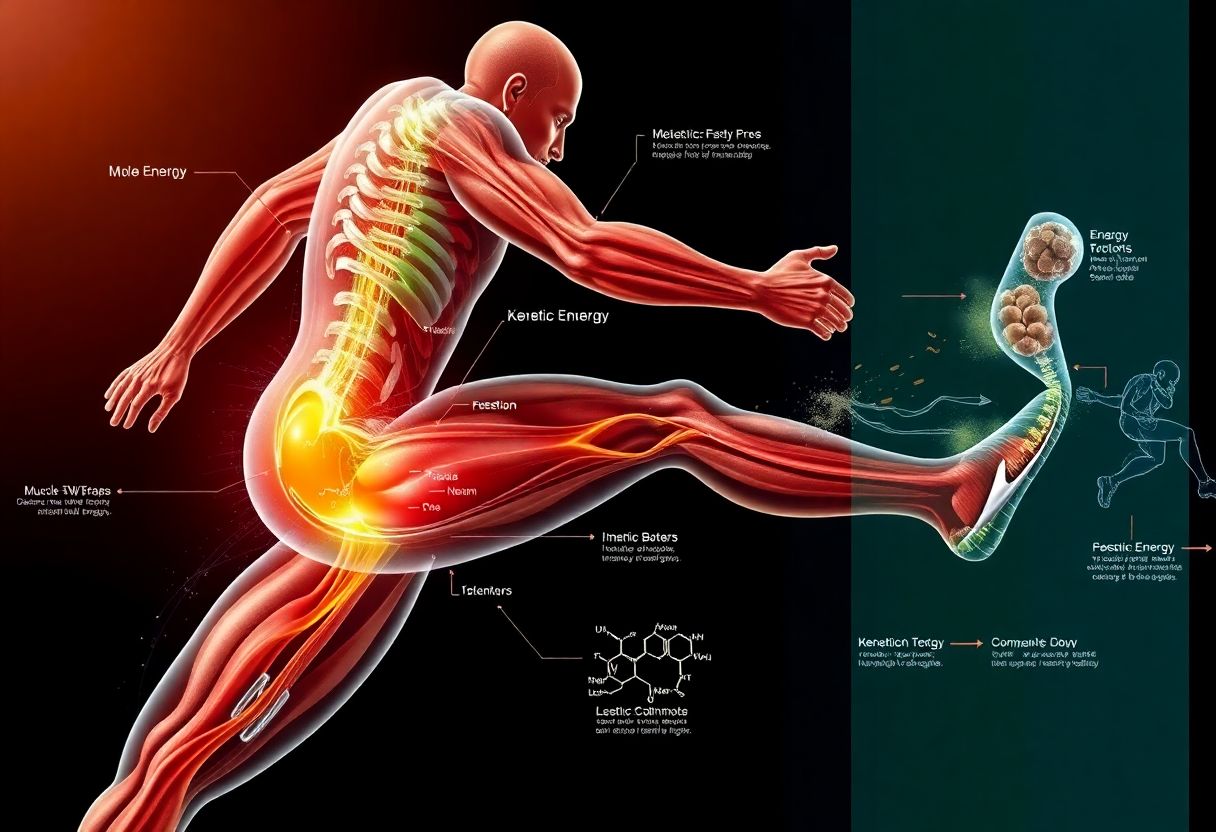
At its core, the kinetic energy in sports originates from the human body's remarkable ability to convert chemical energy into mechanical energy through metabolism. This process is akin to a highly sophisticated and efficient engine, capable of adapting to a wide range of energy demands. Let's examine the key energy systems that power athletic performance:
The ATP-PC System: The Immediate Energy Source
The phosphocreatine (PC) system, also known as the ATP-PC system, is the body's immediate energy source. This system rapidly replenishes adenosine triphosphate (ATP), the primary energy currency of cells, by breaking down stored creatine phosphate. The ATP-PC system is crucial for explosive, short-duration activities lasting up to about 10 seconds.
In sports like sprinting, jumping, or weightlifting, the ATP-PC system provides the initial burst of energy that allows athletes to generate immense power in a fraction of a second. For example, when a sprinter explodes out of the starting blocks, their muscles are primarily relying on this system to fuel the rapid and powerful contractions needed for acceleration.
Research has shown that elite sprinters can deplete their ATP-PC stores by up to 70% in a single 100-meter race, highlighting the system's importance in short-duration, high-intensity events (Hirvonen et al., 1987).
The Glycolytic System: Sustaining Short-Term Intensity
As the duration of intense activity extends beyond 10 seconds, the body begins to rely more heavily on the glycolytic system. This process, also known as anaerobic glycolysis, breaks down glucose without the use of oxygen to produce ATP. The glycolytic system can sustain high-intensity activity for approximately 30 seconds to 2 minutes.
Sports that heavily utilize the glycolytic system include 400-meter sprints, 100-meter freestyle swimming, and intense rallies in sports like tennis or badminton. The byproduct of this energy system is lactic acid, which contributes to the burning sensation athletes feel in their muscles during high-intensity exercise.
Interestingly, trained athletes have been shown to have a higher capacity for anaerobic glycolysis, allowing them to sustain higher intensities for longer periods before fatigue sets in (Gastin, 2001).
The Oxidative System: Powering Endurance
For prolonged activities lasting beyond 2-3 minutes, the body primarily relies on the oxidative system, also known as aerobic metabolism. This system breaks down carbohydrates and fats in the presence of oxygen to produce ATP. While it doesn't provide energy as quickly as the other two systems, the oxidative system is highly efficient and can sustain activity for extended periods.
Endurance sports like marathon running, long-distance cycling, and soccer heavily depend on the oxidative system. The efficiency of this system can be significantly improved through training, which is why endurance athletes focus on increasing their VO2 max – the maximum rate at which their bodies can utilize oxygen during exercise.
Recent research has highlighted the importance of mitochondrial adaptations in enhancing the oxidative system's efficiency. Endurance training has been shown to increase both the number and size of mitochondria in muscle cells, improving the body's ability to generate ATP through aerobic metabolism (Hood et al., 2011).
The body's ability to efficiently utilize these energy systems and transition between them is crucial for athletic performance across different sports and durations. Elite athletes often have highly developed capacities in multiple energy systems, allowing them to excel in various aspects of their sport.
From Chemical to Kinetic: The Muscle-Tendon System
The conversion of metabolic energy into kinetic energy occurs primarily through the intricate workings of the muscle-tendon system. This remarkable biological machinery is capable of generating force, producing movement, and ultimately creating the kinetic energy that powers athletic performance. Let's examine the process in detail:
Muscle Contraction: The Cellular Powerhouse
At the microscopic level, muscle contraction is driven by the interaction between two types of protein filaments: actin and myosin. When a nerve impulse reaches a muscle fiber, it triggers the release of calcium ions, which allows the myosin heads to attach to binding sites on the actin filaments. Through a process called the sliding filament theory, the myosin heads pull the actin filaments toward the center of the sarcomere (the basic unit of muscle contraction), shortening the muscle fiber.
This process is powered by ATP, which is hydrolyzed by the myosin heads to provide the energy needed for contraction. Recent research using high-speed atomic force microscopy has provided unprecedented insights into this process, revealing the precise molecular movements involved in muscle contraction (Kodera et al., 2010).
Force Production: Collective Effort
The collective contraction of thousands of muscle fibers generates significant force. The amount of force produced depends on several factors, including:
- The number of motor units recruited (a motor unit consists of a motor neuron and the muscle fibers it innervates)
- The firing rate of the motor neurons
- The type of muscle fibers involved (fast-twitch vs. slow-twitch)
- The length-tension relationship of the muscle
Elite athletes often have a higher proportion of fast-twitch muscle fibers in relevant muscle groups, allowing for greater force production in explosive movements (Gollnick et al., 1972).
Tendon Elasticity: Nature's Energy Storage
Tendons, which connect muscles to bones, play a crucial role in energy storage and transfer. They possess elastic properties that allow them to store and release energy, much like a spring. This characteristic is particularly important in activities involving the stretch-shortening cycle, such as jumping or running.
When a muscle-tendon unit is stretched, some of the energy is stored as elastic potential energy in the tendon. As the muscle contracts, this stored energy is released, adding to the force produced by the muscle itself. This mechanism enhances the efficiency of movement and can significantly contribute to power output.
Recent studies using ultrasound imaging have quantified the contribution of tendon elasticity to overall power output in jumping. In some cases, the energy released by the tendons can account for up to 16% of the total work done during a vertical jump (Kurokawa et al., 2003).
Joint Movement: The Final Link
The forces generated by muscle contractions and enhanced by tendon elasticity are ultimately transmitted through bones and joints to create movement. The arrangement of bones, joints, and muscles creates various lever systems throughout the body, which can amplify force or increase the speed of movement depending on their configuration.
Understanding these biomechanical principles is crucial for optimizing technique in many sports. For example, in throwing events, athletes use a kinetic chain that starts with force generation in the legs, transfers through the core, and culminates in a rapid rotation of the upper body and arm. This sequential activation of muscle groups allows for the summation of forces, resulting in maximum velocity at the point of release.
Biomechanical Factors: Maximizing Kinetic Energy Output
Several key biomechanical principles play a crucial role in maximizing kinetic energy output in sports. By understanding and optimizing these factors, athletes can significantly enhance their performance:
Lever Systems: Amplifying Force and Speed
The human body utilizes various lever systems to generate and amplify force. There are three classes of levers in the body, each serving different purposes:
-
First-class levers: These are used for balance and are relatively rare in the body. An example is nodding the head, where the fulcrum is the atlanto-occipital joint.
-
Second-class levers: These amplify force and are found in actions like standing on tiptoes. The fulcrum is at one end (the ball of the foot), the effort is at the other end (the calf muscles), and the load (body weight) is in the middle.
-
Third-class levers: These are the most common in the body and are used to amplify speed. Flexing the elbow is an example, where the fulcrum is the elbow joint, the effort (biceps) is between the fulcrum and the load (the object being lifted).
Understanding these lever systems is crucial for optimizing technique in many sports. For instance, in golf, the arms and club act as a third-class lever system, allowing for high-speed rotation of the clubhead.
The Stretch-Shortening Cycle: Elastic Energy in Action
The stretch-shortening cycle (SSC) is a phenomenon that enhances force production through the elastic properties of muscles and tendons. It consists of three phases:
- Eccentric phase: The muscle lengthens under tension, storing elastic energy.
- Amortization phase: A brief pause between lengthening and shortening.
- Concentric phase: Rapid muscle shortening, releasing the stored elastic energy.
This cycle is crucial in many sporting actions, such as jumping, throwing, and running. For example, in a vertical jump, the initial downward movement (countermovement) stretches the quadriceps and calf muscles, storing elastic energy that is then released during the upward phase of the jump.
Research has shown that utilizing the SSC can increase power output by 15-20% compared to concentric-only actions (Komi, 2000). Elite athletes often have superior ability to utilize the SSC, with faster transition times between eccentric and concentric phases.
Summation of Forces: Coordinating the Kinetic Chain
Athletes generate maximum kinetic energy by coordinating multiple body segments in a process known as summation of forces. This principle involves:
- Sequential activation: Larger, slower muscle groups initiate movement.
- Force transfer: Energy is transferred through the kinetic chain.
- Distal acceleration: Smaller, faster muscle groups finish the movement.
This principle is evident in actions like swinging a golf club or throwing a baseball. In a golf swing, for instance, the movement begins with leg drive, transfers through trunk rotation, and culminates in the high-speed rotation of the arms and club.
Recent studies using 3D motion capture and force plate technology have quantified the contribution of different body segments to overall kinetic energy in various sports. In baseball pitching, for example, it's been shown that up to 50% of the ball's final velocity comes from the sequential rotation of the pelvis, upper torso, and throwing arm (Seroyer et al., 2010).
Sport-Specific Examples: Kinetic Energy in Action
To truly appreciate the role of kinetic energy in sports, let's examine how it manifests in various athletic activities:
Running and Sprinting: The Art of Efficient Energy Transfer
In running events, kinetic energy plays a central role from start to finish. During the initial acceleration phase, powerful leg drive converts chemical energy stored in ATP and creatine phosphate into kinetic energy. As the runner reaches top speed, the challenge becomes maintaining and efficiently transferring kinetic energy between steps.
Key factors in maximizing kinetic energy in sprinting include:
- Optimal stride length and frequency
- Minimizing vertical oscillation to conserve energy
- Efficient arm movement to counterbalance leg action
Research using force plates has shown that elite sprinters can generate ground reaction forces of up to 5 times their body weight during the acceleration phase (Bezodis et al., 2008). Furthermore, studies on running economy have demonstrated that elite distance runners are more efficient at conserving energy, with some able to utilize up to 70% of the energy stored in their tendons during each stride (Lai et al., 2014).
Jumping: Harnessing Elastic Energy
Jumping events, such as the high jump and long jump, provide excellent examples of how athletes utilize the stretch-shortening cycle and the conversion of potential energy to kinetic energy.
Key elements in maximizing jump performance include:
- Effective use of the countermovement to store elastic energy
- Coordinated triple extension of the ankle, knee, and hip joints
- Proper arm swing to add to total body kinetic energy
Research has shown that the countermovement in a vertical jump can increase jump height by 2-4 cm compared to a squat jump without countermovement (Bobbert et al., 1996). Additionally, studies using electromyography (EMG) have demonstrated that proper arm swing can increase the vertical ground reaction force by up to 10% during takeoff (Lees et al., 2004).
Throwing and Striking: The Kinetic Chain in Action
Sports involving throwing or striking, such as baseball pitching, tennis serves, or golf swings, showcase the principle of summation of forces through the kinetic chain.
Key aspects of generating maximum kinetic energy in these actions include:
- Efficient energy transfer from lower body through core to upper body
- Generating angular momentum and converting it to linear momentum
- Maximizing energy transfer to the projectile or implement
Advanced biomechanical analysis has revealed the importance of proper sequencing in these actions. For example, in a tennis serve, the kinetic energy generated by the legs and trunk can account for up to 51% of the racket head speed at impact (Elliott et al., 2003).
Cycling: Optimizing Power Output
In cycling, the challenge lies in efficiently converting muscular force into rotational kinetic energy of the wheels. Key factors include:
- Optimal pedaling technique to maximize power through the entire pedal stroke
- Proper gear selection to maintain optimal cadence and force output
- Aerodynamic positioning to minimize energy loss to air resistance
Recent advances in power meter technology have allowed for detailed analysis of pedaling efficiency. Studies have shown that elite cyclists can maintain a more even distribution of power throughout the pedal stroke, reducing energy waste and improving overall efficiency (Bini et al., 2013).
Enhancing Kinetic Energy Output: Strategies for Improvement
Athletes and coaches can employ various strategies to maximize kinetic energy production and utilization:
Strength and Power Training
Resistance training increases an athlete's capacity for force production, directly impacting their ability to generate kinetic energy. Key training modalities include:
- Heavy resistance training to increase maximum strength
- Plyometric exercises to enhance the stretch-shortening cycle
- Olympic lifts and their variations to improve power output and full-body coordination
Research has consistently shown the benefits of strength training for athletic performance. For example, a meta-analysis of studies on resistance training in endurance athletes found improvements in running economy, maximal power output, and time-trial performance (Berryman et al., 2018).
Technique Refinement
Optimizing movement patterns is crucial for efficient energy transfer and maximum kinetic energy output. Strategies include:
- Biomechanical analysis to identify inefficiencies in movement patterns
- Sport-specific drills to develop optimal motor patterns
- Use of feedback systems providing real-time information on force and velocity
Advanced motion capture technology and force plate analysis have revolutionized technique refinement in many sports. For instance, studies on sprint start technique using these tools have led to improvements in block clearance times and first-step ground reaction forces (Bezodis et al., 2015).
Equipment Optimization
Properly fitted and designed equipment can significantly enhance an athlete's ability to generate and transfer kinetic energy. Considerations include:
- Ensuring proper fit to maximize energy transfer
- Utilizing advanced materials for enhanced performance
- Customizing equipment to individual biomechanics
The impact of equipment on performance is particularly evident in cycling, where advances in bicycle design and materials have led to significant improvements in speed and efficiency. For example, the introduction of carbon fiber frames and aerodynamic designs has reduced the energy cost of cycling by up to 5% compared to traditional designs