The Marvelous World of Hard Drives: Exploring the Technology That Powers Our Digital Lives
Introduction: The Unsung Heroes of the Digital Age
In an era where our lives are increasingly intertwined with digital technology, we often take for granted the remarkable devices that store our precious data. Among these unsung heroes, the hard drive stands out as a pinnacle of engineering ingenuity. This article delves into the fascinating world of hard drives, exploring their inner workings, evolution, and the pivotal role they play in our data-driven society.
The Fundamentals of Magnetic Storage
At the heart of every hard drive lies a principle as old as the Earth itself: magnetism. This fundamental force of nature forms the backbone of hard drive technology, allowing us to store vast amounts of information in a compact space.
The Magnetic Magic
To truly appreciate how a hard drive works, we need to understand the basics of magnetic storage. Imagine a simple experiment with a horseshoe magnet and iron nails. When you run the magnet over the nails, they become magnetized and can stick to each other. This elementary demonstration encapsulates the core concept behind hard drive technology.
Taking this idea further, consider using magnetism to store information. If we assign meaning to the magnetic state of an object – for instance, a magnetized nail meaning "yes" and an unmagnetized nail meaning "no" – we've created a rudimentary data storage system. While this might seem like an overly simplistic way to communicate, it illustrates a crucial point: magnetism can be harnessed to store information.
The Intricate Architecture of a Hard Drive
A modern hard drive takes this basic concept of magnetic storage and scales it up to an astonishing degree. Let's explore the key components that make up this marvel of engineering.
The Platter: Where Data Lives
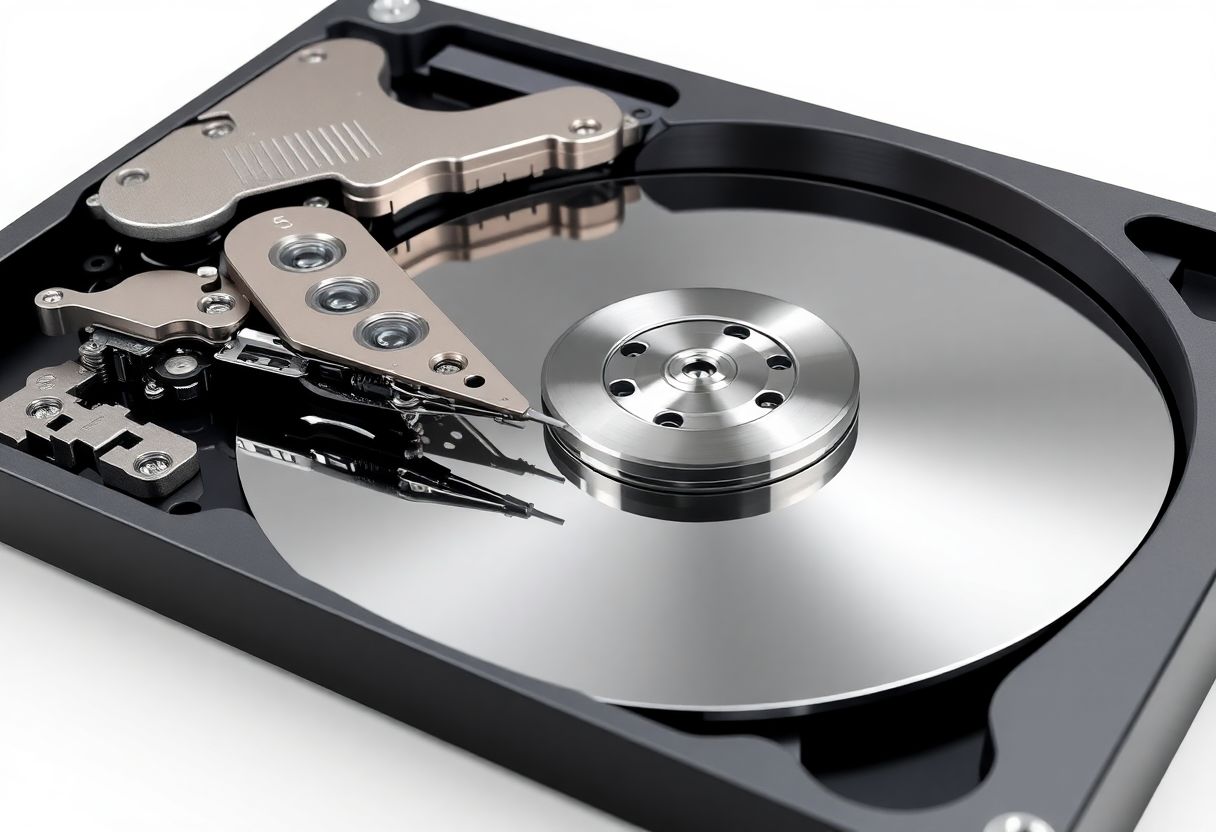
At the core of a hard drive is the platter, a circular disk coated with a thin layer of magnetic material. Unlike our nail example, the platter is divided into billions of minuscule areas, each capable of being independently magnetized or demagnetized. These tiny magnetic regions are the building blocks of data storage in a hard drive.
To put this into perspective, a typical modern hard drive can store terabytes of data on platters not much larger than a drink coaster. If each bit of data on a 1TB drive were the size of a grain of rice, the drive would cover an entire football field! This level of storage density is a testament to the incredible advancements in hard drive technology over the years.
The Read-Write Head: The Artist of Magnetic Patterns
Hovering mere nanometers above the platter surface is the read-write head, a crucial component that performs two vital functions. First, it can generate magnetic fields to alter the state of the tiny magnetic regions on the platter, effectively "writing" data. Second, it can detect the magnetic fields of these regions to "read" the stored information.
The precision of the read-write head is astounding. Modern hard drives can store hundreds of billions of bits per square inch of platter surface. To achieve this density, the read-write head must be capable of manipulating and detecting magnetic fields at an incredibly small scale, often working with regions just a few nanometers wide.
The Actuator Arm: Precision in Motion
The read-write head is mounted on an actuator arm, which moves rapidly across the surface of the platter. This arm can position the read-write head with accuracy measured in nanometers, allowing it to access any part of the disk with incredible speed and precision.
The movement of the actuator arm is controlled by a voice coil motor, which operates on principles similar to those used in audio speakers. This motor can accelerate the arm from a stationary position to several thousand revolutions per minute in a fraction of a second, enabling rapid data access.
The Spindle: Keeping the World Turning
The platter (or multiple platters in larger drives) is mounted on a spindle, which rotates at high speeds, typically 5400 to 7200 rotations per minute in modern drives. Some high-performance drives can spin at up to 15,000 RPM.
This high-speed rotation serves two critical purposes. First, it allows for quick access to data as the platter spins beneath the read-write head. Second, it creates an air cushion that helps the read-write head float just above the platter surface, maintaining the crucial nanometer-scale gap between the head and the platter.
Data Organization: The Method to the Magnetic Madness
The physical components of a hard drive are only part of the story. Equally important is how data is organized and accessed on the platters.
Tracks and Sectors: The Data Map
Data on a hard drive is arranged in a highly structured manner. The platter surface is divided into concentric circles called tracks, analogous to the grooves on a vinyl record. Each track is further divided into smaller units called sectors.
This organization allows the drive to locate specific pieces of data quickly and efficiently. When the computer requests data, the hard drive's controller can calculate exactly which track and sector contain the information, and move the read-write head to the precise location.
The File Allocation Table: The Drive's Directory
A portion of the hard drive is dedicated to storing a map of where all the data is located. In Windows systems, this is known as the File Allocation Table (FAT), while other operating systems may use different systems like the Master File Table (MFT) in NTFS.
This table keeps track of which sectors are in use, which are free, and where each file is located on the drive. It's essential for the efficient operation of the hard drive, allowing the computer to quickly find and access files without having to search through the entire drive.
The Dance of Data: Reading and Writing in Action
Now that we understand the components and organization of a hard drive, let's walk through the process of how data is actually stored and retrieved.
Writing Data: Painting with Magnetism
- When you save a file, your computer sends the data to be stored on the hard drive.
- The drive's controller checks the File Allocation Table to find available sectors.
- The actuator arm swings into action, moving the read-write head to the correct location on the platter.
- As the platter spins beneath it, the read-write head generates precise magnetic fields to change the state of tiny areas on the platter, effectively "writing" the data.
- The new data location is recorded in the File Allocation Table for future reference.
This process happens at incredible speeds. Modern hard drives can write hundreds of megabytes of data per second, with each bit being written in mere nanoseconds.
Reading Data: Decoding the Magnetic Patterns
- When your computer needs to access a file, it sends a request to the hard drive.
- The drive's controller consults the File Allocation Table to locate the data.
- The actuator arm moves the read-write head to the correct track and sector.
- As the platter spins, the read-write head detects the magnetic fields on the platter surface.
- These magnetic signals are converted into digital data and sent back to the computer.
The read process is equally fast, with modern drives capable of reading data at rates of hundreds of megabytes per second.
The Evolution of Hard Drive Technology
The history of hard drives is a story of constant innovation and miniaturization. The first hard drive, IBM's RAMAC 350 introduced in 1956, was the size of two refrigerators and could store about 3.75 megabytes of data. Today, a drive that fits in the palm of your hand can store thousands of times more data.
Technological Milestones
Several key advancements have driven the evolution of hard drives:
-
Giant Magnetoresistance (GMR): Discovered in the 1980s and implemented in hard drives in the late 1990s, GMR technology dramatically increased the sensitivity of read heads, allowing for much higher data densities.
-
Perpendicular Magnetic Recording (PMR): Introduced in the mid-2000s, PMR changed the orientation of magnetic regions on the platter, allowing for even higher data densities.
-
Helium-filled Drives: By filling drives with helium instead of air, manufacturers reduced internal turbulence, allowing for more platters in the same space and reducing power consumption.
-
Heat-Assisted Magnetic Recording (HAMR): This emerging technology uses laser heating to allow writing to smaller, more stable magnetic regions, potentially increasing storage densities even further.
These advancements have led to a steady increase in storage capacity and decrease in cost per gigabyte, making large-scale data storage more accessible than ever before.
Challenges and Limitations: The Achilles' Heel of Hard Drives
Despite their remarkable capabilities, hard drives do face certain challenges and limitations.
Physical Vulnerability
The precision components in a hard drive are sensitive to physical shock. Dropping a laptop or bumping an external drive can potentially cause the read-write head to contact the platter surface, leading to data loss. This vulnerability has led to the development of technologies like active hard drive protection, which can detect sudden movements and park the read-write head to prevent damage.
Speed Limitations
The mechanical nature of hard drives puts a cap on how quickly they can access data. The need to physically move the read-write head to different parts of the platter introduces latency that isn't present in solid-state storage technologies. This limitation is particularly noticeable in tasks that require frequent access to small, scattered pieces of data.
Fragmentation
Over time, as files are written, deleted, and rewritten, they can become scattered across different parts of the platter. This fragmentation can slow down data access speeds as the drive has to gather pieces of files from multiple locations. Modern operating systems include utilities to defragment drives, but this remains an ongoing issue for hard drive performance.
The Future of Storage: Beyond the Hard Drive
While hard drives continue to play a crucial role in data storage, new technologies are emerging that may shape the future of how we store and access information.
Solid-State Drives (SSDs)
SSDs use flash memory instead of magnetic platters, offering faster access times and greater durability. They have no moving parts, making them less vulnerable to physical shock. However, they are currently more expensive per gigabyte than traditional hard drives, and have lower maximum capacities.
Hybrid Drives
These drives combine a traditional hard drive with a smaller SSD component, aiming to offer the best of both worlds: the capacity of a hard drive with the speed of an SSD for frequently accessed data.
Cloud Storage
Many users now store data on remote servers accessed via the internet. This offers convenience and backup protection but raises privacy concerns and requires a reliable internet connection for access.
Emerging Technologies
Research continues into new storage methods that could revolutionize data storage:
- DNA Storage: By encoding data in synthetic DNA molecules, researchers hope to create extremely high-density, long-lasting storage media.
- Quantum Memory: Quantum systems could potentially store vast amounts of data in the quantum states of individual atoms or subatomic particles.
While these technologies are still in the research phase, they point to a future where our ability to store and access data may far exceed what we can achieve with current technology.
Conclusion: The Enduring Legacy of Hard Drives
As we look to the future of data storage, it's clear that our need for storing and accessing information will only continue to grow. While new technologies may eventually supersede the traditional hard drive, the principles pioneered in these devices – the precise control of microscopic regions to store information – will likely remain at the heart of data storage for years to come.
The hard drive stands as a testament to human ingenuity, taking a simple concept – the ability to magnetize and demagnetize materials – and developing it into a technology that has transformed our world. From the room-sized drives of the 1950s to today's pocket-sized terabyte drives, the evolution of hard drive technology mirrors the broader story of the digital revolution.
The next time you save a file, play a song, or browse your photo collection, take a moment to appreciate the incredible technology working behind the scenes. In that quiet hum of your computer, you're hearing the sound of billions of tiny magnets, dancing to the tune of your digital life. The hard drive, often overlooked but always essential, continues to play a vital role in our increasingly data-driven world.