The Turbocharger: Harnessing Waste for Power and Efficiency
In the realm of automotive engineering, few innovations have had as profound an impact as the turbocharger. This ingenious device has revolutionized the way we think about engine performance, fuel efficiency, and environmental impact. Let's dive deep into the world of turbochargers, exploring their inner workings, benefits, and the cutting-edge developments shaping their future.
The Basics: What is a Turbocharger?
At its core, a turbocharger is a forced induction device that increases an engine's power output and efficiency. It accomplishes this feat by compressing the air entering the engine, allowing for more air (and consequently, more fuel) to be pushed into the combustion chamber. This results in a more powerful explosion, generating increased horsepower from a smaller engine displacement.
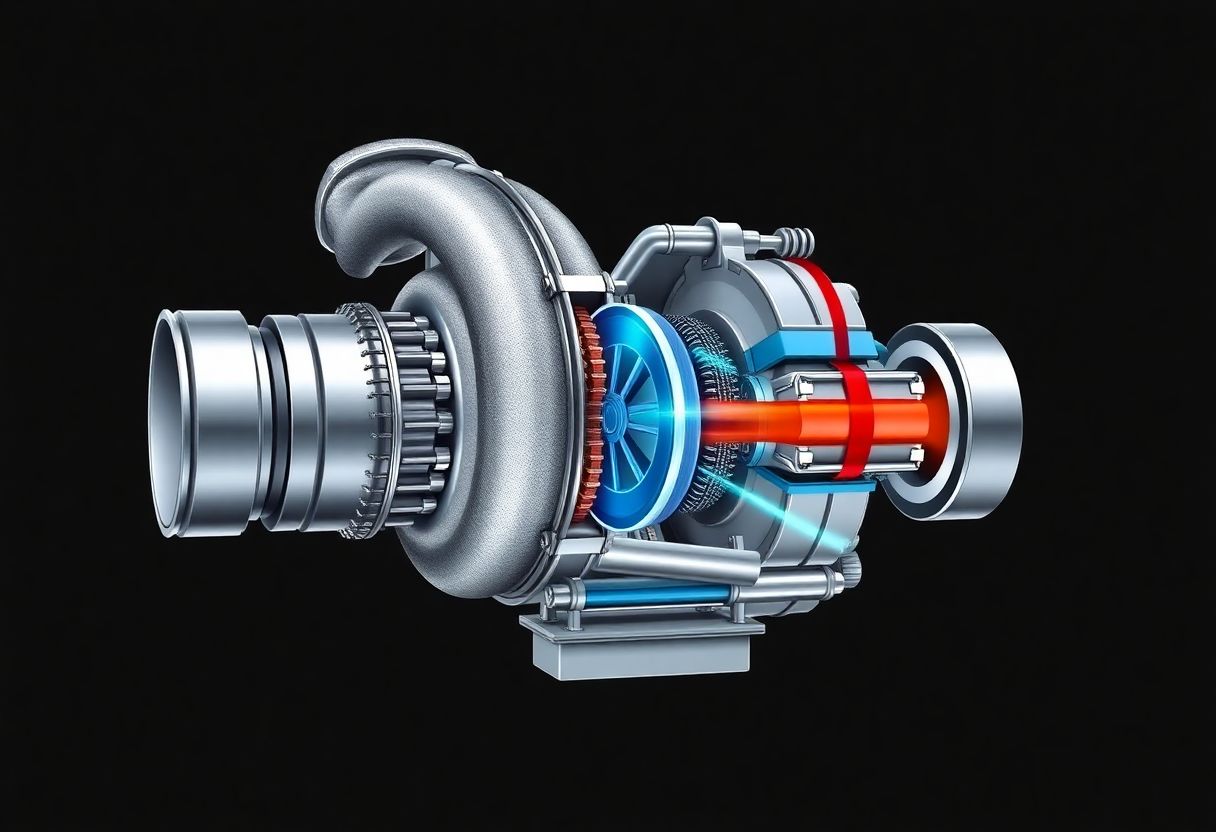
The beauty of the turbocharger lies in its elegant simplicity. It consists of two main components: a turbine and a compressor, connected by a shaft. The turbine harnesses the energy from the engine's exhaust gases, which would otherwise be wasted, to spin the compressor. This compressor then forces more air into the engine's intake manifold, creating a cycle of increased power and efficiency.
The Science Behind the Boost
To truly appreciate the genius of turbocharging, we need to delve into some fundamental scientific principles. The performance of a turbocharger is deeply rooted in thermodynamics and fluid dynamics.
The Ideal Gas Law
The ideal gas law, expressed as PV = nRT, is crucial to understanding how turbochargers work. In this equation, P represents pressure, V is volume, n is the number of moles of gas, R is the universal gas constant, and T is temperature. By increasing the pressure (P) of the intake air, a turbocharger allows more air molecules (n) to fit into the fixed volume (V) of the cylinder. This increased air density is the key to generating more power.
Bernoulli's Principle
The design of the turbocharger's compressor wheel is a practical application of Bernoulli's principle. This principle states that an increase in the speed of a fluid occurs simultaneously with a decrease in pressure. The compressor wheel is carefully shaped to create areas of low pressure that draw in air and then compress it as it moves through the wheel. This process is crucial for efficient air compression and delivery to the engine.
Conservation of Energy
The turbocharger is a prime example of the principle of conservation of energy in action. It takes the waste energy from the exhaust gases and converts it into useful work to compress the intake air. This recycling of energy is what makes turbochargers so efficient and appealing from an engineering standpoint.
The Turbocharger in Action: A Step-by-Step Process
Let's break down the operation of a turbocharger into a series of steps to better understand its function:
-
As the engine runs, it produces hot, fast-moving exhaust gases.
-
These exhaust gases are directed into the turbocharger's turbine housing, where they cause the turbine wheel to spin rapidly. Modern turbines can reach speeds of up to 250,000 RPM in some applications.
-
The turbine wheel is connected via a shaft to the compressor wheel. As the turbine spins, it drives the compressor wheel at the same high speed.
-
The compressor wheel draws in ambient air and accelerates it to high speeds, compressing it in the process.
-
This compressed air is then forced into the engine's intake manifold at pressures that can exceed 2 bar in some high-performance applications.
-
The increased air pressure in the intake manifold allows more air to enter each cylinder during the intake stroke.
-
With more air in the cylinders, more fuel can be added while maintaining the proper air-fuel ratio.
-
The result is a larger, more powerful combustion event, producing more power from each cycle of the engine.
The Critical Role of Intercooling
When air is compressed, it heats up significantly. This phenomenon, known as adiabatic heating, can be a double-edged sword in turbocharging. While we want to increase the density of the intake air, hot air is less dense than cool air, which means it contains less oxygen per unit volume.
This is where the intercooler comes into play. An intercooler is a heat exchanger that cools the compressed air from the turbocharger before it enters the engine. By reducing the temperature of the compressed air, the intercooler increases its density, allowing even more oxygen to be packed into each cylinder. This further increases the power output of the engine and helps prevent detonation, a damaging form of combustion that can occur with overly hot intake temperatures.
Modern intercooler designs can reduce intake air temperatures by 60-100°C, depending on the system design and operating conditions. This cooling effect can result in power gains of 10-15% over a non-intercooled system.
Overcoming the Turbo Lag Challenge
One of the most discussed aspects of turbocharging is the phenomenon known as turbo lag. This is the delay between when the driver demands more power (by pressing the accelerator) and when the turbocharger can deliver the additional boost. This delay occurs because the turbocharger needs sufficient exhaust gas flow to spin up to its effective operating speed.
Engineers have developed several innovative solutions to minimize turbo lag:
Variable Geometry Turbochargers (VGT)
VGTs use movable vanes in the turbine housing to alter the effective size of the turbine. At low engine speeds, the vanes close to accelerate the exhaust gas and spin the turbine faster. As engine speed increases, the vanes open to prevent over-boosting. This technology allows for quicker turbocharger response and better low-end torque.
Twin-Scroll Turbochargers
These turbochargers use a divided exhaust manifold and turbine housing to separate the exhaust pulses from different cylinders. This design maintains higher exhaust gas velocity and reduces interference between cylinders, resulting in faster turbine spool-up and reduced lag.
Electric Turbochargers
The latest innovation in turbocharging is the electric turbocharger, which uses an electric motor to spin up the compressor quickly. This system can provide near-instantaneous boost, virtually eliminating turbo lag. As automotive electrical systems move to higher voltages, we can expect to see more widespread adoption of this technology.
The Advantages of Turbocharging
The benefits of turbocharging extend far beyond just increased power output:
-
Improved Fuel Efficiency: By extracting more power from a smaller engine, turbocharging allows for "downsizing" – using a smaller, more efficient engine that performs like a larger one when needed.
-
Better High-Altitude Performance: As air pressure decreases at higher altitudes, naturally aspirated engines lose power. Turbocharged engines can maintain performance better at altitude by compressing the thinner air.
-
Reduced Emissions: Smaller, turbocharged engines often produce fewer emissions than larger, naturally aspirated engines of equivalent power output.
-
Weight Reduction: Using a smaller, turbocharged engine instead of a larger, naturally aspirated one can reduce overall vehicle weight, improving handling and further enhancing fuel efficiency.
Turbocharging Beyond Automobiles
While we often associate turbochargers with cars, their applications extend far beyond the automotive world:
Aviation
In aviation, turbochargers and their close relatives, superchargers, have been crucial in achieving high performance at altitude. Turbocharged aircraft engines can maintain sea-level power output at much higher altitudes than naturally aspirated engines, greatly extending their practical ceiling.
Marine Applications
Large ship engines often employ turbocharging to improve efficiency and power output. In the marine environment, where fuel efficiency is paramount due to long operating hours, turbochargers can significantly reduce operating costs.
Industrial and Power Generation
Many stationary engines used in power generation and industrial applications are turbocharged. These engines often operate continuously for long periods, making the efficiency gains from turbocharging particularly valuable.
The Future of Turbocharging
As we move towards a future focused on reducing emissions and improving efficiency, turbocharging technology continues to evolve:
Electric Turbochargers
As mentioned earlier, electric turbochargers are at the cutting edge of turbocharger technology. By using an electric motor to assist or even replace the traditional exhaust-driven turbine, these systems promise to deliver the benefits of turbocharging with even quicker response times.
Integration with Hybrid Systems
In hybrid vehicles, turbochargers can work in concert with electric motors to provide efficient power delivery across a wide range of operating conditions. The electric motor can provide instant torque at low speeds, while the turbocharger takes over at higher speeds for sustained power output.
Advanced Materials
Research into high-temperature materials, such as ceramic turbine wheels, promises to push the boundaries of turbocharger performance even further. These materials can withstand higher temperatures, allowing for more efficient operation and potentially eliminating the need for wastegates in some applications.
Conclusion: The Turbocharged Future
From its humble beginnings in aircraft engines to its current ubiquity in automotive applications, the turbocharger has proven to be one of the most versatile and impactful innovations in engine technology. As we continue to push for greater efficiency and lower emissions, the role of the turbocharger is likely to grow even further.
The elegance of the turbocharger lies in its ability to turn waste into power, extracting useful energy from exhaust gases that would otherwise be lost to the atmosphere. This fundamental principle of energy recovery aligns perfectly with our modern focus on efficiency and sustainability.
As we look to the future, it's clear that the turbocharger will continue to play a crucial role in powertrain development. Whether it's in conjunction with traditional internal combustion engines, as part of hybrid systems, or even in fuel cell applications, the ability to compress air efficiently will remain a key factor in achieving high performance and efficiency.
The story of the turbocharger is far from over. It's a testament to human ingenuity, showing us that sometimes, the key to moving forward is to look back at what we've been leaving behind. In the case of the turbocharger, that waste exhaust gas has turned out to be the boost we needed all along.