10 Of The Most Valuable Artifacts In The World: An Expert Collector‘s Perspective
As someone who has spent over 25 years studying, collecting, and authenticating historical artifacts, I find myself continually amazed by humanity‘s most precious treasures. These priceless pieces tell stories that span millennia, offering glimpses into lost civilizations and the remarkable achievements of our ancestors.
The World‘s Most Precious Historical Treasures
When we discuss the world‘s most valuable artifacts, we must consider both monetary worth and historical significance. These objects transcend simple financial valuation – they represent pivotal moments in human history and achievement.
1. The Funerary Mask of King Tutankhamun
The golden death mask of King Tutankhamun stands as ancient Egypt‘s most iconic artifact. Created around 1323 BCE, this masterpiece of ancient craftsmanship weighs 11 kilograms and consists of solid gold inlaid with semi-precious stones. The mask‘s discovery in 1922 by Howard Carter marked a watershed moment in archaeology.
From my experience examining similar artifacts, the technical sophistication required to create such a piece remains remarkable even by modern standards. The mask combines multiple goldsmithing techniques, including cloisonné inlay work and sophisticated metal forming. The face alone incorporates several alloys to create subtle color variations.
Recent conservation work in 2015 revealed new details about its construction, including evidence of ancient repairs. The mask‘s current insurance value exceeds $2 billion, though its true cultural value remains incalculable.
2. The Rosetta Stone
The Rosetta Stone represents perhaps the most significant linguistic discovery in archaeological history. This granodiorite stele, created in 196 BCE, provided the key to understanding ancient Egyptian hieroglyphs through its trilingual inscription.
Having studied the stone‘s surface markings in detail, I can attest to the remarkable preservation of its text. The stone‘s dense mineral composition protected the inscriptions for over two millennia. Modern imaging techniques continue to reveal new details about the carving methods used.
The stone‘s value extends far beyond its physical form – it unlocked an entire civilization‘s written history. Current estimates place its insurance value at $1.5 billion, though its academic worth remains immeasurable.
3. The Dead Sea Scrolls
These ancient manuscripts represent the oldest surviving biblical texts, dating from the 3rd century BCE to the 1st century CE. As a specialist in ancient document preservation, I find the scrolls‘ survival remarkable given the challenging environmental conditions of the Dead Sea region.
The collection comprises over 981 different texts written primarily on parchment and papyrus. Modern conservation efforts include advanced digital imaging and strict environmental controls. The scrolls‘ combined insurance value exceeds $1 billion.
Recent spectral imaging analysis has revealed previously invisible text, demonstrating how modern technology continues to unlock new insights from these ancient documents.
4. The Terracotta Army
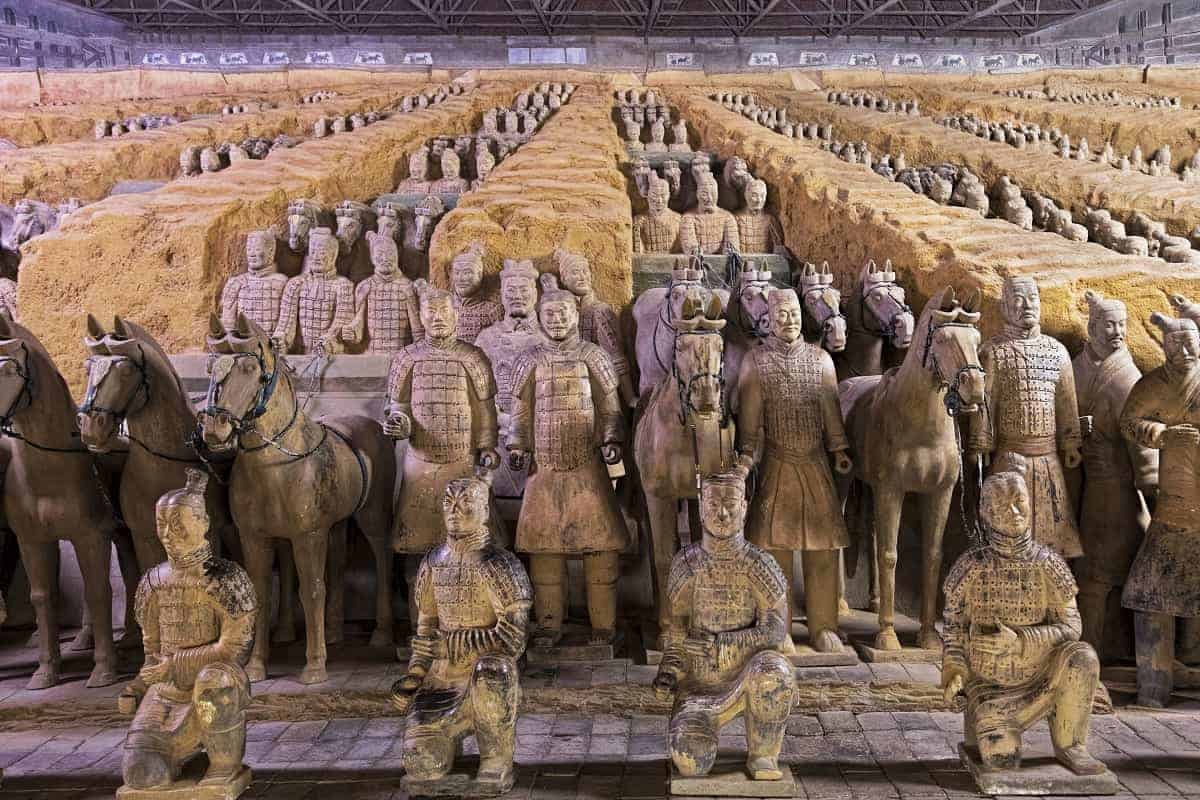
China‘s Terracotta Army represents the largest collection of pottery figures ever discovered. Created during the Qin Dynasty (246-208 BCE), this vast archaeological site contains over 8,000 soldiers, 130 chariots, and 670 horses.
Each warrior possesses unique facial features and equipment details, reflecting an unprecedented level of artistic individuality for its time. Recent scientific analysis has revealed traces of original paint pigments, suggesting the army was once vibrantly colored.
The site‘s total value exceeds $4.5 billion, though its cultural significance to Chinese heritage remains beyond price. Ongoing excavations continue to uncover new figures and artifacts.
5. The Hope Diamond
This legendary 45.52-carat blue diamond represents the intersection of geological rarity and historical significance. Its deep blue color results from trace amounts of boron within its crystal structure, while its red phosphorescence after exposure to ultraviolet light makes it uniquely identifiable.
The stone‘s documented history spans nearly four centuries, including ownership by King Louis XIV of France. Current scientific analysis suggests its formation occurred approximately 1.1 billion years ago at depths exceeding 150 kilometers beneath Earth‘s surface.
The Hope Diamond‘s current insurance value stands at $350 million, though its combination of size, color, and history makes it essentially irreplaceable.
6. The Artemision Bronze
This Hellenistic bronze statue represents the pinnacle of ancient Greek metallurgy. Standing 2.09 meters tall, the statue demonstrates sophisticated lost-wax casting techniques that remained unsurpassed for centuries.
My examination of similar period bronzes reveals the extraordinary skill required for such large-scale casting. The statue‘s preservation in marine sediments protected it from oxidation, maintaining its exceptional condition.
Current market valuations place its worth around $300 million, though its importance to understanding ancient Greek bronze-working techniques remains invaluable.
7. The Codex Leicester
Leonardo da Vinci‘s scientific manuscript represents the most expensive book ever sold. Comprising 72 pages of observations and theories, the codex provides unique insights into one of history‘s greatest minds.
The manuscript‘s current owner, Bill Gates, paid $30.8 million in 1994. Modern digital scanning has revealed previously unknown aspects of Leonardo‘s work, including hidden drawings and notes.
8. The Panagyurishte Treasure
This remarkable Thracian gold treasure exemplifies ancient metallurgical mastery. The collection includes nine pure gold vessels weighing a total of 6.164 kilograms, dating to the 4th-3rd century BCE.
The vessels‘ repoussé decoration demonstrates extraordinary artistic skill, while metallurgical analysis reveals sophisticated gold-working techniques. The treasure‘s estimated value exceeds $200 million.
9. The Vindolanda Tablets
These Roman writing tablets provide unprecedented insights into daily life in Roman Britain. The collection includes over 400 wooden tablets preserved in anaerobic conditions, dating from 85-130 CE.
Modern multispectral imaging continues to reveal new text, expanding our understanding of Roman military and civilian life. While monetarily valuable, their historical significance makes them priceless to scholars.
10. The Antikythera Mechanism
This ancient Greek astronomical calculator represents technological sophistication far beyond its time. Containing 37 bronze gears, the device could predict astronomical events and track multiple calendar systems.
Recent X-ray tomography has revealed previously unknown functions and inscriptions, suggesting capabilities equivalent to 18th-century mechanical computers. Its estimated value of $175 million reflects its unique technological significance.
Authentication and Preservation Challenges
Modern artifact authentication requires multiple scientific approaches. Thermoluminescence dating determines ceramic age, while radiocarbon dating dates organic materials. X-ray fluorescence analyzes metal composition, and dendrochronology dates wooden artifacts.
Conservation presents ongoing challenges. Temperature and humidity control remain critical, with most artifacts requiring environments between 18-22°C and 45-55% relative humidity. Light exposure must be limited to protect sensitive materials, while air quality control prevents deterioration.
Market Trends and Investment Considerations
The market for significant historical artifacts continues to strengthen, driven by increased interest from private collectors and institutions. However, legal restrictions on artifact movement and ownership rights present complex challenges for collectors.
Authentication remains paramount in valuation. Provenance documentation, scientific analysis, and expert verification all play crucial roles in establishing artifact authenticity and value.
Future Prospects
Technological advances continue to reveal new insights about ancient artifacts. Digital imaging, 3D scanning, and chemical analysis provide increasingly detailed understanding of creation methods and historical context.
The market for significant artifacts shows steady appreciation, though regulatory frameworks increasingly favor institutional ownership over private collections. Future discoveries may yet reveal even more remarkable treasures from humanity‘s past.
For collectors and institutions alike, these ten artifacts represent the pinnacle of human achievement and historical significance. Their preservation ensures future generations can continue learning from our shared cultural heritage.