8 Most Valuable Rare Antique Fishing Lures: From $13,000 to a Record-Breaking $101,200
The world of antique fishing lure collecting witnessed a defining moment in 2003 when a Giant Copper Haskell Minnow sold for an astonishing $101,200 at Lang‘s Auction. As someone who has spent three decades collecting and studying vintage fishing tackle, I can tell you this sale marked a dramatic shift in how collectors and investors view these remarkable pieces of American craftsmanship.
The Rich History of American Fishing Lures
Before we dive into the most valuable specimens, let‘s explore why these pieces command such remarkable prices. The story begins in the late 1800s, when American ingenuity and the industrial revolution collided to create a golden age of lure manufacturing. Prior to this period, anglers relied primarily on live bait or crude hand-carved wooden lures.
The first commercial fishing lures emerged from small workshops and kitchens of innovative craftsmen. James Heddon, often credited with starting the artificial bait industry, reportedly discovered the potential of wooden lures when he casually tossed a whittled piece of wood into a Michigan millpond and watched bass strike at it. This simple observation led to the founding of Heddon Lures in 1902, marking the beginning of modern sport fishing.
The Eight Most Valuable Antique Fishing Lures
1. Giant Copper Haskell Minnow (1859) – $101,200
The undisputed king of antique lures, this 10-inch copper masterpiece represents the pinnacle of 19th-century American craftsmanship. Riley Haskell created this extraordinary piece in his Painesville, Ohio workshop. What makes this lure particularly remarkable is its size – at 10 inches, it‘s substantially larger than typical Haskell minnows.
The lure features incredibly detailed scale work, hand-fitted joints, and a revolutionary revolving tail mechanism that was decades ahead of its time. The copper has developed a natural patina that collectors prize, while maintaining its structural integrity. This specimen remains the only known example of its size, contributing significantly to its record-breaking value.
2. Pflueger and Pardee Wooden Minnow (1890-1904) – $42,500
This lure holds special significance as America‘s first patented wooden minnow. Discovered in pristine condition in Hiram Rice‘s tackle box in Ohio, it represents a crucial transition period in fishing lure development. The lure features innovative articulated sections that mimic natural fish movement, hand-painted details that have retained their vibrancy, and original brass hardware showing minimal wear.
The historical significance of this piece cannot be overstated – it established the blueprint for wooden minnow design that manufacturers would follow for decades. Its 2006 sale price of $42,500 reflects both its rarity and its importance in fishing tackle evolution.
3. Chautauqua Minnow (1908) – $37,400
The Chautauqua Minnow tells a fascinating story of market forces and collecting value. Manufactured by Kratz & Smith in New York, this lure initially failed commercially – a fact that now makes it one of the most sought-after pieces among serious collectors.
Its distinctive copper and brass construction features intricate soldered joints and a unique swimming action that was perhaps too advanced for its time. The few remaining unused specimens command premium prices, with this particular example selling for $37,400 due to its pristine condition and original box.
4. Rare Haskell Musky Minnow (1859) – $32,000
Another Riley Haskell creation, this 7.5-inch minnow showcases the maker‘s legendary attention to detail. Each scale was individually hand-hammered and soldered, creating a realistic pattern that still influences lure design today. The rotating parts move as smoothly now as they did over 160 years ago, testament to Haskell‘s superior craftsmanship.
The lure‘s original hooks and hardware remain intact, and its copper surface displays an even, natural patina that authenticators love to see. When this piece sold for $32,000, it reinforced the premium market for Haskell‘s work.
5. Musky Charmer Minnow (1900s) – $21,000
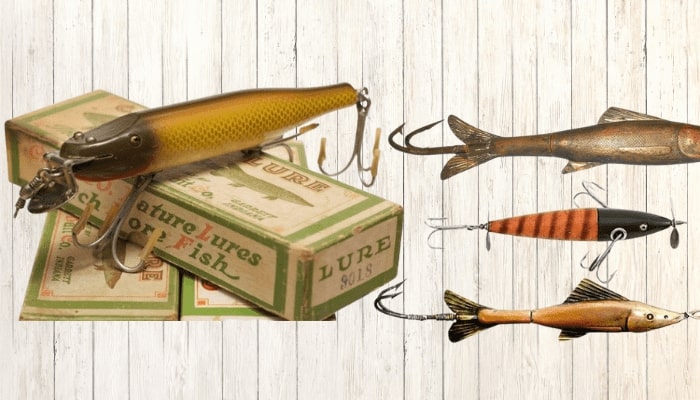
The Musky Charmer stands out for its innovative design features and striking appearance. At 5 inches long, it sports a distinctive striped pattern that resembles a bumblebee more than a fish – yet proved remarkably effective at attracting large muskellunge.
Its surface-disturbing propeller design was revolutionary for its time, creating both visual and acoustic attraction for predatory fish. The specimen that sold for $21,000 retained 90% of its original paint, making it exceptionally rare in the collecting world.
6. Heddon Black Sucker (1900-1911) – $19,000
James Heddon‘s early wooden lures set the standard for quality and innovation in the industry. This Black Sucker model features exquisite hand-painted details and original hardware that collectors prize. What makes this particular piece special is its documented provenance – it came directly from the Heddon family collection.
The lure‘s $19,000 sale price reflects both its exceptional condition and its important connection to one of fishing‘s most influential families. The black head and orange-striped body combination remains one of the most sought-after color patterns among Heddon collectors.
7. Shakespeare Wooden Minnow (1907) – $18,700
William Shakespeare Jr.‘s contribution to fishing tackle history is well represented by this early wooden minnow. Its distinctive longhorn propellers and five-hook configuration set it apart from competitors‘ offerings. This specimen‘s extraordinary value stems partly from its original box and paper label – items that rarely survived regular use.
The lure‘s paint work shows minimal wear, and all original hardware remains intact. These factors, combined with its documented early production date, justified its $18,700 sale price.
8. Hosmer Mechanical Frog (1936) – $13,000
The Hosmer Mechanical Frog represents a different direction in lure design. Rather than mimicking small fish, this lure accurately recreates frog movement through an innovative mechanical action. The yellow variant that sold for $13,000 came complete with its original box and instruction sheet – documentation that provides valuable insights into period fishing techniques.
Authentication and Valuation
For collectors and investors, proper authentication becomes crucial when dealing with high-value lures. Key factors include:
Hardware Analysis: Period-correct materials and construction methods are essential. Pre-1915 cup-rig designs used specific mounting methods, while solder patterns and wear marks should match the lure‘s purported age.
Paint Examination: Original factory finishes have distinctive characteristics. Hand-painted details should show appropriate brush strokes and pigment composition for the era. Natural aging patterns help confirm authenticity.
Construction Methods: Tool marks and joining techniques must align with period manufacturing capabilities. Wood species should match known factory preferences, while metal components should display appropriate patina and wear.
Market Dynamics and Investment Strategy
The antique fishing lure market continues to strengthen, with several factors driving growth:
Regional Variations: Different areas show distinct preferences and values. Northeast collectors often focus on early wooden lures, while Midwest collectors prize metal lures from local manufacturers. Understanding these regional dynamics can create investment opportunities.
Condition Premium: Mint condition lures with original boxes command exponentially higher prices than similar pieces showing wear. However, even damaged rare lures can hold significant value if they represent important models or makers.
Documentation Value: Provenance documentation, original packaging, and period advertising materials can multiply a lure‘s value. Serious collectors should maintain detailed records of their acquisitions.
Preservation and Conservation
Proper storage and handling become crucial for maintaining value:
Temperature Control: Maintain consistent temperatures between 65-70°F to prevent wood expansion and contraction.
Humidity Management: Keep relative humidity between 45-55% to prevent metal corrosion and wood deterioration.
Light Protection: Shield lures from direct sunlight to prevent paint fading and material degradation.
Handling Protocols: Use cotton gloves when handling valuable pieces, and store them in acid-free materials.
Future Market Outlook
The antique fishing lure market shows strong potential for continued growth. International collectors have begun entering the market, while younger American collectors show increasing interest in their sporting heritage. As supply remains fixed and demand grows, particularly rare pieces likely will appreciate significantly.
For new collectors, I recommend focusing on knowledge development before making major purchases. Study reference materials, attend shows and auctions, and build relationships with experienced collectors. Understanding authentication methods and market dynamics will prove invaluable as you build your collection.
The record-breaking sale of the Giant Copper Haskell Minnow may have marked a high point in the market, but it certainly won‘t be the last time an exceptional piece commands extraordinary prices. These eight valuable lures represent not just financial worth, but the remarkable history of American sporting craftsmanship and innovation.