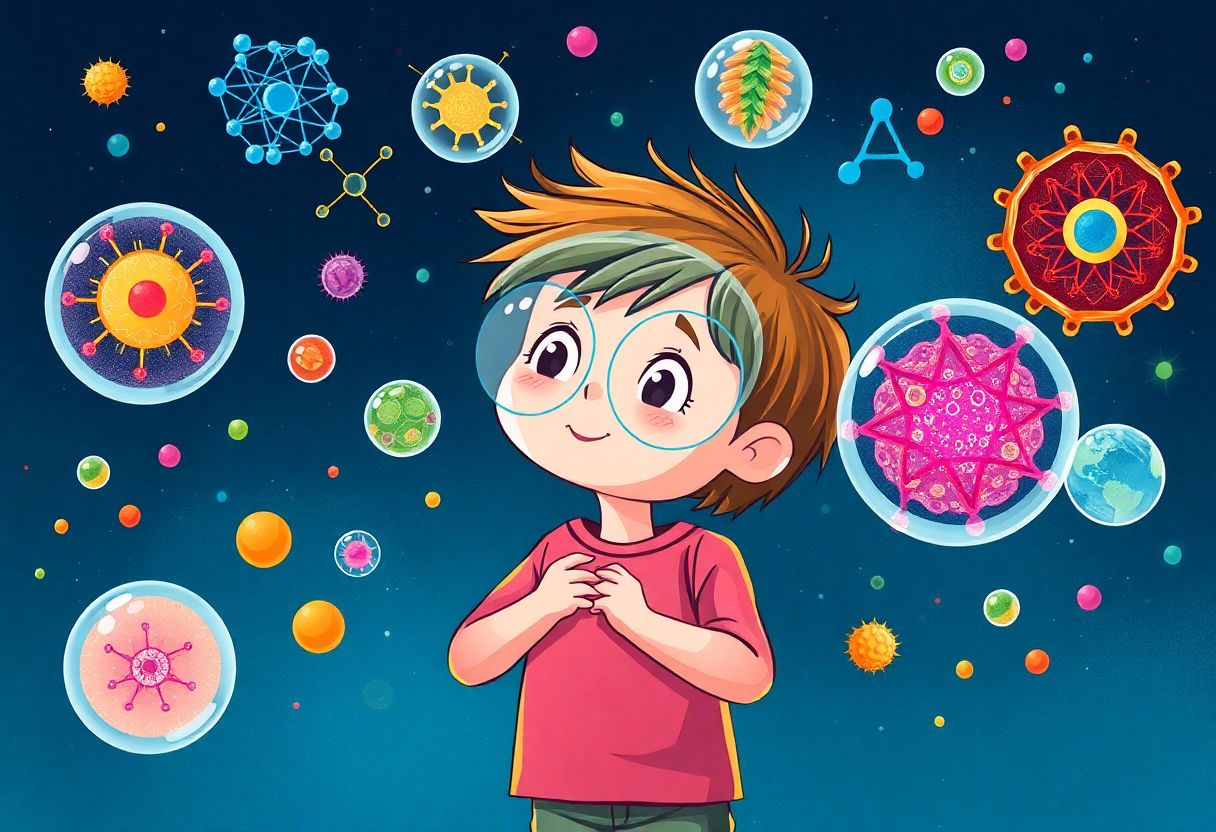
Exploring the Nano-Universe: A Kid’s Guide to the Wonders of Nanotechnology
Welcome to the Incredible World of the Very, Very Small!
Have you ever wondered what the tiniest things in the world look like? Imagine shrinking down to the size of an atom – that's the amazing realm we're about to explore! Welcome to the world of nanotechnology, where scientists work with things so small you can't even see them with your eyes. Get ready for a mind-bending adventure into the nano-universe!
What Exactly Is Nanotechnology?
Nanotechnology is the science of working with materials at an incredibly tiny scale – we're talking about manipulating individual atoms and molecules! The word "nano" comes from the Greek word for "dwarf," and in science, it means one billionth of something. To put that in perspective, if you're about 1.5 meters tall, that's a whopping 1.5 billion nanometers! A nanometer is so small that your fingernails grow about one nanometer every second.
At this minuscule scale, the world behaves very differently from what we're used to. Materials can have surprising properties – gold might appear red or purple instead of yellow, and normally tough materials like steel can become super stretchy. It's like entering a magical realm where the rules of our everyday world don't always apply!
The Nanoscale: Where Things Get Really Weird
What makes the nanoscale so special? There are a few key reasons:
First, tiny particles have much more surface area compared to their volume. This makes them incredibly reactive, which can be useful for all sorts of applications, from cleaning up pollution to delivering medicine in the body.
Second, at the nanoscale, the laws of quantum physics take over. This leads to some truly bizarre and useful properties that scientists are only beginning to understand and harness.
Finally, some nanomaterials can automatically arrange themselves into specific structures, a process called self-assembly. It's like having tiny building blocks that can put themselves together!
How Do Scientists Work in This Tiny World?
Working with things so small requires some pretty amazing tools. Scientists use instruments like Atomic Force Microscopes (AFM) that can "feel" the surface of atoms with a super tiny probe, and Scanning Tunneling Microscopes (STM) that can actually move individual atoms around!
Imagine being able to build things by putting atoms together one by one, like the tiniest LEGO set ever. That's the kind of precise control nanotechnology offers. It's opening up possibilities that were once only found in science fiction stories.
Nanotechnology in Action: Cool Applications
Nanotechnology isn't just confined to high-tech labs – it's already making our lives better in many ways. Let's explore some of the exciting applications:
Super Strong Materials
One of the most promising areas of nanotechnology is the development of incredibly strong materials. Carbon nanotubes, for example, are tiny tubes made of carbon atoms. They're about 100 times stronger than steel but much lighter! These could revolutionize everything from building construction to space exploration.
Medicine and Health
Nanotechnology is transforming healthcare. Tiny nanoparticles can carry medicine directly to sick cells in your body, like a microscopic delivery service. This targeted approach could make treatments more effective and reduce side effects. Nanosensors are also being developed that can detect diseases earlier and more accurately than ever before, potentially saving millions of lives.
Cleaner Energy
As we face global challenges like climate change, nanotechnology offers hope for cleaner energy solutions. Researchers are developing more efficient solar panels using nanomaterials that can capture more energy from the sun. Nano-enhanced batteries can store more energy and charge faster, which could make electric vehicles more practical and affordable.
Smarter Electronics
Your smartphone is already a marvel of miniaturization, but nanotechnology is pushing the boundaries even further. Computer chips are getting tinier and more powerful thanks to nanoscale engineering. We might soon see flexible screens that you can bend or fold, opening up new possibilities for wearable technology.
Cleaner Water
Access to clean water is a critical global issue, and nanotechnology might hold the key to solving it. Nano-filters can remove pollutants and even salt from water, making it safe to drink. This technology could provide clean water to millions of people around the world who currently lack access.
Nature's Nanotechnology: Learning from the Masters
While we're making exciting breakthroughs in nanotechnology, nature has been using these techniques for millions of years. Here are some fascinating examples:
Geckos can walk on walls thanks to millions of nano-sized hairs on their toes. These tiny structures create a powerful adhesive force through something called van der Waals interactions. Scientists are studying this to develop better adhesives and even climbing robots!
The vibrant colors on butterfly wings often come from nano-structures that reflect light in special ways, rather than from pigments. This structural color is inspiring new ways to create paints and displays that don't fade over time.
Lotus leaves stay remarkably clean because of their nano-textured surface that repels water and dirt. This "lotus effect" is being mimicked to create self-cleaning surfaces for everything from building materials to clothing.
The Future of Nanotechnology: From Science Fiction to Reality
The potential applications of nanotechnology in the future are truly mind-boggling. Scientists are working on some incredible ideas that sound like they're straight out of a sci-fi movie:
Imagine tiny nanobots swimming through our bodies to fight diseases or repair damage at the cellular level. While this technology is still in its early stages, it could revolutionize medicine as we know it.
Some researchers are exploring the possibility of using super-strong nanomaterials to build space elevators – literal elevators that could reach from Earth into space, making space travel much more accessible and affordable.
By controlling how light interacts with nano-structures, scientists think we might one day be able to create "invisibility cloaks" that bend light around objects, effectively making them invisible!
Safety and Ethics: Navigating the Nano-Frontier
As exciting as nanotechnology is, it's important to approach it responsibly. Scientists and policymakers are working to ensure that nanoparticles are safe for people and the environment. There are also important ethical considerations to keep in mind.
Privacy is a major concern, as super tiny sensors could potentially be used for surveillance. It's crucial that we develop this technology with strong safeguards in place to protect individual rights.
There's also the question of equal access. As nanotechnology advances, we need to make sure its benefits are available to everyone, not just wealthy countries or individuals. This technology has the potential to solve global challenges, but only if it's developed and distributed equitably.
Become a Nano-Explorer!
You don't need a billion-dollar lab to start exploring the nano-world. There are lots of ways you can get involved and learn more about this fascinating field:
Use a small microscope to look at everyday objects up close. You'll be amazed at the details you can see that are invisible to the naked eye.
Try some safe experiments at home (with adult supervision, of course). For example, you can make a ferrofluid – a magnetic liquid that behaves in weird ways due to its nanoparticles.
Go outside and look for examples of natural nanotechnology, like the iridescent colors on butterfly wings or water-repelling leaves. Nature is full of nano-wonders if you know where to look!
Keep learning by reading books, watching documentaries, and staying curious about the latest discoveries in nanotechnology. Who knows? You might be inspired to become a nano-scientist yourself one day!
Conclusion: The Big Impact of the Very Small
Nanotechnology is opening up a whole new world of possibilities. By working with the tiniest building blocks of matter, we're finding solutions to some of our biggest challenges – from treating diseases to protecting the environment.
As we've explored in this guide, the nano-world is full of surprises. Materials behave differently, new properties emerge, and the lines between biology, chemistry, and physics start to blur. It's a field that requires creativity, curiosity, and collaboration across many different areas of science.
The next time you look at something, remember that there's a whole universe of tiny wonders hiding just out of sight. The world of the very small is full of big surprises, and we're only just beginning to unlock its potential.
Who knows what amazing discoveries are waiting to be made? Maybe you'll be the one to make the next big breakthrough in the tiny world of nanotechnology!