The Science and Magic of Thermocouples: Measuring Temperature with Electrical Precision
Thermocouples are ingenious devices that have revolutionized temperature measurement across countless industries. These simple yet powerful sensors harness the fundamental relationship between heat and electricity to provide accurate readings in environments ranging from the frigid depths of space to the searing heat of industrial furnaces. In this comprehensive exploration, we'll uncover the fascinating science behind thermocouples, their practical applications, and the cutting-edge developments shaping their future.
The Foundations of Thermocouple Technology
The Intimate Dance of Heat and Electricity
At the heart of thermocouple operation lies a profound connection between thermal and electrical energy. In materials that conduct electricity well, such as metals, the same tiny particles – electrons – are responsible for carrying both electrical current and heat. This dual nature of electrons is the key to understanding how thermocouples function.
When heat is applied to one end of a metal, it energizes the electrons, causing them to move more rapidly. This movement creates a flow of electrical current through the material. It's as if the heat gives the electrons a gentle push, sending them on a journey through the metal's crystalline structure.
The Seebeck Effect: A Eureka Moment in Physics
The phenomenon that makes thermocouples possible was discovered in 1821 by German physicist Thomas Johann Seebeck. His groundbreaking observation, now known as the Seebeck effect, revealed that when two different metals are joined and their junctions are held at different temperatures, a small but measurable voltage is produced.
This effect is more pronounced in some metal combinations than others, leading to the development of various thermocouple types optimized for different temperature ranges and environments. The voltage generated is directly proportional to the temperature difference between the two junctions, allowing for precise temperature measurements.
The Inner Workings of a Thermocouple
A Tale of Two Junctions
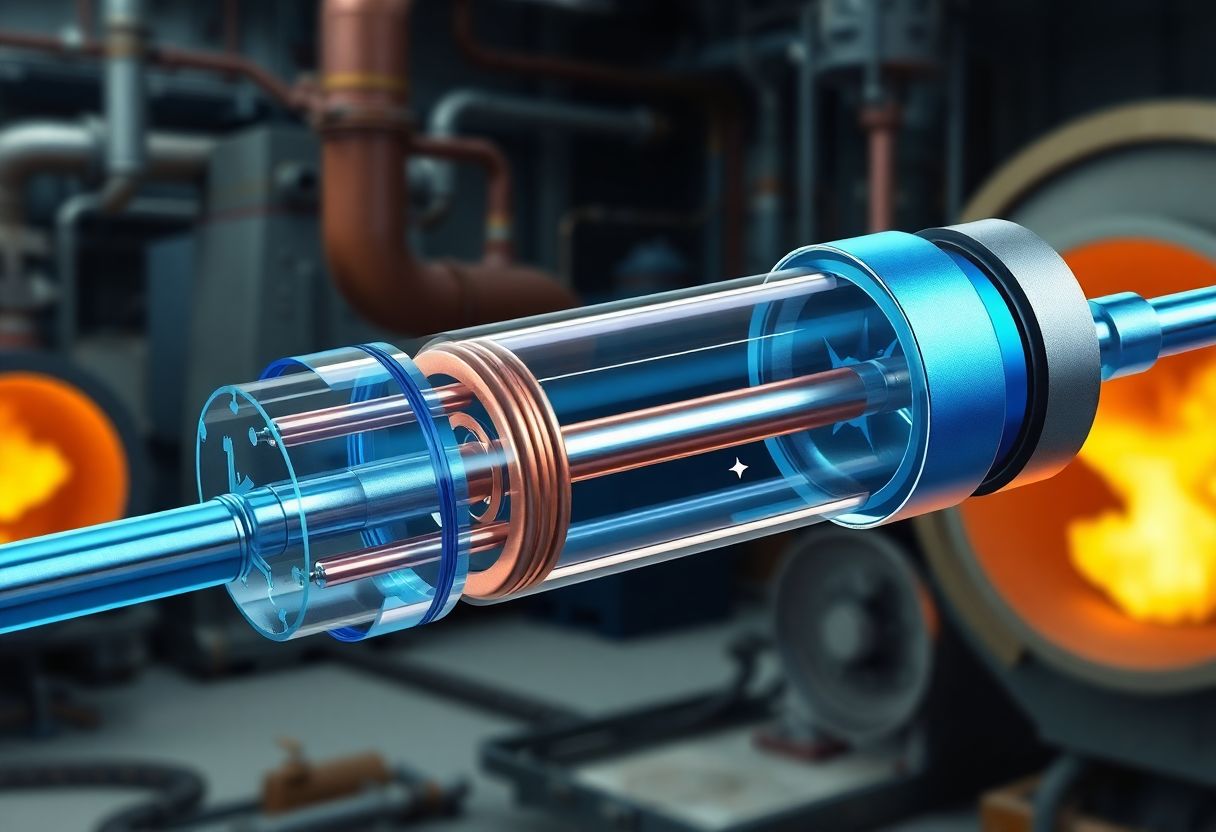
A typical thermocouple consists of two wires made from different metals or alloys. These wires are joined at two points, creating what are known as the measuring junction and the reference junction.
The measuring junction is placed at the location where temperature needs to be measured. This could be inside a furnace, immersed in a liquid, or even in the exhaust stream of a jet engine. The reference junction, on the other hand, is kept at a known, constant temperature. Historically, this was often achieved by immersing the reference junction in an ice bath, maintaining it at a steady 0°C.
As the measuring junction experiences temperature changes, the difference in temperature between it and the reference junction causes electrons to flow differently through the two metals. This difference in electron flow generates a small but measurable voltage.
The Atomic Ballet of Electrons
To truly appreciate the elegance of thermocouple operation, we need to zoom in to the atomic level. In metals, some electrons are loosely bound to their atoms, allowing them to move freely through the material. These "free" electrons behave much like a gas, with their energy and movement increasing as temperature rises.
When two different metals are in contact, there's a natural tendency for electrons to flow from one to the other, based on their respective electron energies. Heating one junction disrupts this equilibrium, causing a net flow of electrons and generating a voltage difference.
This process is akin to opening two different-sized doors on opposite sides of a crowded room. The flow of people (electrons) through each door will differ, creating a net movement that we can measure.
Practical Thermocouple Design and Implementation
Choosing the Right Metals
The selection of metals for a thermocouple is crucial and depends on the intended application. Some common thermocouple types include:
-
Type K: Uses Chromel (90% nickel, 10% chromium) and Alumel (95% nickel, 2% manganese, 2% aluminum, 1% silicon). It's the most common type, suitable for temperatures from -200°C to +1350°C.
-
Type J: Combines iron and constantan (55% copper, 45% nickel). It's less expensive than Type K but has a more limited range of -40°C to +750°C.
-
Type T: Made from copper and constantan, it excels in low-temperature applications, from -250°C to +350°C.
-
Type E: Uses chromel and constantan, offering high sensitivity and a range of -200°C to +900°C.
Each type has its own unique thermoelectric properties, sensitivity, and suitable temperature range, allowing engineers to choose the best option for their specific needs.
From Raw Materials to Robust Sensor
Modern thermocouples are marvels of engineering, designed to withstand harsh environments while providing accurate measurements. A typical thermocouple assembly includes:
- Two carefully selected metal wires
- A welded or fused junction point
- Electrical insulation to prevent interference
- A protective sheath for durability and chemical resistance
- Connecting wires and terminals for integration with measurement equipment
The construction process involves precise welding techniques to create the measuring junction, often using laser welding for consistency and reliability. The protective sheath material is chosen based on the expected environment, with options ranging from stainless steel for general use to platinum for extremely high temperatures or corrosive conditions.
The Art and Science of Temperature Measurement
Calibration: The Key to Accuracy
While the Seebeck effect provides a reliable relationship between temperature difference and voltage, precise measurements require careful calibration. This process involves exposing the thermocouple to known temperatures and recording the corresponding voltages.
Modern calibration techniques use highly stable temperature references, such as the freezing and boiling points of pure substances. Advanced systems may employ fixed-point cells, which utilize the precise temperatures at which certain materials undergo phase changes.
The result of calibration is a set of data points or a mathematical formula that relates voltage output to temperature. This calibration data is crucial for converting the raw voltage readings into accurate temperature measurements.
Cold Junction Compensation: Bringing Precision to the Real World
One of the challenges in thermocouple measurement is accounting for the temperature of the reference junction. While early systems used ice baths to maintain a constant 0°C reference, modern instruments employ electronic cold junction compensation.
This technique uses a separate temperature sensor, often a thermistor or RTD (Resistance Temperature Detector), to measure the temperature at the point where the thermocouple wires connect to the measurement circuit. By knowing this temperature, the system can mathematically adjust the thermocouple reading to provide an accurate measurement relative to a virtual 0°C reference.
Thermocouples in Action: Real-World Applications
Industrial Processes: The Backbone of Manufacturing
Thermocouples play a critical role in countless industrial processes. In steel production, for example, Type B thermocouples (made from platinum and rhodium alloys) can measure temperatures up to 1800°C in molten metal, ensuring the precise control needed for high-quality steel.
In the chemical industry, thermocouples monitor reactor temperatures, helping maintain optimal conditions for complex reactions. Their fast response time and ability to withstand harsh chemicals make them ideal for these demanding environments.
Aerospace: Pushing the Boundaries of Performance
The aerospace industry relies heavily on thermocouples for both safety and efficiency. In jet engines, multiple thermocouples monitor exhaust gas temperatures, providing crucial data to prevent overheating and optimize fuel consumption.
Space exploration presents unique challenges for temperature measurement. Thermocouples on spacecraft must function in the extreme cold of deep space and withstand the intense heat of atmospheric re-entry. The Mars rovers, for instance, use specially designed thermocouples to monitor critical components in the harsh Martian environment.
Everyday Applications: The Hidden Helpers
Thermocouples are not limited to high-tech industries. They're found in many everyday appliances and systems:
- Home heating systems use thermocouples as safety devices in gas-fired furnaces and water heaters.
- Commercial kitchens rely on thermocouples in ovens and grills to maintain precise cooking temperatures.
- Automotive engines employ thermocouples to monitor exhaust temperatures, helping optimize performance and reduce emissions.
Advantages and Limitations: Understanding the Trade-offs
The Strengths of Thermocouple Technology
Thermocouples offer several compelling advantages:
- Wide temperature range: From cryogenic temperatures below -200°C to over 2300°C for specialized types.
- Robustness: Their simple construction makes them resistant to shock and vibration.
- Fast response: They can detect temperature changes rapidly, often in less than a second.
- Self-powered: Thermocouples generate their own voltage, requiring no external power source for basic operation.
- Cost-effective: Especially for high-temperature applications, thermocouples are often the most economical choice.
Navigating the Limitations
Despite their strengths, thermocouples do have some limitations:
- Lower accuracy: Compared to resistance temperature detectors (RTDs) or thermistors, thermocouples are generally less accurate, typically ±0.5°C to ±2°C.
- Nonlinearity: The voltage-temperature relationship is not perfectly linear, requiring more complex conversion calculations.
- Susceptibility to electromagnetic interference: In environments with strong electromagnetic fields, shielding may be necessary.
- Drift over time: Especially at high temperatures, thermocouple performance can degrade, requiring periodic recalibration.
The Evolution of Thermocouple Technology
From Discovery to Industry Standard
The journey of thermocouples from scientific curiosity to indispensable tool spans nearly two centuries:
1821: Seebeck discovers the thermoelectric effect.
1830s: First practical thermocouples developed by Antoine Becquerel.
1880s: Henry Le Chatelier introduces the platinum-rhodium thermocouple, dramatically extending the measurable temperature range.
1930s: Standardization of thermocouple types begins, leading to the letter designations (K, J, T, etc.) still used today.
1960s-1970s: Development of noble metal thermocouples for extreme high-temperature applications.
1980s-1990s: Introduction of miniature and thin-film thermocouples for specialized applications.
2000s onwards: Integration with digital systems and wireless technology, enabling remote monitoring and IoT applications.
Cutting-Edge Developments
Thermocouple technology continues to evolve, with several exciting areas of research and development:
-
Nanotechnology: Researchers are exploring nanoscale thermoelectric effects to create ultra-sensitive thermocouples. By manipulating materials at the atomic level, it may be possible to enhance the Seebeck effect and improve measurement precision.
-
Smart thermocouples: Integration of microprocessors directly into thermocouple assemblies allows for on-board signal processing, self-diagnostics, and even self-calibration. These smart sensors can compensate for drift and provide more reliable long-term performance.
-
New materials: The search for novel thermoelectric materials continues, with researchers investigating complex alloys and even ceramic materials that could offer improved sensitivity or stability at extreme temperatures.
-
Energy harvesting: The Seebeck effect works both ways – not only can temperature differences generate electricity, but electricity can also create temperature differences (known as the Peltier effect). This principle is being explored for small-scale power generation from waste heat in industrial processes or even in wearable devices.
The Future of Temperature Measurement
As we look to the future, thermocouples are likely to remain a cornerstone of temperature measurement technology. However, they will evolve to meet the demands of an increasingly connected and data-driven world.
Imagine a future where networks of self-powered, wireless thermocouples continuously monitor the thermal profile of entire manufacturing plants, providing real-time data to AI-driven control systems. Or consider the potential for biomedical applications, where microscopic thermocouples could provide precise temperature mapping within the human body, aiding in diagnostics and treatment.
The fundamental principles discovered by Seebeck two centuries ago continue to open new possibilities. As our understanding of materials science and quantum effects deepens, we may yet uncover new phenomena that revolutionize how we measure and manipulate temperature.
Conclusion: The Enduring Legacy of a Simple Idea
Thermocouples stand as a testament to the power of scientific observation and the practical application of fundamental physical principles. From their humble beginnings in a 19th-century laboratory to their ubiquitous presence in modern industry and technology, these devices have played a crucial role in shaping our world.
The elegance of the thermocouple lies in its simplicity – two different metals, joined together, creating a sensitive temperature probe through the natural behavior of electrons. This simplicity belies the profound impact thermocouples have had on fields ranging from metallurgy to space exploration.
As we continue to push the boundaries of technology, seeking to measure and control ever more extreme environments, the thermocouple will undoubtedly evolve. Yet its core principle, the intimate dance between heat and electricity, will remain at the heart of how we understand and interact with the thermal world around us.
The next time you encounter a precisely controlled industrial process, a perfectly cooked meal, or a spacecraft transmitting data from a distant planet, take a moment to appreciate the humble thermocouple. In its quiet operation, converting temperature to voltage with unwavering diligence, lies a beautiful example of how understanding nature's laws can lead to transformative technologies.