Steam Turbines: Harnessing the Power of Steam for a Dynamic World
Steam turbines have been the backbone of global power generation for over a century, quietly converting the energy of superheated water vapor into the electricity that powers our modern world. These marvels of engineering are a testament to human ingenuity, embodying principles of thermodynamics and fluid mechanics to achieve remarkable efficiency in energy conversion. In this comprehensive exploration, we'll delve into the intricate workings of steam turbines, trace their historical development, and examine their crucial role in our energy infrastructure, both present and future.
The Fundamentals of Steam Power
At the heart of steam turbine technology lies a profound understanding of the properties of water and steam. Water, a substance we often take for granted, possesses unique characteristics that make it ideal for power generation. When water transitions from its liquid to gaseous state, it undergoes a dramatic expansion, increasing in volume by a factor of about 1,600. This expansion, coupled with the high energy content of steam, forms the basis for steam turbine operation.
The energy potential of steam is quantified by its enthalpy, a thermodynamic property that represents the total heat content of the steam. At standard atmospheric pressure (1 atm), the enthalpy of saturated steam at 100°C is approximately 2,676 kJ/kg, compared to 419 kJ/kg for water at the same temperature. This substantial difference in enthalpy (2,257 kJ/kg) is known as the latent heat of vaporization, representing the energy required to change water from liquid to vapor without a change in temperature.
The Evolution of Steam Power: From Engines to Turbines
The journey from early steam engines to modern turbines spans over three centuries of technological progress. The first practical steam engine, developed by Thomas Newcomen in 1712, was a rudimentary device used primarily for pumping water out of mines. James Watt's improvements in the late 18th century, including the separate condenser and rotary motion, greatly enhanced the efficiency and applicability of steam engines, catalyzing the Industrial Revolution.
However, steam engines had inherent limitations. They operated on a reciprocating motion, which was inefficient for generating electricity and prone to mechanical wear. The need for a more efficient and compact means of harnessing steam power led to the development of the steam turbine.
The Birth of the Steam Turbine
The concept of using steam to drive a rotary device dates back to the 1st century AD, with Hero of Alexandria's aeolipile. However, it wasn't until the late 19th century that practical steam turbines emerged. In 1884, Sir Charles Parsons invented the modern steam turbine, revolutionizing power generation. Parsons' design used multiple stages of rotating blades to extract energy from steam gradually, achieving much higher efficiencies than previous steam engines.
Around the same time, Swedish engineer Gustaf de Laval developed a single-stage impulse turbine capable of reaching extremely high rotational speeds. These pioneering designs laid the foundation for the diverse array of steam turbines we see today.
The Inner Workings of a Steam Turbine
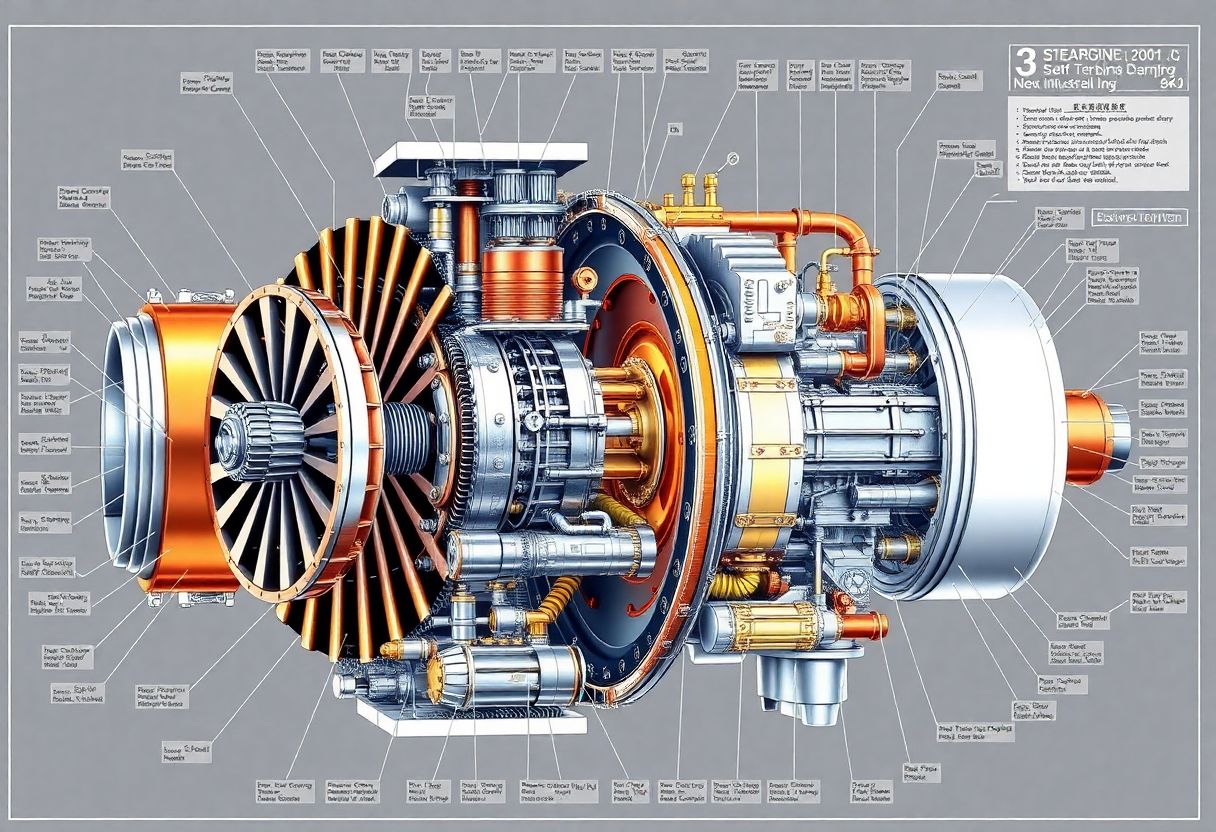
Modern steam turbines are marvels of precision engineering, designed to extract maximum energy from high-temperature, high-pressure steam. Let's examine the key components and principles that make these machines so effective:
Steam Inlet and Control Valves
The journey begins at the steam inlet, where superheated steam from the boiler enters the turbine at pressures that can exceed 300 bar (30 MPa) and temperatures above 600°C in advanced systems. Control valves regulate the steam flow, allowing for precise adjustment of turbine output and efficiency.
Turbine Stages
The turbine itself consists of multiple stages, each designed to extract a portion of the steam's energy. In large power plant turbines, there can be dozens of stages divided into high-pressure, intermediate-pressure, and low-pressure sections.
High-Pressure Section
The initial stages, often of the impulse type, handle the highest pressure steam. Here, nozzles accelerate the steam to supersonic velocities before it strikes the turbine blades. The steam pressure drops rapidly, but its high kinetic energy drives the turbine rotor.
Intermediate-Pressure Section
As the steam expands and cools, it passes through intermediate stages, often a mix of impulse and reaction designs. These stages are optimized for the changing steam conditions, continuing to extract energy efficiently.
Low-Pressure Section
The final stages, typically of the reaction type, extract energy from the now relatively low-pressure steam. These stages have longer blades to handle the increased volume of the expanding steam.
Blade Design
Turbine blade design is a complex field, combining aerodynamics, materials science, and mechanical engineering. Modern blades are carefully shaped to maximize energy extraction while minimizing losses. Advanced designs include features like:
- Twisted blade profiles to account for the radial variation in steam velocity
- Shrouded blade tips to reduce tip losses and vibration
- Hollow blades for reduced weight and improved cooling in high-temperature applications
Rotor and Bearings
The turbine rotor, a massive forged steel shaft weighing up to 200 tons in large units, carries the turbine blades and transmits the rotational energy. It's supported by precision bearings, often of the tilting-pad type, which allow for smooth operation at high speeds while minimizing friction losses.
Sealing Systems
Effective sealing is crucial for turbine efficiency. Labyrinth seals, consisting of a series of tight-fitting baffles, create a tortuous path for steam, minimizing leakage between stages and to the atmosphere. In some designs, steam itself is used as a sealing medium, further reducing losses.
Condensers and Cooling Systems
In condensing turbines, which are common in large power plants, the exhaust steam is cooled and condensed back to water. This process creates a vacuum at the turbine exit, maximizing the pressure differential across the turbine and improving overall efficiency. Modern condensers use advanced heat exchanger designs and can process hundreds of thousands of gallons of cooling water per minute.
Efficiency and Performance
The efficiency of steam turbines has improved dramatically since their inception. Early turbines had thermal efficiencies around 15%, but modern advanced designs can achieve over 45% in simple cycle operation and even higher in combined cycle plants.
Several factors contribute to turbine efficiency:
-
Steam Conditions: Higher initial steam temperatures and pressures generally lead to higher efficiencies. Supercritical and ultra-supercritical steam cycles, operating above the critical point of water (374°C and 221 bar), can achieve thermal efficiencies approaching 50%.
-
Reheat Cycles: Many large turbines use reheat cycles, where steam is returned to the boiler for reheating after passing through the high-pressure turbine section. This increases overall cycle efficiency and reduces moisture in the low-pressure stages.
-
Regenerative Feedwater Heating: Steam extracted from various turbine stages is used to preheat feedwater returning to the boiler, improving overall cycle efficiency.
-
Materials and Coatings: Advanced alloys and protective coatings allow turbines to operate at higher temperatures, improving efficiency and resisting corrosion and erosion.
-
Computational Fluid Dynamics (CFD): Sophisticated computer modeling allows engineers to optimize steam flow paths and blade designs for maximum efficiency.
Applications Beyond Power Generation
While electricity generation remains the primary application for steam turbines, their versatility extends to numerous other fields:
Marine Propulsion
Large ships, including nuclear-powered vessels, often use steam turbines for propulsion. Their compact size, smooth operation, and high power output make them ideal for this application. The Royal Navy's Queen Elizabeth-class aircraft carriers, for instance, use two Rolls-Royce MT30 gas turbines (derivatives of the Trent 800 aero engine) coupled with four diesel generators to drive steam turbines for propulsion.
Industrial Processes
Many industries rely on steam turbines to drive large compressors, pumps, and other equipment. In the oil and gas industry, for example, steam turbines are used to power compressors for natural gas pipelines and in liquefied natural gas (LNG) plants.
Combined Heat and Power (CHP)
CHP systems, also known as cogeneration, use steam turbines to generate electricity while also providing useful heat for industrial processes or district heating. This dual-use approach can achieve overall energy efficiencies of 80% or more.
The Future of Steam Turbine Technology
Despite being a mature technology, steam turbines continue to evolve, driven by the need for increased efficiency, flexibility, and integration with renewable energy sources. Some exciting developments include:
Advanced Materials
Research into new alloys and ceramics promises to push the temperature limits of turbine operation even higher. Materials like ceramic matrix composites (CMCs) could allow for steam temperatures exceeding 700°C, further improving efficiency.
Additive Manufacturing
3D printing technologies are being explored for creating complex blade geometries and internal cooling passages that would be impossible with traditional manufacturing methods. This could lead to more efficient, lighter turbine components.
Digital Twins and AI
The use of digital twin technology, coupled with artificial intelligence, is enabling more precise monitoring and predictive maintenance of turbines. These systems can optimize performance in real-time and predict potential failures before they occur.
Integration with Renewable Energy
Steam turbines are finding new applications in renewable energy systems. Concentrated solar power plants use steam turbines to generate electricity from solar heat, while some geothermal plants employ binary cycles with organic working fluids in turbines specially designed for lower temperatures.
Flexible Operation
As the electrical grid incorporates more variable renewable sources like wind and solar, steam turbines are being redesigned for more flexible operation. This includes faster start-up times, improved part-load efficiency, and the ability to quickly adjust output to balance grid demand.
Conclusion: The Enduring Legacy of Steam Power
From the dawn of the Industrial Revolution to the present day, steam power has been a driving force behind human progress. Steam turbines, with their elegant blend of simplicity and sophistication, continue to play a pivotal role in our energy landscape. As we navigate the challenges of climate change and the transition to a more sustainable energy future, the principles embodied in steam turbine technology – the efficient conversion of heat to useful work – remain as relevant as ever.
Whether powered by fossil fuels, nuclear energy, or renewable heat sources, steam turbines will likely continue to be a cornerstone of global power generation for decades to come. Their ongoing evolution, driven by advances in materials science, manufacturing techniques, and digital technologies, ensures that these remarkable machines will keep pace with the changing demands of our dynamic world.
As we look to the future, it's clear that the story of steam turbines is far from over. These devices, born from the ingenuity of 19th-century inventors, continue to be at the forefront of 21st-century energy solutions. In the quest for cleaner, more efficient power generation, the humble steam turbine stands as a testament to the enduring power of human innovation and the transformative potential of engineering excellence.