The Straight Path of X-Rays: Unveiling the Nature of Their Propagation
X-rays have captivated scientists and the public alike since their discovery in 1895 by Wilhelm Röntgen. These high-energy electromagnetic waves have revolutionized fields ranging from medicine to astrophysics. But how exactly do these invisible rays move through space? Let's embark on a journey to explore the intriguing question: do X-rays travel in straight lines?
The Nature of X-Rays
To understand the movement of X-rays, we must first grasp their fundamental nature. X-rays are a form of electromagnetic radiation, occupying a high-energy portion of the electromagnetic spectrum. With wavelengths typically ranging from 0.01 to 10 nanometers, they possess energies between 100 eV to 100 keV. This places them between ultraviolet light and gamma rays in terms of energy.
X-rays share characteristics with other forms of electromagnetic radiation, including visible light. However, their higher energy and shorter wavelengths grant them unique properties, such as the ability to penetrate many materials opaque to visible light. This penetrating power is what makes X-rays so valuable in medical imaging and material analysis.
The Straight-Line Propagation of X-Rays
The short answer to our central question is yes, X-rays do indeed travel in straight lines. This behavior is fundamental to their nature and critical to their various applications. Let's delve into the reasons behind this straight-line propagation:
Electromagnetic Wave Nature
As electromagnetic waves, X-rays follow the same basic principles of wave propagation as other forms of electromagnetic radiation. In a vacuum or uniform medium, electromagnetic waves travel in straight lines. This is a consequence of Maxwell's equations, which describe the behavior of electromagnetic fields.
High Frequency and Short Wavelength
X-rays have extremely high frequencies, typically in the range of 30 petahertz to 30 exahertz. This corresponds to very short wavelengths, which contribute significantly to their straight-line behavior. Shorter wavelengths are less prone to diffraction, the bending of waves around obstacles. While diffraction can occur with X-rays, it's much less pronounced than with longer wavelength radiation like radio waves or even visible light.
Particle-Like Behavior
Quantum mechanics tells us that X-rays, like all electromagnetic radiation, exhibit wave-particle duality. When considering X-rays as particles (photons), we can visualize them as tiny packets of energy traveling in straight paths. These photons move in straight lines unless acted upon by external forces or interacting with matter.
Experimental Evidence
The straight-line propagation of X-rays is not just theoretical but has been demonstrated through numerous experiments and practical applications. The most straightforward evidence comes from X-ray imaging techniques. The sharp, well-defined shadows produced in X-ray images are a direct result of X-rays traveling in straight lines from the source, through the subject, and onto the detector.
X-Ray Propagation in Different Media
While X-rays generally travel in straight lines, their behavior can be influenced by the medium through which they pass. Let's explore how different media affect X-ray propagation:
Propagation in Vacuum
In a perfect vacuum, X-rays travel in absolutely straight lines. There are no particles to interact with, so the X-ray photons continue unimpeded in the direction they were emitted. This is why X-ray astronomy, which observes X-rays from distant cosmic sources, is conducted using space-based telescopes above Earth's atmosphere.
Propagation in Air
In air, X-rays still travel in essentially straight lines. The density of air is low enough that interactions with air molecules are relatively rare for high-energy X-rays. This is why X-ray imaging can be performed with the subject and detector separated by air.
Propagation in Dense Matter
When X-rays encounter denser matter, such as human tissue or metal, several processes can occur:
-
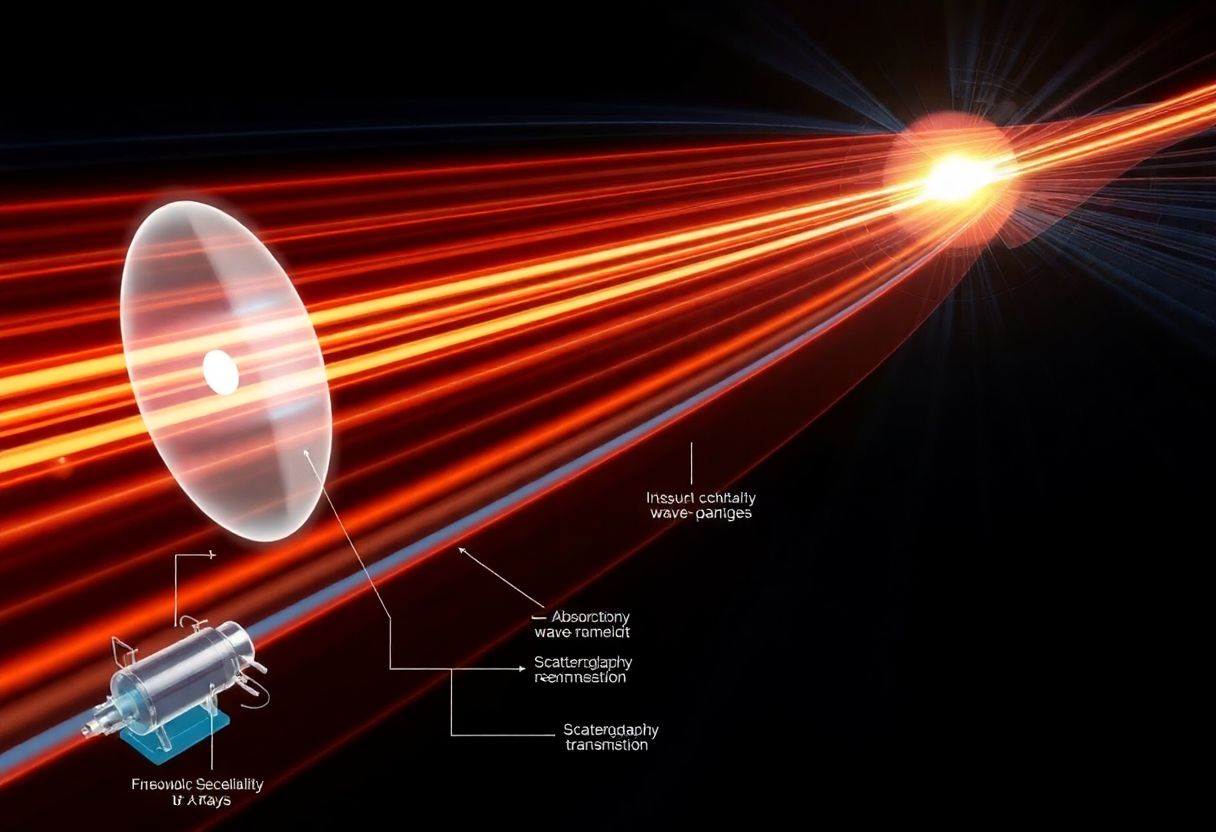
Absorption: Some X-ray photons are absorbed by atoms in the material, transferring their energy to electrons. This process doesn't change the direction of the X-rays but reduces their intensity.
-
Scattering: X-rays can be scattered by electrons in the material, causing them to change direction. There are two types of scattering:
- Coherent (Rayleigh) scattering: The X-ray changes direction without losing energy.
- Incoherent (Compton) scattering: The X-ray changes direction and loses some energy.
-
Transmission: Some X-rays pass through the material without interacting, continuing in their original straight-line path.
The balance between these processes depends on the energy of the X-rays and the properties of the material. Higher energy X-rays are more likely to travel straight through materials without interaction.
Applications Leveraging Straight-Line Propagation
The straight-line travel of X-rays is crucial for many of their applications:
Medical Imaging
X-ray radiography, the most common medical application of X-rays, relies entirely on their straight-line propagation. When X-rays pass through the body, denser tissues like bone absorb more X-rays, while softer tissues allow more to pass through. This differential absorption creates a shadow image on the detector, providing a clear picture of internal structures.
Computed Tomography (CT) scans take this a step further, using multiple X-ray images taken from different angles to construct detailed 3D images. The precision of these images is only possible because X-rays travel in straight lines.
Industrial Non-Destructive Testing
In manufacturing and engineering, X-rays are used to inspect the internal structure of materials and products without damaging them. This technique relies on X-rays traveling in straight lines through the object, creating a shadow image that reveals internal defects or structures.
Security Screening
Airport security scanners use X-rays to create images of luggage contents. The straight-line propagation of X-rays allows for clear, detailed images that security personnel can interpret to identify potential threats.
X-Ray Crystallography
This powerful technique used to determine the atomic and molecular structure of crystals depends on the diffraction of X-rays. While diffraction involves the bending of waves, the overall straight-line nature of X-rays is crucial for interpreting the resulting diffraction patterns.
Challenges and Solutions in X-Ray Optics
The straight-line nature of X-rays, while beneficial in many applications, presents challenges when it comes to focusing or manipulating X-ray beams. Unlike visible light, X-rays cannot be easily focused using conventional lenses or reflected using ordinary mirrors. This has led to the development of specialized X-ray optics:
Grazing Incidence Mirrors
X-rays can be reflected at very shallow angles (typically less than 1 degree) using specially designed mirrors. This technique, known as grazing incidence reflection, is used in X-ray telescopes and some X-ray microscopes.
Zone Plates
These are circular diffraction gratings that can focus X-rays. They work by constructive interference of X-rays passing through alternating opaque and transparent rings.
Compound Refractive Lenses
By using a series of many lenses, each producing a tiny deflection, X-rays can be focused. These lenses are typically made of low-atomic-number materials like beryllium or aluminum.
The Quantum Perspective
From a quantum mechanical viewpoint, the straight-line propagation of X-rays can be understood in terms of the path integral formulation. In this framework, a particle (or photon) can be thought of as simultaneously taking all possible paths between two points. However, for macroscopic distances, the paths that deviate significantly from a straight line interfere destructively, leaving only the straight-line path as the observable outcome.
This quantum perspective doesn't contradict the classical view of straight-line propagation but provides a deeper understanding of why this behavior emerges at the macroscopic scale.
Future Directions in X-Ray Technology
As our understanding of X-ray physics deepens and technology advances, new frontiers in X-ray science are emerging:
Coherent X-Ray Sources
X-ray free-electron lasers (XFELs) can produce incredibly bright, coherent X-ray beams. These allow for new types of experiments, including the imaging of individual molecules and the study of ultrafast chemical reactions.
Phase-Contrast Imaging
This technique utilizes the wave nature of X-rays to create images based on phase shifts rather than just absorption. It can provide higher contrast for soft tissues, potentially revolutionizing medical imaging.
Adaptive Optics for X-Rays
Borrowed from astronomy, adaptive optics techniques are being developed for X-rays. These could allow for better focusing and correction of wavefront distortions, leading to higher resolution X-ray imaging and more efficient X-ray optics.
Conclusion
In conclusion, the straight-line propagation of X-rays is a fundamental property that underlies their vast array of applications. This behavior stems from their nature as high-energy electromagnetic waves and particles, characterized by short wavelengths and high frequencies. While interactions with matter can cause deviations through processes like scattering and refraction, the overall straight-line behavior remains dominant.
Understanding and harnessing this property has enabled tremendous advancements in fields ranging from medicine to materials science. As we continue to push the boundaries of X-ray technology, from more precise medical imaging to probing the mysteries of protein structures and distant celestial objects, the straight-line travel of X-rays will undoubtedly remain a crucial factor.
The journey of an X-ray photon, traveling in a nearly perfect straight line from its source, through matter, and to our detectors, is a testament to the elegant simplicity underlying complex physical phenomena. It reminds us of the power of fundamental physical principles in shaping our understanding of the universe and driving technological innovation.
As we look to the future, emerging technologies promise to extend our control over X-rays even further, potentially opening up new realms of scientific discovery and practical applications. The story of X-rays, from Röntgen's serendipitous discovery to today's cutting-edge research, continues to unfold, guided always by the straight and narrow path these remarkable rays traverse.