The Fascinating World of Aerodynamics: Shaping the Future of Technology and Transportation
Introduction: The Invisible Force That Shapes Our World
Imagine standing on an airport runway as a massive airliner gracefully lifts into the sky, or watching in awe as a sleek Formula 1 car hugs tight corners at mind-bending speeds. These everyday marvels are made possible by a branch of science that has revolutionized our world: aerodynamics. At its core, aerodynamics is the study of how air interacts with solid objects in motion. But this simple definition belies the profound impact this field has on our daily lives, from the cars we drive to the buildings we inhabit.
In this comprehensive exploration, we'll delve deep into the principles of aerodynamics, uncover its wide-ranging applications, and peek into the future of this dynamic field. Whether you're a budding engineer, a curious student, or simply someone fascinated by the wonders of science, this journey through the world of aerodynamics promises to enlighten and inspire.
The Fundamentals of Airflow: Nature's Invisible River
To truly grasp aerodynamics, we must first understand the behavior of air itself. Air, though invisible to the naked eye, behaves much like a fluid when objects move through it. This fundamental concept is the cornerstone of fluid dynamics, the broader field encompassing aerodynamics.
Laminar vs. Turbulent Flow: The Two Faces of Air Movement
Air flow can be categorized into two main types: laminar and turbulent. Laminar flow is characterized by smooth, predictable movements where layers of air glide past each other with minimal mixing. Picture the graceful pour of honey from a jar – this is analogous to laminar air flow. On the other hand, turbulent flow is chaotic and unpredictable, filled with swirls and eddies. This is more akin to the bubbling and churning of a fast-moving river.
The distinction between these two types of flow is crucial in aerodynamic design. Engineers often strive to maintain laminar flow over surfaces to reduce drag, but in some cases, controlled turbulence can be beneficial. For instance, the dimples on a golf ball create a thin layer of turbulence that actually reduces overall drag, allowing the ball to fly farther.
The Boundary Layer: Where Air Meets Surface
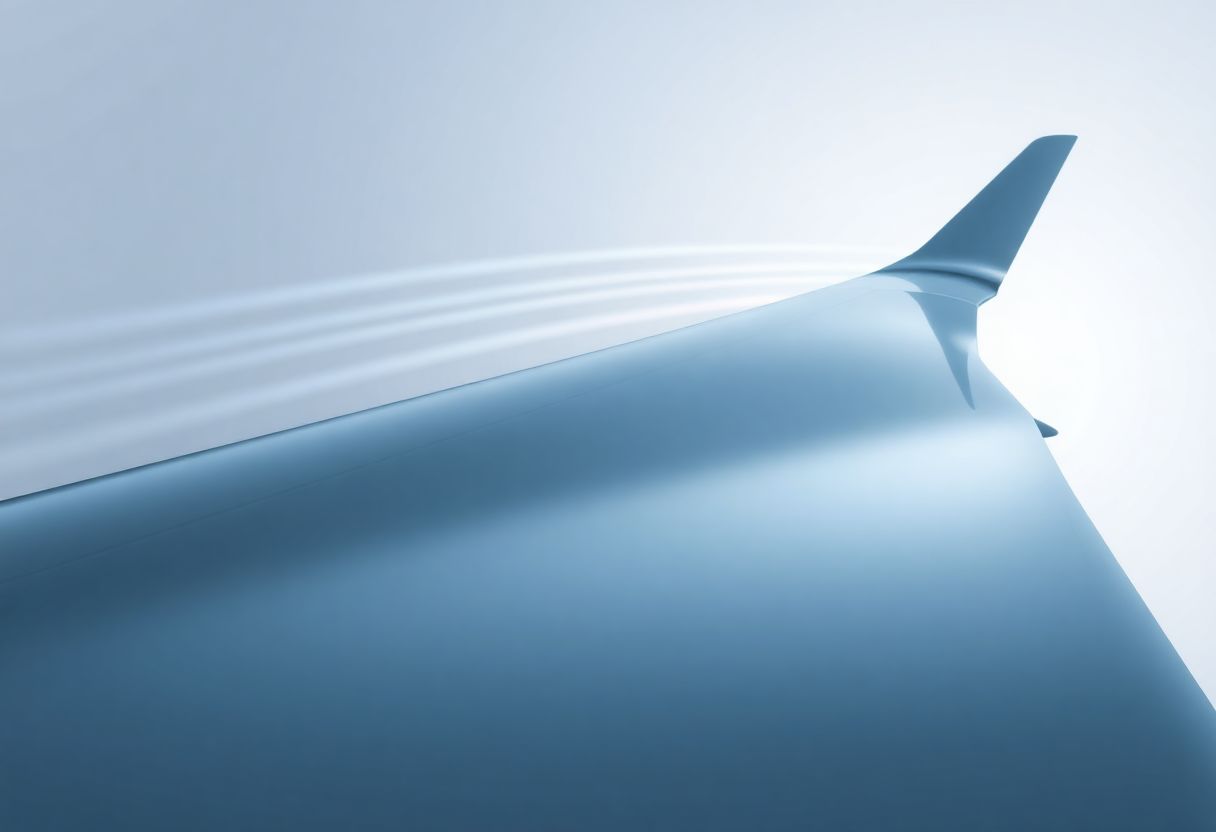
One of the most critical concepts in aerodynamics is the boundary layer. This is a thin layer of air that clings to the surface of an object moving through the air due to friction. The behavior of this layer can dramatically affect an object's aerodynamic performance.
The boundary layer can be either laminar or turbulent, and it can separate from the surface under certain conditions. This separation can lead to increased drag and reduced lift – phenomena that aerodynamicists work tirelessly to control and optimize.
Bernoulli's Principle and the Magic of Lift
No discussion of aerodynamics would be complete without exploring Bernoulli's principle, a fundamental concept that helps explain how aircraft generate lift. Named after Swiss mathematician Daniel Bernoulli, this principle states that as the speed of a fluid increases, its pressure decreases.
In the context of an airplane wing, here's how it works:
- The wing's shape (called an airfoil) is designed so that air traveling over the top surface has to move faster than air moving under the wing.
- According to Bernoulli's principle, this faster-moving air creates an area of lower pressure above the wing.
- The higher pressure below the wing pushes upward, generating lift.
While this explanation is a useful starting point, it's important to note that it's a simplified model. The true mechanism of lift is more complex, involving the wing's angle of attack (the angle between the wing and the oncoming air) and the downward deflection of air. Modern computational fluid dynamics (CFD) simulations have revealed the intricate vortex systems and pressure distributions that contribute to lift generation.
Breaking the Sound Barrier: Supersonic Aerodynamics
As objects approach the speed of sound (approximately 343 meters per second or 767 miles per hour at sea level), they enter a realm where the rules of aerodynamics change dramatically. This is the domain of supersonic aerodynamics, where new challenges and phenomena emerge.
Shock Waves and Sonic Booms
When an object moves faster than the speed of sound, it creates a shock wave – a thin region where air pressure, temperature, and density change abruptly. This shock wave is responsible for the iconic "sonic boom" associated with supersonic flight.
The formation of shock waves leads to a significant increase in drag, a phenomenon known as wave drag. This sudden increase in drag as an object approaches the speed of sound is often referred to as the "sound barrier," a term that captured the public imagination in the mid-20th century.
Designing for Supersonic Flight
Overcoming the challenges of supersonic flight required innovative design solutions:
-
Swept wings: By angling wings backward, designers could delay the onset of shock wave formation, allowing aircraft to achieve higher speeds before encountering the dramatic increase in drag.
-
Area rule: This principle, discovered by Richard Whitcomb in the 1950s, involves carefully shaping the aircraft's fuselage to minimize changes in cross-sectional area along its length. This reduces wave drag and is often visible as the "Coke bottle" shape of some supersonic aircraft.
-
Engine intakes: Supersonic engines require special intake designs to slow the incoming air to subsonic speeds before it enters the engine, a process that involves complex shock wave management.
These advancements culminated in aircraft like the iconic Concorde, capable of sustained supersonic passenger flight, and modern military aircraft that can supercruise (maintain supersonic flight without afterburners).
Applications of Aerodynamics: Beyond Aviation
While aviation is perhaps the most obvious application of aerodynamics, its principles touch nearly every aspect of our lives. Let's explore some of the diverse fields where aerodynamics plays a crucial role:
Automotive Engineering
In the automotive world, aerodynamics is key to improving fuel efficiency, enhancing high-speed stability, and in the case of racing, achieving competitive advantage. Modern cars are shaped in wind tunnels to minimize drag and reduce lift at high speeds, which improves both efficiency and safety.
Interesting fact: Some high-performance cars now incorporate active aerodynamic elements, such as adjustable spoilers or underbody flaps, that change position based on speed and driving conditions to optimize performance.
Sports and Athletics
Aerodynamics has a significant impact on many sports:
- In cycling, riders adopt aerodynamic tucked positions and use specially designed helmets and clothing to reduce drag.
- Ski jumpers manipulate their body position in flight to maximize distance.
- Even the design of soccer balls has been influenced by aerodynamics, with the infamous Jabulani ball used in the 2010 World Cup criticized for its unpredictable flight characteristics due to its unique surface texture.
Architecture and Civil Engineering
Tall buildings and long-span bridges must be designed with wind loads in mind. Wind tunnel testing and computational fluid dynamics simulations are used to predict how structures will behave in high winds and to design features that mitigate potentially dangerous oscillations.
The Burj Khalifa in Dubai, currently the world's tallest building, incorporates a unique spiraling shape that helps break up wind vortices, reducing wind forces on the structure.
Renewable Energy
Wind turbines rely heavily on aerodynamic principles to maximize energy extraction from the wind. The shape of turbine blades is carefully designed to optimize lift and minimize drag across a range of wind speeds.
Recent innovations in wind turbine design include blade tip modifications inspired by owl feathers, which reduce noise while maintaining efficiency.
The Cutting Edge: Current Research and Future Directions
Aerodynamics continues to be an active area of research, with new discoveries and innovations constantly pushing the boundaries of what's possible. Here are some exciting areas of current and future research:
Biomimicry and Nature-Inspired Design
Scientists and engineers are increasingly looking to nature for inspiration in aerodynamic design. For example:
- The boxfish, with its seemingly un-aerodynamic cube-like shape, has inspired more efficient car designs.
- The tubercles (bumps) on humpback whale flippers have led to more efficient wind turbine and fan blade designs.
- The silent flight of owls is being studied to develop quieter aircraft and wind turbines.
Hypersonic Flight
As we look beyond supersonic speeds to hypersonic flight (typically defined as speeds above Mach 5), new challenges emerge. At these extreme speeds, the air around the vehicle becomes so hot that it chemically dissociates, creating a plasma layer that can interfere with communications and control systems.
Research in this area is ongoing, with potential applications ranging from faster intercontinental travel to more efficient space launch systems.
Active Flow Control
Rather than relying solely on passive shapes to control airflow, researchers are developing active flow control systems. These might use tiny jets of air, vibrating surfaces, or plasma actuators to manipulate the boundary layer and reduce drag or enhance lift.
Morphing Structures
Imagine an aircraft wing that could change its shape in flight to optimize performance for different conditions. This is the promise of morphing structures, which could revolutionize aircraft design by allowing a single vehicle to perform efficiently across a wide range of flight regimes.
Conclusion: The Endless Horizons of Aerodynamics
As we've seen, aerodynamics is a field of endless fascination and practical importance. From the graceful flight of birds to the cutting-edge designs of supersonic aircraft, the principles of aerodynamics shape our world in countless ways.
As we look to the future, aerodynamics will play a crucial role in addressing some of humanity's greatest challenges. More efficient aircraft and wind turbines will help combat climate change. Advanced aerodynamic designs will enable exploration of other planets with different atmospheric conditions. And innovations in fields like hypersonic flight may revolutionize global transportation.
For students, engineers, and curious minds alike, aerodynamics offers a rich field of study that combines physics, mathematics, and creative problem-solving. Whether you're watching leaves dance in the wind or marveling at the latest aerospace innovation, remember that you're witnessing the principles of aerodynamics in action – the invisible force that helps shape our technological future.