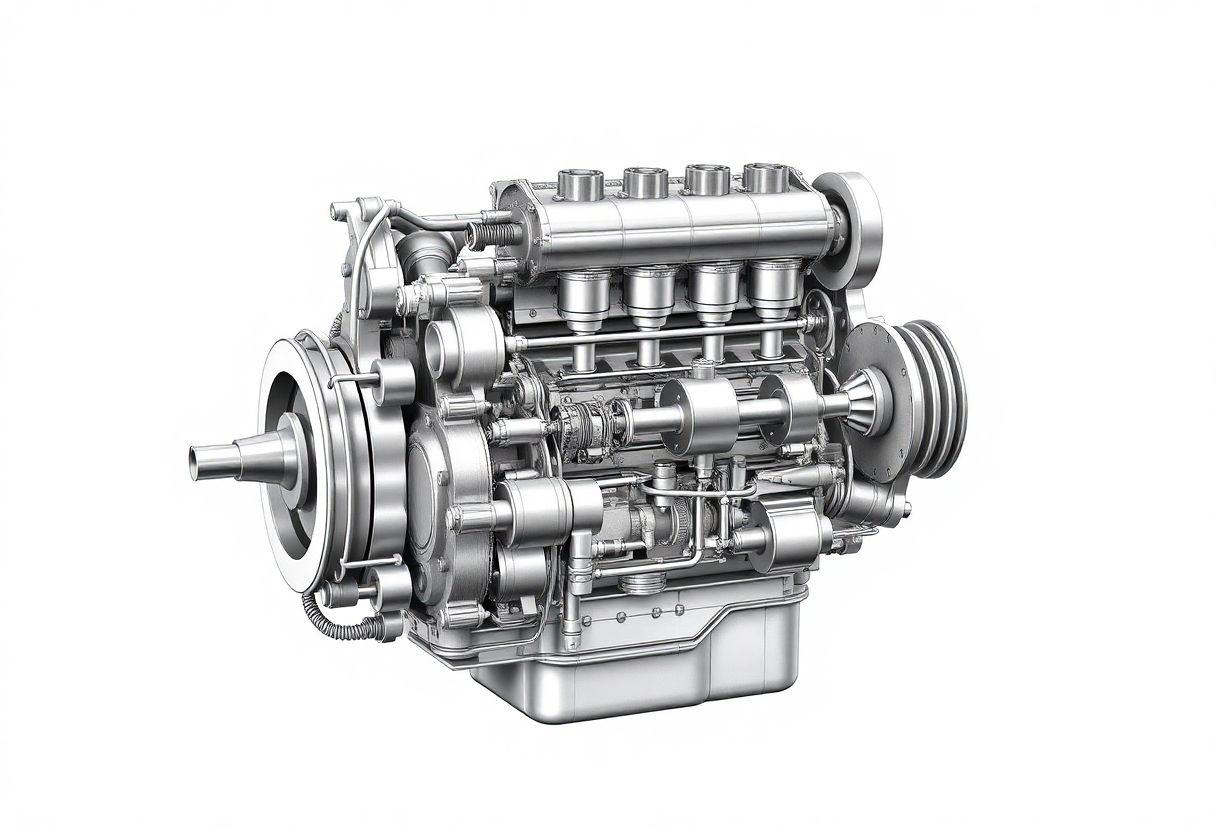
The Fascinating World of Diesel Engines: How They Work and Why They Matter
Diesel engines have been powering the world's most demanding machines for over a century, from massive cargo ships traversing oceans to powerful locomotives hauling freight across continents. While they may seem similar to gasoline engines at first glance, diesel engines operate on fundamentally different principles that allow them to generate more power more efficiently. In this comprehensive guide, we'll explore the inner workings of diesel engines, their history, advantages, challenges, and future prospects.
The Basics: What Sets Diesel Engines Apart
At its core, a diesel engine is a type of internal combustion engine, much like its gasoline-powered counterpart. However, the way it achieves combustion is what makes it unique. While gasoline engines rely on spark plugs to ignite a compressed mixture of fuel and air, diesel engines use the heat of compression alone to ignite the fuel.
This process, known as compression ignition, is the key to understanding how diesel engines work. When air is compressed, its temperature rises dramatically. In a diesel engine, this principle is taken to the extreme. Air is compressed to such a degree that its temperature rises well above the ignition point of diesel fuel – typically around 540°C (1,000°F).
The Four-Stroke Cycle: The Heart of Diesel Power
Most modern diesel engines operate on a four-stroke cycle, similar to gasoline engines. However, the details of each stroke differ significantly:
-
Intake Stroke: The piston moves down, drawing in fresh air through the open intake valve. Unlike in a gasoline engine, no fuel is introduced at this stage.
-
Compression Stroke: With both valves closed, the piston moves upward, compressing the air to a fraction of its original volume – typically between 14:1 and 25:1. This extreme compression causes the air temperature to soar.
-
Power Stroke: Just before the piston reaches the top of its stroke, diesel fuel is injected into the cylinder under extremely high pressure. The heat of the compressed air causes the fuel to ignite spontaneously, creating a controlled explosion that forces the piston back down.
-
Exhaust Stroke: The exhaust valve opens, and the rising piston pushes out the spent gases, preparing the cylinder for the next cycle.
This process repeats hundreds or even thousands of times per minute, depending on the engine's speed and design.
The Role of Fuel Injection: Precision and Power
The fuel injection system is crucial to a diesel engine's operation. Unlike gasoline engines, which mix fuel and air before entering the cylinder, diesel engines inject fuel directly into the combustion chamber at precisely the right moment.
Modern diesel engines use sophisticated electronic control units (ECUs) to manage fuel injection with incredible precision. These systems can adjust injection timing and duration multiple times during a single combustion event, optimizing power output and efficiency while minimizing emissions.
The injectors themselves are engineering marvels, capable of withstanding enormous pressures – up to 2,500 bar (36,000 psi) in some systems – and delivering fuel in microscopic droplets for better atomization and more complete combustion.
Turbocharging: Boosting Diesel Performance
Many diesel engines, especially in automotive and heavy-duty applications, use turbochargers to increase power output and efficiency. A turbocharger uses the engine's exhaust gases to spin a turbine, which in turn drives a compressor that forces more air into the engine.
This additional air allows more fuel to be burned, increasing power output without significantly increasing engine size. Turbocharging is particularly effective in diesel engines due to their already high compression ratios and the ability to precisely control fuel injection.
The Efficiency Advantage: Why Diesel Engines Excel
Diesel engines are renowned for their efficiency, typically converting 40-45% of fuel energy into mechanical power, compared to 25-30% for gasoline engines. This superior efficiency stems from several factors:
-
Higher Compression Ratios: The extreme compression in diesel engines allows for more complete fuel combustion and higher thermal efficiency.
-
No Throttle Losses: Diesel engines don't use a throttle to control air intake, reducing pumping losses that sap efficiency in gasoline engines.
-
Lean Burn Operation: Diesel engines can operate with excess air, allowing for more complete fuel combustion.
-
Higher Energy Density Fuel: Diesel fuel contains about 15% more energy per gallon than gasoline.
-
Better Lubrication: Diesel fuel acts as a lubricant, reducing internal engine friction.
These factors combine to make diesel engines the powerplant of choice for applications where efficiency and durability are paramount.
Emissions Challenges and Solutions
While diesel engines offer significant advantages in terms of efficiency and power, they have faced challenges related to emissions, particularly particulate matter (PM) and nitrogen oxides (NOx). However, modern diesel engines employ a range of technologies to address these issues:
-
Diesel Particulate Filters (DPF): These devices trap soot particles from the exhaust, periodically burning them off in a process called regeneration.
-
Selective Catalytic Reduction (SCR): This system injects a urea-based solution into the exhaust stream to convert NOx into harmless nitrogen and water.
-
Exhaust Gas Recirculation (EGR): By recirculating a portion of the exhaust gases back into the engine, combustion temperatures are reduced, lowering NOx formation.
-
Advanced Fuel Injection: Precise, high-pressure injection systems allow for better fuel atomization and more complete combustion, reducing emissions at the source.
These technologies have dramatically reduced diesel emissions, with many modern diesel engines meeting or exceeding the stringent Euro 6 and Tier 4 Final emissions standards.
The Future of Diesel: Adaptation and Innovation
Despite challenges from electric and hybrid technologies, diesel engines continue to evolve and find new applications. Some exciting developments include:
-
Homogeneous Charge Compression Ignition (HCCI): This experimental technology combines aspects of both gasoline and diesel engines, potentially offering diesel-like efficiency with lower emissions.
-
Renewable Diesel: Advanced biofuels that are chemically identical to petroleum diesel but produced from renewable sources offer a path to lower carbon emissions without engine modifications.
-
Hybridization: Combining diesel engines with electric motors can offer the best of both worlds – the long-range capability and efficiency of diesel with the low-speed torque and zero-emissions operation of electric power.
-
Digital Optimization: Advanced sensors and machine learning algorithms are being used to continuously optimize engine performance and efficiency in real-time.
While the role of diesel engines in passenger vehicles may diminish in some markets due to regulatory pressures and the rise of electrification, their unmatched combination of efficiency, durability, and power ensures their continued importance in heavy-duty transportation, construction, and power generation applications for the foreseeable future.
Conclusion: The Enduring Legacy of Diesel Power
From their invention by Rudolf Diesel in the late 19th century to their current status as the backbone of global logistics and heavy industry, diesel engines have proven their worth time and again. Their unique operating principle – using the heat of compression to ignite fuel – has allowed them to achieve levels of efficiency and durability that other engine types struggle to match.
As we face the challenges of the 21st century, including climate change and the need for sustainable energy sources, diesel engines continue to adapt and improve. Whether powering a container ship across the Pacific, generating electricity in a remote village, or propelling a combine harvester through fields of grain, diesel engines remain an indispensable technology, driving progress and powering our world.
The story of the diesel engine is far from over. As engineers and scientists continue to push the boundaries of what's possible, we can expect to see even cleaner, more efficient, and more powerful diesel engines in the future. The distinctive rumble of a diesel engine, a sound that has become synonymous with power and reliability, will likely continue to be heard around the world for many years to come.