The Intricate World of Broadband: How High-Speed Internet Connects Us All
In today's digital age, broadband Internet has become as essential as electricity or running water. It powers our work, entertainment, education, and increasingly, our homes and cities. But how exactly does this technology work to deliver lightning-fast data to our devices? Let's embark on a journey through the intricate world of broadband technology.
The Evolution of Internet Connectivity
To appreciate the marvel of broadband, we must first understand its predecessor: dial-up Internet. In the early days of the Internet, users would connect through standard telephone lines, literally "dialing in" to establish a connection. This method was slow, with speeds maxing out at 56 Kbps, and it tied up the phone line, making it impossible to use the telephone and Internet simultaneously.
Broadband changed all that. By utilizing a wider range of frequencies on the same phone line, broadband offers an always-on connection that's significantly faster and doesn't interfere with voice calls. This leap forward paved the way for the Internet-centric world we live in today.
The Technology Behind Fixed-Line Broadband
Digital Subscriber Line (DSL)
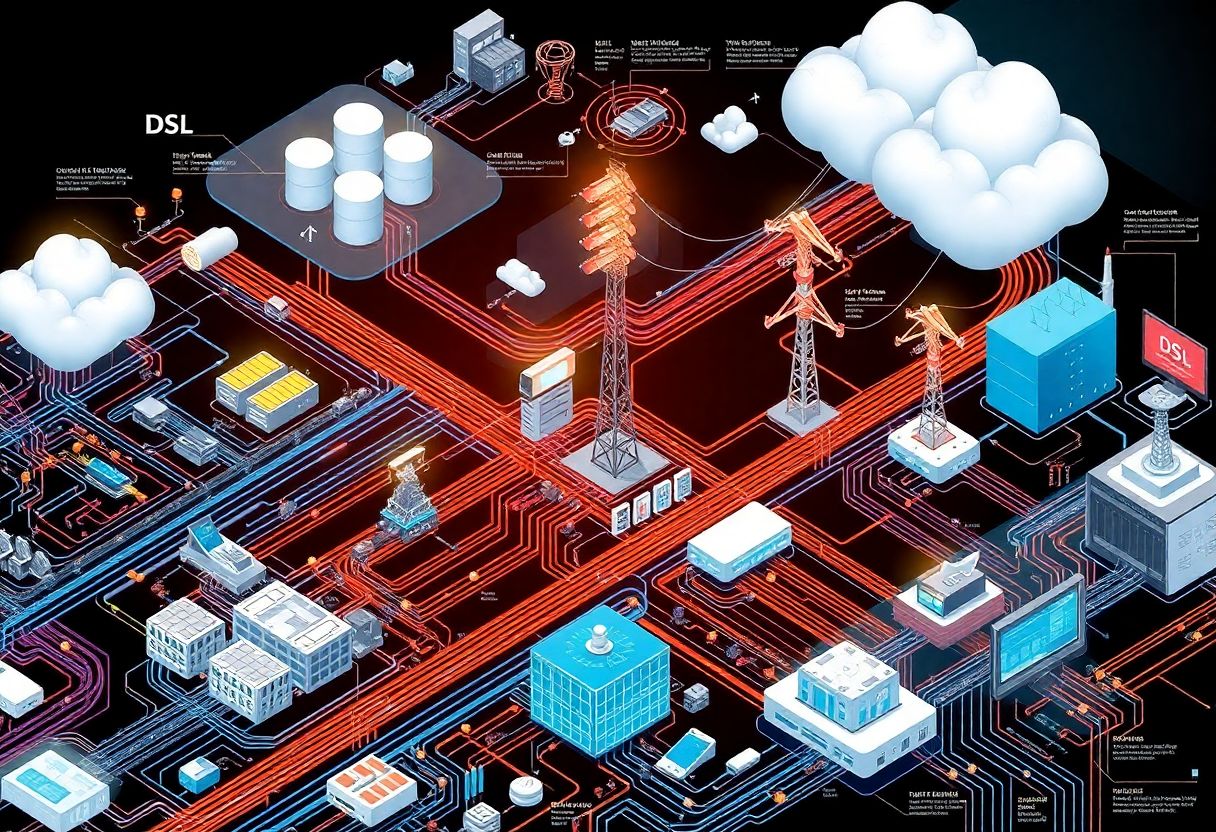
DSL technology revolutionized Internet access by cleverly dividing the phone line into three distinct channels. The lowest frequencies are reserved for voice calls, while medium and high frequencies are used for upstream and downstream data respectively. This frequency division is managed by a device called a Digital Subscriber Line Access Multiplexer (DSLAM) located at your local telephone exchange.
At home, your DSL modem acts as a translator, converting digital signals from your devices into analog signals that can travel over phone lines, and vice versa. This process happens continuously, maintaining a constant Internet connection.
There are several variants of DSL technology, each with its own characteristics. Asymmetric DSL (ADSL) offers faster download speeds than upload speeds, making it ideal for most home users who consume more content than they produce. Symmetric DSL (SDSL) provides equal upload and download speeds, catering to businesses that need to send large amounts of data. Very High Bit-Rate DSL (VDSL) pushes the technology even further, offering blazing fast speeds over shorter distances.
Cable Broadband
Cable broadband leverages the coaxial cables originally installed for cable television to deliver high-speed Internet. Unlike DSL, which provides a dedicated connection to each user, cable bandwidth is shared among users in a neighborhood. This shared nature can lead to slower speeds during peak usage times, but overall, cable broadband often provides faster speeds than DSL.
The technology that makes this possible is called Data Over Cable Service Interface Specification (DOCSIS). This standard defines how data is transmitted over cable TV networks, allowing for high-speed Internet access alongside traditional cable television services.
Many modern cable networks employ a hybrid fiber-coaxial (HFC) architecture. In this setup, fiber-optic cables are used for the main network backbone, switching to coaxial cables for the "last mile" connection to homes. This hybrid approach balances the high capacity of fiber with the cost-effectiveness of existing coaxial infrastructure.
Fiber-Optic Broadband
Fiber-optic broadband represents the cutting edge of fixed-line Internet technology. Instead of electrical signals traveling through copper wires, fiber-optic networks transmit data as pulses of light through thin strands of glass or plastic. This method allows for incredibly fast speeds and low latency, making fiber the gold standard for broadband connectivity.
There are different types of fiber deployments, each with its own balance of performance and cost. Fiber to the Cabinet (FTTC) brings fiber-optic cables to a street cabinet, with the final leg to homes using existing copper wires. Fiber to the Premises (FTTP), also known as Fiber to the Home (FTTH), extends fiber all the way to the end user's location, providing the best possible performance.
In your home, an Optical Network Terminal (ONT) serves as the bridge between the fiber-optic network and your home network, converting optical signals into electrical signals that your devices can use.
Mobile Broadband: Internet Untethered
While fixed-line broadband connects our homes and offices, mobile broadband keeps us connected on the go. This technology has evolved rapidly over the past few decades, progressing through several generations of cellular network technology.
The journey began with 1G, which provided analog voice calls only. 2G introduced digital voice calls and basic data services like SMS and MMS. 3G marked the birth of true mobile broadband, enabling web browsing and video calls on mobile devices. 4G LTE (Long-Term Evolution) brought speeds comparable to fixed-line broadband, supporting bandwidth-intensive applications like HD video streaming and online gaming.
Now, we stand at the dawn of the 5G era. This latest generation of mobile technology promises to revolutionize not just how we use our smartphones, but how entire industries operate. With theoretical peak speeds of up to 20 Gbps, ultra-low latency of less than 1 millisecond, and the ability to support up to 1 million devices per square kilometer, 5G is set to enable everything from autonomous vehicles to smart cities.
The magic of mobile broadband happens through a complex interplay of technologies. The mobile network is divided into cells, each served by a base station. These cells use specific radio frequency bands assigned by regulatory authorities to transmit data. Advanced modulation techniques encode this data onto radio waves, while multiple access technologies like CDMA, TDMA, and OFDMA allow multiple users to share the same frequency band efficiently.
As you move between cells, your connection is seamlessly handed off from one base station to another, maintaining your connection even as you travel. This handoff process is one of the most impressive aspects of mobile broadband technology, allowing for truly mobile Internet access.
The Last Mile and Beyond
The "last mile" refers to the final leg of the telecommunications network that reaches the end-user. This can be copper wire (as in DSL), coaxial cable (as in cable broadband), fiber-optic cable, or even wireless in the case of mobile broadband and fixed wireless solutions. The technology used in this last mile can significantly impact the speed and reliability of your Internet connection.
Once the broadband signal reaches your home, it's processed by your modem, which converts the signal from your ISP into a format your devices can use. A router then distributes this connection to multiple devices, creating your home network. Wi-Fi technology allows devices to connect to this network wirelessly, while Ethernet cables provide a direct, wired connection for devices near the router.
Factors Affecting Broadband Performance
Several factors can impact the speed and reliability of your broadband connection. For DSL users, distance from the telephone exchange is crucial – the farther you are, the slower your connection is likely to be. Network congestion can affect all types of broadband, but is particularly noticeable in cable and mobile networks where bandwidth is shared among users.
Hardware limitations can also play a role. Older modems, routers, or devices may not support the fastest speeds offered by your ISP. For DSL users, the quality of the copper phone lines can significantly affect speed and reliability. Wi-Fi interference from other electronic devices or physical obstacles can impact wireless connections within your home.
The Future of Broadband
As our appetite for data continues to grow, broadband technology is evolving to meet these needs. We can expect to see wider deployment of fiber-optic networks, bringing ultra-fast speeds to more areas. 5G technology may provide an alternative to wired broadband in some regions, potentially bridging the digital divide in rural areas.
Exciting developments are also happening in satellite Internet technology. Low Earth Orbit (LEO) satellite constellations, like SpaceX's Starlink, promise to bring high-speed broadband to even the most remote corners of the globe. These systems could revolutionize Internet access in rural and developing areas.
As speeds continue to increase, we'll see new applications emerge that take advantage of this enhanced connectivity. Virtual and augmented reality, 8K video streaming, and advanced IoT applications are just a few examples of technologies that will flourish in a world of ubiquitous high-speed broadband.
Conclusion
Broadband Internet has become the backbone of our digital society, enabling everything from remote work to streaming entertainment. By understanding the intricate technologies that power broadband – from the DSLAMs in telephone exchanges to the complex cellular networks that keep us connected on the go – we can better appreciate the marvel of modern connectivity.
As we look to the future, broadband will continue to evolve, pushing the boundaries of speed and reliability. Whether through advanced fiber-optic networks, 5G wireless technology, or innovative satellite systems, the goal remains the same: to connect people and devices with fast, reliable Internet access. In this increasingly connected world, broadband isn't just a luxury – it's the foundation upon which our digital future is built.