The Logic Behind Computing: Exploring the Fascinating World of Logic Gates
In the realm of digital electronics, logic gates stand as the fundamental building blocks that power our modern technological world. These tiny marvels of engineering form the basis of all computing devices, from the simplest calculator to the most advanced supercomputer. As we delve into the intricate world of logic gates, we'll uncover their inner workings, explore their diverse applications, and peek into the future of this crucial technology.
Understanding the Basics: What Are Logic Gates?
At their core, logic gates are electronic circuits designed to perform basic logical operations. They take one or more input signals and produce a single output signal based on specific logical rules. These gates are the foundation upon which complex digital systems are built, including microprocessors, memory units, and control systems that drive our technological society.
To truly grasp the concept of logic gates, we must first understand the language they speak: binary logic. In the digital realm, information is represented using only two states: ON (represented by 1) and OFF (represented by 0). These states can be thought of as "true" (1) and "false" (0) in logical terms. Logic gates manipulate these binary states to perform operations and make decisions, forming the basis of all digital computations.
The Cast of Characters: Types of Logic Gates
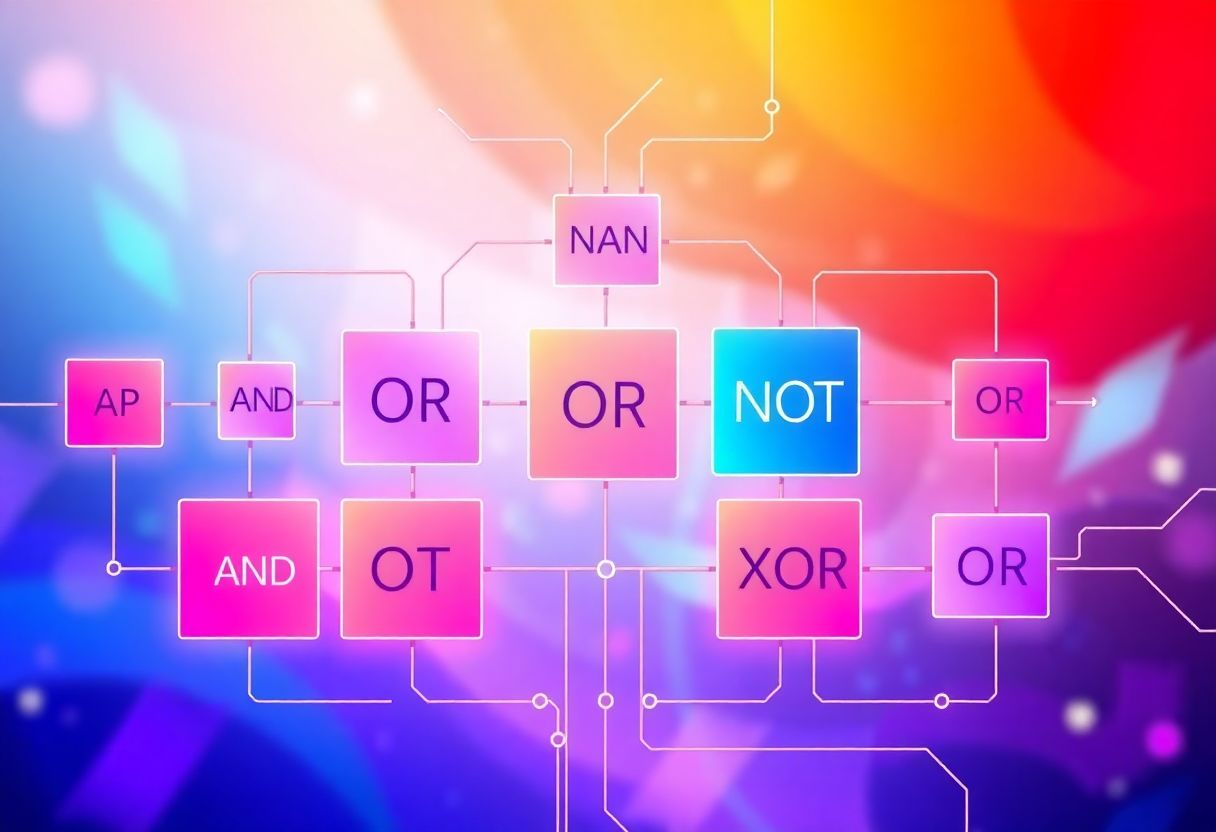
Let's meet the main players in the world of logic gates, each with its unique personality and function:
AND Gate: The Strict Doorman
The AND gate can be likened to a strict doorman at an exclusive club. It only allows entry (outputs a 1) if all inputs are 1. In electronic terms, it requires all conditions to be met before producing a positive output. This gate is symbolized by a shape resembling the letter 'D' and finds applications in systems where multiple conditions must be satisfied simultaneously.
OR Gate: The Lenient Bouncer
In contrast to the AND gate, the OR gate is like a lenient bouncer. It allows entry (outputs a 1) if at least one input is 1. Symbolized by a shield or bullet shape, the OR gate is useful in scenarios where any one of several conditions can trigger an action.
NOT Gate: The Digital Contrarian
The NOT gate, also known as an inverter, is the rebel of the logic gate family. It always does the opposite of its input, flipping 0 to 1 and vice versa. Represented by a triangle with a small circle at the output, the NOT gate is crucial for creating complementary signals and is often used in combination with other gates.
NAND and NOR Gates: The Logical Opposites
NAND (NOT AND) and NOR (NOT OR) gates are the opposites of AND and OR gates, respectively. The NAND gate outputs 0 only if all inputs are 1, while the NOR gate outputs 1 only if all inputs are 0. These gates are particularly important because they are considered universal gates, meaning any logical function can be implemented using only NAND gates or only NOR gates.
XOR Gate: The Exclusive Club
The XOR (Exclusive OR) gate is like an exclusive club that only allows entry when inputs are different. It outputs 1 if inputs are different and 0 if they are the same. This gate is crucial in arithmetic operations and error detection circuits.
The Inner Workings: How Logic Gates Function
To understand how logic gates work in practice, we need to peek under the hood of digital circuits. At their most basic level, logic gates are built from transistors – tiny electronic switches that can be turned on or off by applying voltage. By combining transistors in specific configurations, we create circuits that perform logical operations.
For instance, an AND gate requires all its transistors to be ON to allow current flow, mirroring its logical operation of requiring all inputs to be 1 for a positive output. An OR gate, on the other hand, allows current flow if any of its transistors are ON, reflecting its function of outputting 1 if any input is 1.
In modern integrated circuits, logic gates are implemented using technologies like TTL (Transistor-Transistor Logic) and CMOS (Complementary Metal-Oxide-Semiconductor). These technologies enable the creation of extremely small and efficient logic gates, paving the way for the development of complex digital systems that power our world.
Logic Gates in Action: Real-World Applications
The applications of logic gates are as diverse as they are numerous. Let's explore some everyday examples:
-
Digital Calculators: These devices use combinations of logic gates to perform arithmetic operations. For instance, adding two binary numbers involves a series of half adders and full adders, which are built from XOR and AND gates.
-
Computer Processors: Modern CPUs contain billions of logic gates, working in harmony to execute instructions and process data at incredible speeds. The Arithmetic Logic Unit (ALU), a core component of a CPU, uses various combinations of logic gates to perform both arithmetic and logical operations.
-
Digital Watches: Logic gates control timekeeping and display functions in digital watches. For example, counters built from flip-flops (which are themselves made from logic gates) keep track of seconds, minutes, and hours.
-
Traffic Light Controllers: These systems employ logic gates to manage traffic flow. The gates process inputs from sensors and timers to control the sequence and duration of traffic lights.
-
Home Automation Systems: Smart home devices utilize logic gates for decision-making. For instance, a smart thermostat might use logic gates to decide when to turn heating or cooling on based on temperature sensors and user preferences.
From Simple Gates to Complex Systems: Logic in Computer Architecture
The journey from simple logic gates to complex computing systems is a fascinating one. Let's explore how these basic components come together to form more complex structures:
Half Adder and Full Adder
A half adder, which adds two binary digits, is built using an XOR gate (to determine the sum) and an AND gate (to determine the carry). A full adder, which adds three binary digits (including a carry from a previous addition), is constructed from two half adders and an OR gate.
Arithmetic Logic Unit (ALU)
The ALU, the mathematical brain of a computer processor, is essentially a complex arrangement of logic gates. It uses various combinations of gates to perform operations like addition, subtraction, multiplication, and logical comparisons.
Memory Cells
Even computer memory relies on logic gates. Flip-flops and latches, the basic storage elements in digital circuits, are built using interconnected logic gates. These elements can store a single bit of information, forming the basis of computer memory.
The Art of Digital Design: Creating with Logic Gates
Designing digital circuits using logic gates is both an art and a science. Engineers typically follow these steps:
- Define the logical function required
- Create a truth table
- Simplify the logic using Boolean algebra
- Draw the circuit diagram
- Implement the circuit using physical components
Boolean algebra, developed by George Boole in the 19th century, provides the mathematical foundation for logic gates. It allows engineers to simplify complex logical expressions, optimize circuit designs, and analyze and verify digital systems. This mathematical tool is crucial in creating efficient and reliable digital circuits.
Advanced Concepts: Pushing the Boundaries of Logic Gates
As we delve deeper into the world of logic gates, several advanced concepts emerge:
Universal Gates
NAND and NOR gates hold a special status as universal gates. Any logical function can be implemented using only NAND gates or only NOR gates. This property makes them particularly valuable in circuit design, as it allows for the creation of any digital system using a single type of gate.
Propagation Delay
In the real world, logic gates don't switch instantaneously. The time taken for the output to change after the input changes is called propagation delay. This delay, while measured in nanoseconds, becomes crucial when designing high-speed digital systems.
Fan-in and Fan-out
Fan-in refers to the number of inputs a gate can handle, while fan-out is the number of gate inputs that can be driven by the output of another gate. These parameters are important considerations in circuit design, affecting the complexity and performance of digital systems.
Power Consumption
Logic gates consume power, especially when switching states. In modern circuit design, minimizing power consumption is a key consideration, particularly for mobile and battery-powered devices.
The Quantum Leap: The Future of Logic Gates
As technology advances, new forms of logic gates are being developed, pushing the boundaries of what's possible in computing:
Quantum Logic Gates
Quantum logic gates operate on quantum bits (qubits) and are fundamental to quantum computing. Unlike classical bits, qubits can exist in multiple states simultaneously, thanks to the principle of superposition. This property allows quantum computers to perform certain calculations exponentially faster than classical computers.
Optical Logic Gates
Optical logic gates use light instead of electricity to perform logical operations. These gates have the potential to enable faster and more efficient computing, as light can travel at higher speeds and with less energy loss compared to electrical signals.
Biological Logic Gates
An exciting frontier in logic gate technology is the development of biological logic gates. These gates implement logical operations using biological molecules, opening up possibilities in fields like medical diagnostics and bio-computing.
Conclusion: The Enduring Legacy of Logic Gates
From the simplest electronic devices to the most advanced quantum computers, logic gates remain at the heart of digital technology. These fundamental building blocks enable the complex computations that drive our modern world, translating the abstract concepts of Boolean logic into the tangible reality of computing devices.
As we continue to push the boundaries of technology, logic gates will evolve and adapt. However, their core principle of making binary decisions will remain central to digital logic. Whether implemented in silicon, light, or even biological systems, the legacy of Boolean logic and the simple yet powerful concept of logic gates will continue to shape our technological future.
Understanding logic gates not only provides insight into how our digital devices work but also opens the door to creating new and innovative electronic systems. As we stand on the brink of new computing paradigms, from quantum to biological, the humble logic gate reminds us that even the most complex systems are built from simple, elegant principles. The future of computing is bright, and logic gates will undoubtedly play a crucial role in shaping that future, continuing to be the silent workhorses of our digital age.