The Spin Cycle Revolution: Exploring the Science and Impact of Centrifuge Washing Machines
Introduction: The Whirling Wonder in Your Laundry Room
In the heart of every modern home, a marvel of engineering quietly goes about its work, transforming our laundry routines with the power of physics. The centrifuge washing machine, with its spinning drum and water-extracting prowess, has become an indispensable appliance in households worldwide. But this device is far more than just a convenience; it's a testament to human ingenuity and our ability to harness fundamental forces of nature for everyday tasks.
As we delve into the world of centrifuge washing machines, we'll uncover the fascinating science that powers them, trace their evolution from simple hand-cranked devices to high-tech marvels, and explore their far-reaching impact on everything from energy conservation to space exploration. Whether you're a curious homeowner, a budding engineer, or simply someone who appreciates the hidden complexity in everyday objects, this exploration of centrifuge technology promises to spin your understanding in exciting new directions.
The Science Behind the Spin: Understanding Centripetal Force
To truly appreciate the genius of centrifuge washing machines, we must first grasp the fundamental principle that makes them work: centripetal force. Often confused with its counterpart, centrifugal force, centripetal force is the real star of the show in our spinning laundry drums.
Imagine you're at a carnival, riding a spinning teacup ride. As the ride accelerates, you feel pushed against the outer wall of the cup. This sensation, often mistakenly attributed to centrifugal force, is actually the result of your body's inertia being constantly redirected by centripetal force. In the case of the teacup ride, the walls of the cup provide this force, keeping you moving in a circular path.
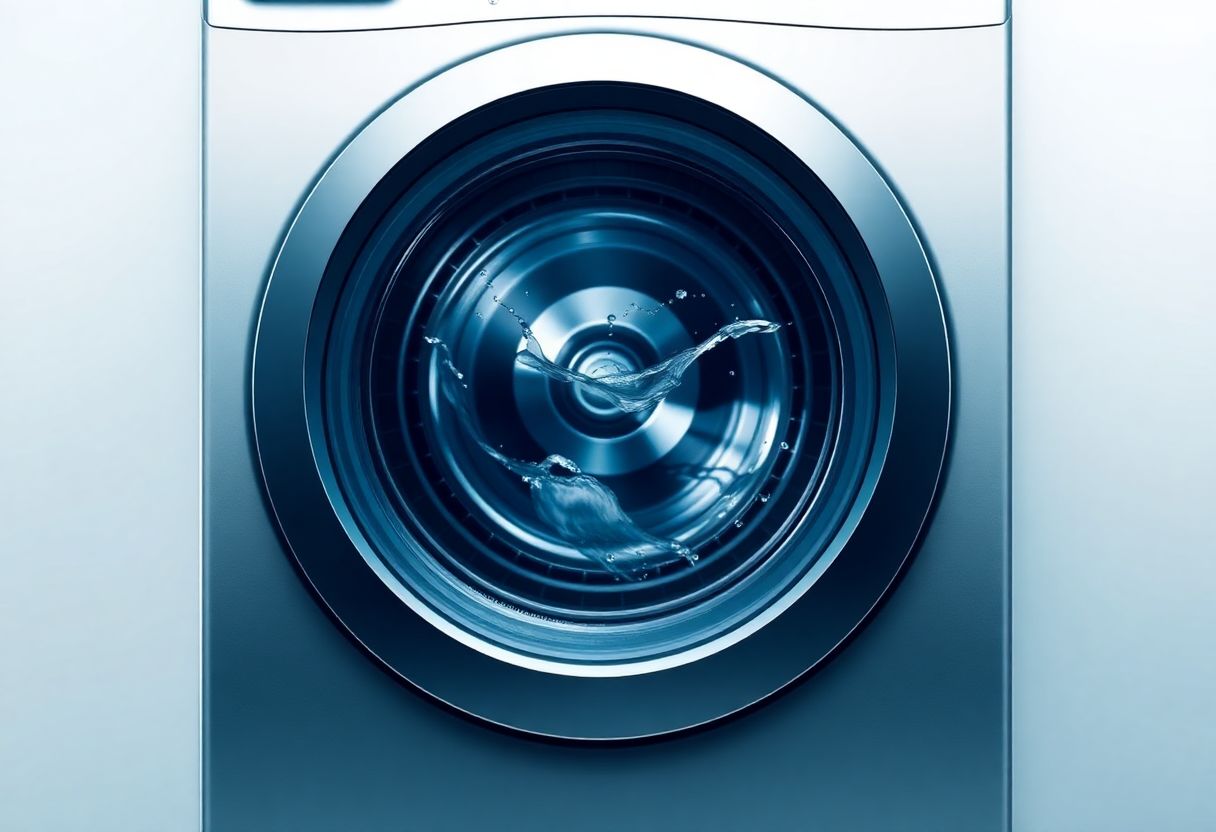
In a washing machine, the drum plays the role of the teacup, with your clothes as the riders. As the drum spins, it exerts a constant centripetal force on the clothes, pressing them against the drum's perforated walls. Water, being less massive than the clothes, requires less force to keep it in circular motion. As a result, it passes through the perforations, separating from the fabric.
The mathematics behind this process is elegantly simple yet powerful. The centripetal force (F) required to keep an object moving in a circular path is given by the equation:
F = (mv²) / r
Where:
- m is the mass of the object
- v is the velocity of the object
- r is the radius of the circular path
This equation reveals three critical factors that influence the effectiveness of a centrifuge:
- Mass matters: Heavier objects require more force to keep them moving in a circle.
- Speed is king: Velocity has a squared relationship with force, meaning a small increase in speed results in a significant increase in force.
- Radius plays a role: A smaller radius creates more force for the same speed.
Understanding these principles allows engineers to design washing machines that maximize water extraction while minimizing wear and tear on fabrics.
The Evolution of Spin: From Hand-Cranked Wringers to High-Tech Tumblers
The journey of the centrifuge washing machine from novelty to necessity is a fascinating tale of incremental innovation. While the use of centrifugal force to remove water from clothes may seem like a modern convenience, its roots stretch back to the 19th century.
In 1851, James King patented the first washing machine to use a drum, although it was still hand-powered. This marked the beginning of a revolution in laundry technology. The next major leap came in 1908 when Alva J. Fisher invented the Thor, the first electric washing machine. While this was a significant advancement, it still lacked a built-in water extraction system.
The 1922 introduction of the Savage Spin Dryer marked a crucial step towards modern centrifuge technology. This separate appliance was designed specifically to use centrifugal force for water removal, paving the way for integrated systems.
The 1950s saw the widespread adoption of automatic washing machines with built-in spin cycles. These machines combined washing, rinsing, and water extraction in a single appliance, revolutionizing home laundry care. Since then, advancements have focused on increasing spin speeds, improving energy efficiency, and incorporating smart technologies.
Today's high-end washing machines can achieve spin speeds of up to 1600 rotations per minute (RPM), with some experimental models pushing even higher. These machines often incorporate advanced balance systems and AI-driven algorithms to optimize spin cycles based on load size, fabric type, and even individual garment care instructions.
The Anatomy of a Modern Centrifuge Washing Machine
To appreciate the complexity of modern centrifuge washing machines, let's break down their key components and how they work together to clean and dry our clothes:
-
The Drum: The heart of the centrifuge system, the drum is typically made of stainless steel with numerous small perforations. These holes allow water to pass through during the spin cycle while retaining clothes.
-
The Motor: Modern washing machines use variable-speed motors that can adjust RPMs based on the selected cycle. These motors must be powerful enough to accelerate a full load of wet clothes to high speeds quickly.
-
Suspension System: To prevent excessive vibration during high-speed spins, washing machines employ sophisticated suspension systems. These often include shock absorbers and balance rings to distribute the load evenly.
-
Balance Sensors: Advanced models use sensors to detect imbalances in the load. If an imbalance is detected, the machine can redistribute the clothes or adjust spin speed to prevent damage.
-
Control Board: The brain of the machine, the control board manages all functions, including spin speed, duration, and any smart features.
-
Drain Pump: This component expels water extracted during the spin cycle, ensuring it doesn't reabsorb into the clothes.
When you start a wash cycle, these components work in harmony to clean and dry your clothes efficiently. After the wash and rinse cycles, the spin cycle begins:
- The drum starts rotating slowly, gradually building up speed.
- As speed increases, clothes are pressed against the drum walls by centripetal force.
- Water passes through the drum perforations and is pumped out of the machine.
- The spin speed may vary throughout the cycle, with some machines using intermittent pauses to redistribute the load.
- At the end of the cycle, the drum slows down gradually to prevent tangling of clothes.
This process can remove up to 70% of the water from your laundry, significantly reducing drying time and energy consumption.
Beyond the Laundry Room: Diverse Applications of Centrifuge Technology
While our focus has been on washing machines, the principles of centrifuge technology have found applications far beyond the laundry room. These diverse uses showcase the versatility and power of this simple yet effective concept:
Medical Centrifuges: In hospitals and laboratories, centrifuges play a crucial role in separating blood components for analysis or transfusion. These machines can spin at speeds up to 15,000 RPM, allowing for the separation of plasma, red blood cells, and other components based on their density.
Industrial Centrifuges: Large-scale centrifuges are employed in various industries. In food processing, they're used to separate cream from milk or clarify juices. Wastewater treatment plants use centrifuges to remove solids from water. The chemical industry relies on centrifuges for processes like oil dehydration and polymer drying.
Ultracentrifuges: These specialized devices can reach astonishing speeds of up to 1,000,000 RPM. Used in molecular biology, they can separate cellular components like ribosomes, mitochondria, and even individual proteins based on their sedimentation rates.
Space Training: NASA and other space agencies use human-rated centrifuges to simulate the high G-forces experienced during spacecraft launches and reentries. These massive machines can subject astronauts to forces up to 20 times that of Earth's gravity, helping them prepare for the physical stresses of space travel.
Uranium Enrichment: Perhaps one of the most controversial applications, centrifuges play a key role in the enrichment of uranium for nuclear power and weapons. Gas centrifuges spin at incredibly high speeds to separate uranium-235 from the more common uranium-238 based on their slight mass difference.
These applications demonstrate how the simple principle of centripetal force, so effectively used in our washing machines, can be scaled and adapted to solve complex problems across various fields of science and industry.
The Environmental Impact: Spinning Towards Sustainability
As we become increasingly aware of our environmental footprint, the efficiency of our household appliances takes on new importance. Centrifuge washing machines, with their ability to significantly reduce the water content of laundry, play a crucial role in promoting energy efficiency and water conservation.
Energy Savings: By extracting more water during the spin cycle, centrifuge washing machines reduce the energy needed for subsequent drying. Whether you use a tumble dryer or air-dry your clothes, starting with drier laundry means less time and energy spent on the drying process. According to the U.S. Department of Energy, using a high-speed spin cycle can reduce the energy used by your dryer by up to 20%.
Water Conservation: Efficient water extraction also means less water is needed for rinsing. Modern washing machines use sensors to detect the soil level in the rinse water and can adjust the number of rinses accordingly. This technology, combined with high-speed spins, can save thousands of gallons of water per year in an average household.
Detergent Efficiency: Better water extraction leads to more effective rinsing, potentially reducing the amount of detergent needed. This not only saves money but also reduces the environmental impact of chemical detergents entering wastewater systems.
Extending Clothing Lifespan: While high-speed spins can be tough on some delicate fabrics, overall, they can extend the lifespan of clothing by reducing reliance on tumble drying. Heat from dryers is a major factor in fabric wear and tear, so reducing drying time can help clothes last longer.
However, it's important to note that the production and disposal of washing machines also have environmental impacts. Manufacturers are increasingly focusing on using recyclable materials and improving the longevity of their machines to address these concerns.
Innovations on the Horizon: The Future of Centrifuge Washing Technology
As we look to the future, several exciting developments promise to make centrifuge washing machines even more efficient and effective:
AI-Powered Optimization: Machine learning algorithms are being developed to fine-tune spin cycles based on load composition, fabric types, and even individual garment care instructions. These systems could potentially learn from user preferences and laundry habits to provide truly personalized washing experiences.
Advanced Materials: Research into new drum materials and designs could allow for even higher spin speeds without increased wear on the machine or fabrics. Carbon fiber composites and advanced polymers are being explored for their strength-to-weight ratio and durability.
Energy Recovery Systems: Some manufacturers are exploring ways to capture and reuse the kinetic energy from the spin cycle. This recovered energy could potentially be used to heat water for the next wash or to power other household devices.
Integrated Drying Technology: While not strictly centrifuge-based, some machines are beginning to incorporate targeted heat application during high-speed spins. This combination of centrifugal force and controlled heat could dramatically reduce or even eliminate the need for separate dryers.
Waterless Washing: Perhaps the most revolutionary development on the horizon is the concept of waterless or near-waterless washing. While these technologies may not rely on traditional centrifuge systems, they represent the next frontier in laundry care, promising to dramatically reduce water usage and environmental impact.
Conclusion: The Spinning Heart of Modern Laundry
From its humble beginnings as a hand-cranked curiosity to its current status as a high-tech household essential, the centrifuge washing machine has truly revolutionized the way we care for our clothes. It stands as a testament to the power of applying fundamental principles of physics to solve everyday problems.
As we've explored, the centrifuge in your washing machine is far more than just a spin cycle – it's a finely tuned application of centripetal force, balancing the needs of water extraction, energy efficiency, and fabric care. Its impact extends far beyond clean clothes, influencing everything from water conservation efforts to space exploration.
The next time you hear your washing machine whirring into its spin cycle, take a moment to appreciate the elegant physics at work. That humble spin is not just drying your clothes – it's a microcosm of human ingenuity, a daily reminder of our ever-evolving relationship with the fundamental forces of nature.
As we look to the future, the principles that power our centrifuge washing machines will undoubtedly continue to spin off new innovations, not just in laundry care, but across numerous fields of science and industry. The story of the centrifuge washing machine is far from over – it's simply entering its next revolutionary cycle.