The Science and Engineering Behind Eddy Current Brakes: A Deep Dive into Electromagnetic Deceleration
Introduction: The Power of Invisible Forces
In the realm of physics and engineering, some of the most fascinating innovations arise from harnessing invisible forces. Eddy current brakes stand as a prime example of this principle, utilizing electromagnetic fields to bring objects to a halt without any physical contact. This article delves into the intricate world of eddy current brakes, exploring their underlying physics, diverse applications, and potential future developments.
As we hurtle towards an era of faster transportation and more advanced industrial processes, the need for efficient, wear-resistant braking systems becomes increasingly critical. Eddy current brakes offer a compelling solution, combining the elegance of electromagnetic theory with practical engineering to create a braking mechanism that defies our conventional understanding of deceleration.
The Fundamentals of Eddy Currents
To truly appreciate the genius of eddy current brakes, we must first understand the phenomenon of eddy currents themselves. These currents, named for their circular flow pattern resembling eddies in water, are induced in conductive materials when exposed to changing magnetic fields.
The foundation of eddy currents lies in Faraday's law of electromagnetic induction, which states that a changing magnetic field induces an electromotive force (EMF) in a conductor. This EMF, in turn, causes electric currents to flow within the conductor. When the conductor is a solid piece of metal rather than a wire, these induced currents form swirling patterns – hence the term "eddy currents."
Crucially, eddy currents always flow in a direction that opposes the change that created them, a principle known as Lenz's law. This opposition is key to understanding how eddy current brakes function. As these currents flow through the conductor, they encounter electrical resistance, which causes them to dissipate energy in the form of heat.
The Mechanics of Eddy Current Brakes
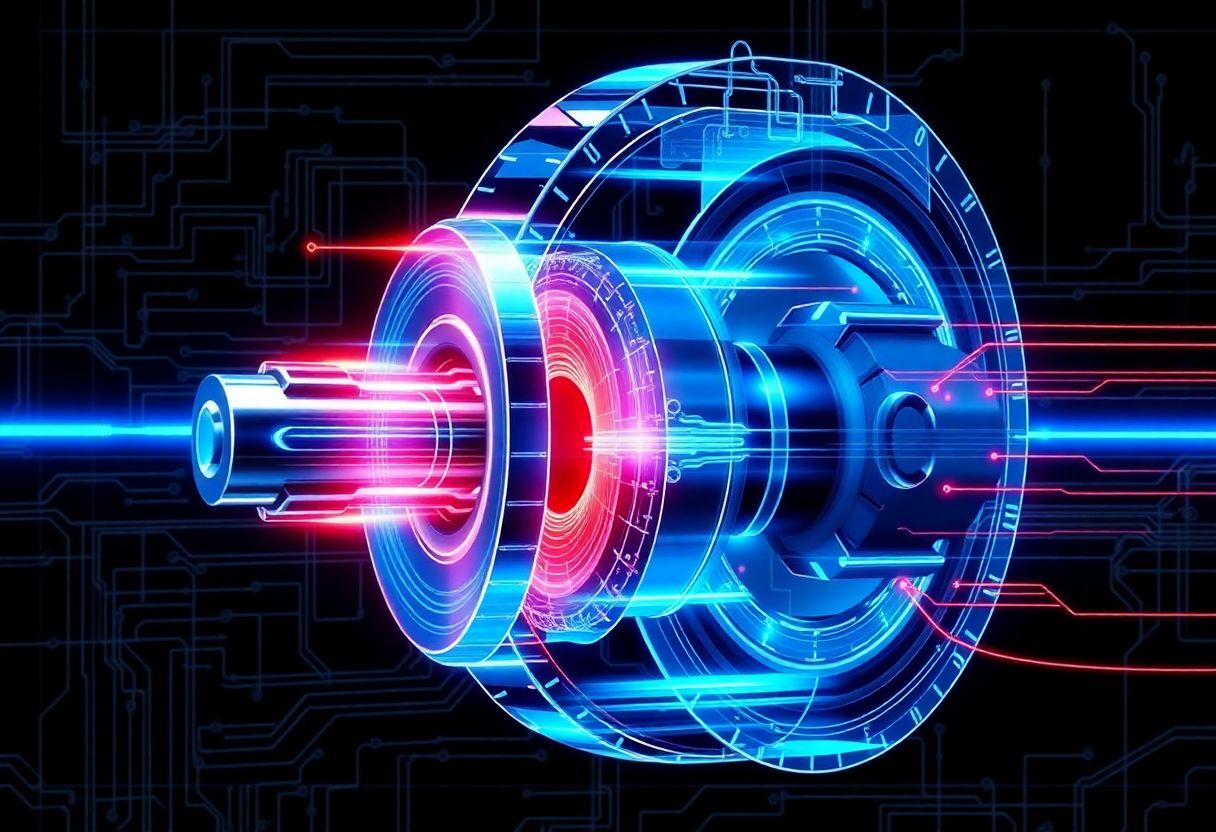
Eddy current brakes ingeniously apply these electromagnetic principles to create a braking force. The basic components of an eddy current brake system include:
- A strong magnetic field, typically generated by electromagnets or permanent magnets
- A conductive material, usually in the form of a metal disc or plate
- A mechanism for relative motion between the magnetic field and the conductor
When the conductive material moves through the magnetic field (or vice versa), eddy currents are induced within it. These currents, following Lenz's law, create their own magnetic field that opposes the motion of the conductor. This opposing force effectively acts as a brake, slowing down the system.
The braking force generated by eddy currents is proportional to the strength of the magnetic field, the conductivity of the material, and the relative velocity between the field and the conductor. This relationship allows for precise control of the braking force by adjusting the strength of the magnetic field, often achieved through varying the current in electromagnets.
Types of Eddy Current Brakes
Eddy current brakes come in two primary configurations, each suited to different applications:
Linear Eddy Current Brakes
Linear eddy current brakes are designed for applications involving linear motion, such as trains or roller coasters. In these systems, the magnets are typically fixed, while the conductive surface moves past them. The braking force is applied along the length of the track, allowing for smooth and controlled deceleration over a longer distance.
For instance, in high-speed train applications, linear eddy current brakes can be integrated into the tracks or mounted on the underside of the train. As the train passes over the magnetic field generated by these brakes, eddy currents are induced in the rails or a separate braking surface, creating a drag force that slows the train.
Circular Eddy Current Brakes
Circular eddy current brakes are used in rotating applications, such as motors, generators, or industrial machinery. These brakes can be configured in two ways:
- A static electromagnet with a rotating conductive disc
- Rotating electromagnets around a fixed conductive shaft
In both configurations, the relative motion between the magnetic field and the conductive material generates the braking force. The circular design allows for compact integration into rotating machinery, making these brakes ideal for applications where space is at a premium.
Real-World Applications of Eddy Current Brakes
The unique properties of eddy current brakes have led to their adoption in a diverse range of applications:
High-Speed Rail
Some of the world's most advanced high-speed trains, including Germany's Intercity Express (ICE) and Japan's Shinkansen, utilize eddy current brakes. These brakes provide rapid, wear-free deceleration at high speeds, complementing traditional friction brakes used at lower velocities. For example, the ICE 3 train can engage its eddy current brakes at speeds up to 300 km/h (186 mph), significantly reducing wear on its conventional braking system.
Roller Coasters and Amusement Rides
Modern roller coasters often employ linear eddy current brakes for smooth, controlled stops. These brakes allow for precise speed control throughout the ride and provide a consistent braking force regardless of weather conditions or the weight of the train. Cedar Point's Top Thrill Dragster, for instance, uses eddy current brakes to rapidly decelerate trains from speeds over 120 mph.
Wind Turbines
In the renewable energy sector, eddy current brakes play a crucial role in wind turbine technology. They help control rotor speed, especially in high wind conditions, preventing damage to the turbine and ensuring consistent power output. Some designs use eddy current brakes as part of their emergency stopping system, providing a fail-safe mechanism to halt the rotor in case of malfunction.
Industrial Machinery
Various industrial applications benefit from the wear-free operation of eddy current brakes. They are commonly used in equipment like circular saws, conveyor belts, and winding machines where rapid, precise speed control is essential. For example, in the paper industry, eddy current brakes help maintain tension in high-speed paper winding processes, ensuring consistent product quality.
Exercise Equipment
Many modern rowing machines and stationary bicycles use eddy current brakes to provide adjustable resistance. By varying the strength of the magnetic field, these machines can simulate different workout intensities without the need for mechanical adjustments. This results in smoother, quieter operation compared to traditional friction-based resistance systems.
Dynamometers
Eddy current dynamometers are widely used in the automotive and aerospace industries for testing engines and powertrains. These devices can accurately measure power output and torque across a wide range of speeds, providing essential data for engine development and quality control. Unlike hydraulic dynamometers, eddy current systems offer faster response times and more precise control, making them ideal for high-performance engine testing.
Advantages of Eddy Current Brakes
The unique characteristics of eddy current brakes offer several advantages over conventional friction-based braking systems:
-
Wear-free operation: With no physical contact between braking components, eddy current brakes experience virtually no wear. This dramatically reduces maintenance requirements and extends the lifespan of the braking system.
-
Smooth, consistent braking: Eddy current brakes provide a smooth deceleration force without the jerking or vibration often associated with friction brakes. This is particularly beneficial in applications like high-speed trains, where passenger comfort is paramount.
-
Silent operation: The absence of physical contact means eddy current brakes operate almost silently, contributing to reduced noise pollution in urban environments.
-
No brake dust: Unlike friction brakes, which produce fine particulate matter as brake pads wear down, eddy current brakes generate no brake dust. This eliminates a significant source of environmental pollution, particularly in heavily trafficked areas.
-
Heat management: In linear applications, the heat generated by eddy current braking is distributed over a large area, reducing the risk of localized overheating. This is particularly advantageous in high-speed, high-energy braking scenarios.
-
Precise control: The braking force can be finely tuned by adjusting the strength of the magnetic field, allowing for precise speed control in various applications.
Challenges and Limitations
Despite their numerous advantages, eddy current brakes do face some challenges and limitations:
-
Electromagnetic interference: The strong magnetic fields used in eddy current brakes can potentially interfere with nearby electronic systems. This is a particular concern in rail applications, where signaling and communication systems must function reliably.
-
Heat dissipation in circular designs: While linear eddy current brakes benefit from distributed heat generation, circular designs can face challenges in managing heat buildup. Effective cooling systems are often necessary to prevent overheating in high-use scenarios.
-
Reduced effectiveness at low speeds: The braking force generated by eddy currents is proportional to the relative velocity between the magnetic field and the conductor. As a result, eddy current brakes become less effective at lower speeds, often requiring supplementation with conventional friction brakes for complete stops.
-
Weight considerations: The magnets and conductive materials required for eddy current brakes can add significant weight to a vehicle or system. This is less of an issue in stationary applications but can impact efficiency in transportation systems.
-
Initial cost: The installation of eddy current brake systems often involves higher upfront costs compared to traditional friction brakes. However, this can be offset by reduced maintenance costs over the system's lifetime.
-
Energy loss: Unlike regenerative braking systems used in electric vehicles, eddy current brakes convert kinetic energy directly into heat, which is essentially lost energy. In applications where energy efficiency is paramount, this can be a significant drawback.
Future Developments and Potential Innovations
As technology continues to advance, several areas of development could enhance the capabilities and expand the applications of eddy current brakes:
Advanced Materials
Research into high-temperature superconductors and novel magnetic materials could lead to more efficient and powerful eddy current brake systems. For example, the use of high-temperature superconducting magnets could significantly increase the magnetic field strength while reducing the system's weight and size.
Integration with Regenerative Braking
In electric and hybrid vehicles, combining eddy current brakes with regenerative braking systems could offer the best of both worlds. Eddy current brakes could handle high-speed deceleration, while regenerative systems could capture energy at lower speeds, maximizing overall efficiency.
Adaptive Control Systems
The development of sophisticated control algorithms could allow eddy current brakes to adapt in real-time to changing conditions. This could include adjusting braking force based on factors like vehicle weight, weather conditions, and track geometry in rail applications.
Miniaturization
Advances in magnet technology and materials science could lead to more compact eddy current brake designs. This could open up new applications in smaller devices and machinery where space is at a premium.
High-Speed Transportation
As we push the boundaries of transportation speed with concepts like hyperloop systems, the need for reliable, wear-free braking will become even more critical. Eddy current brakes, with their ability to operate effectively at very high speeds, are likely to play a crucial role in these futuristic transportation systems.
Conclusion: The Future of Frictionless Braking
Eddy current brakes represent a fascinating convergence of electromagnetic theory and practical engineering. By harnessing the invisible forces of electromagnetism, engineers have created a braking system capable of slowing massive, high-speed objects without any physical contact. This innovation has found applications ranging from the thrilling drops of roller coasters to the precise control of industrial machinery.
As we continue to push the boundaries of speed and efficiency in transportation and industry, eddy current brakes are likely to play an increasingly important role. Their unique advantages – wear-free operation, silent braking, and precise control – make them well-suited to the demands of future technologies.
While challenges remain, ongoing research and development in materials science, control systems, and electromagnetic theory promise to expand the capabilities and applications of eddy current brakes. As we move towards a future of faster, more efficient, and environmentally friendly technologies, the principles behind eddy current brakes will undoubtedly continue to inspire innovative solutions across various fields of engineering.
The next time you experience the smooth deceleration of a high-speed train or the controlled descent of a modern elevator, remember that you might be witnessing the invisible power of eddy currents at work. It's a testament to how understanding and applying fundamental principles of physics can lead to transformative technologies that shape our world in ways both seen and unseen.