The Science Behind Loud Speakers: Exploring the Realm of Audio Engineering
Introduction: The Ubiquitous Nature of Sound Reproduction
In our modern world, we are constantly surrounded by sound. From the moment our alarm clocks wake us up to the background music in elevators and stores, audio reproduction has become an integral part of our daily lives. At the heart of this auditory revolution lies a remarkable piece of technology that often goes unnoticed: the loudspeaker. These unsung heroes of our audio experiences are responsible for translating electrical signals into the sound waves that flood our ears with music, speech, and ambient noise.
Whether they're the tiny drivers in our earbuds or the massive arrays at concert venues, loudspeakers all operate on the same fundamental principles. In this comprehensive exploration, we'll delve deep into the science and technology behind loudspeakers, uncovering what makes them tick—or rather, what makes them loud. We'll examine the intricate interplay of physics, engineering, and materials science that allows these devices to reproduce the full spectrum of human hearing with remarkable fidelity.
The Fundamental Principles: From Electricity to Sound
At its core, a loudspeaker is an energy converter, transforming electrical energy into mechanical energy, which in turn becomes sound energy. This process, while complex in its execution, follows a series of logical steps that showcase the brilliance of audio engineering.
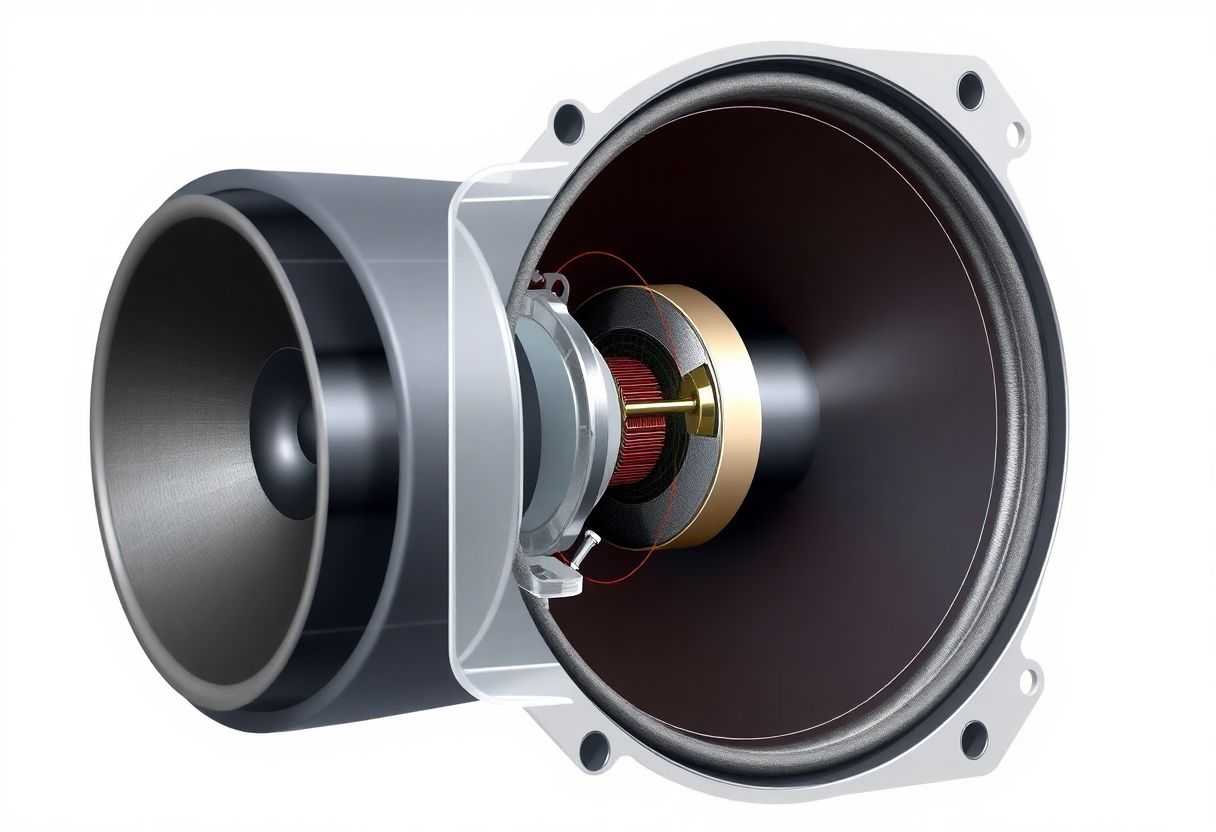
The journey begins with an electrical signal, a representation of the sound we want to hear, encoded as fluctuations in electrical current. This signal is sent to a coil of wire known as the voice coil, which is attached to the speaker cone. The voice coil sits within a magnetic field created by a permanent magnet in the speaker.
As the electrical signal varies, it creates a changing magnetic field around the voice coil. This field interacts with the permanent magnet's field, causing the voice coil to move back and forth rapidly. Because the voice coil is attached to the speaker cone (or diaphragm), the cone moves in sync with the coil, pushing and pulling the air in front of it. This movement creates compressions and rarefactions in the air, which propagate as sound waves.
To visualize this process, imagine throwing a pebble into a still pond. The pebble's impact creates ripples that spread out across the water's surface. Similarly, the speaker cone's movement creates "ripples" in the air—sound waves that spread out and eventually reach our ears.
The Anatomy of a Loudspeaker: A Symphony of Components
To truly understand what makes a speaker loud, we must first examine its constituent parts. A typical loudspeaker consists of several key components, each playing a crucial role in the sound reproduction process:
-
The cone (or diaphragm) is the part that actually moves the air to create sound waves. Usually made of paper, plastic, or metal, its shape is designed to move air efficiently. The material choice significantly affects the speaker's performance, with each material offering different benefits in terms of stiffness, weight, and damping properties.
-
The voice coil, a cylinder of wire wound around a former (a small cylinder made of heat-resistant material), receives the electrical signal and moves in the magnetic field. The number of windings and the wire gauge used in the voice coil can greatly impact the speaker's efficiency and power handling capabilities.
-
The magnet, typically a permanent magnet, creates the static magnetic field that interacts with the voice coil's field. Advancements in magnet technology, such as the use of rare earth magnets like neodymium, have allowed for more powerful and efficient speaker designs.
-
The spider, a flexible, corrugated support, holds the voice coil in place while allowing it to move freely. Its design is critical for maintaining the linearity of the speaker's motion, especially at high excursion levels.
-
The surround, an elastic ring connecting the outer edge of the cone to the speaker's frame, allows the cone to move while keeping it centered. The material and design of the surround can significantly affect the speaker's ability to produce low frequencies and handle high power levels.
-
The basket, a rigid frame that holds all the components together, plays a crucial role in maintaining the structural integrity of the speaker and can influence its overall performance through its material properties and design.
-
The dust cap, a small dome in the center of the cone, protects the voice coil from dust and debris. In some designs, it also contributes to the speaker's high-frequency response.
Each of these components plays a vital role in the speaker's performance, and the design choices made for each part can significantly affect the speaker's sound quality, efficiency, and durability.
The Physics of Loudness: Amplitude, Power, and Perception
When we discuss a speaker being "loud," we're actually referring to a complex interplay of physical phenomena and human perception. Two key concepts in this discussion are amplitude and power.
Amplitude refers to the size of the sound waves. Larger amplitude waves contain more energy and thus sound louder to our ears. In a speaker, this corresponds to how far the cone moves back and forth. A greater movement of the cone displaces more air, creating larger sound waves and thus a louder sound.
Power, measured in watts, is a measure of how much energy the speaker can output over time. More powerful speakers can move their cones with greater force, potentially creating louder sounds. However, it's crucial to understand that the relationship between power and perceived loudness is not linear. In fact, our perception of loudness follows a logarithmic scale. As a rule of thumb, it takes about ten times the power to sound twice as loud.
This logarithmic relationship is described by the Weber-Fechner law, which states that the perceived change in a stimulus is proportional to the logarithm of the change in the physical stimulus. In the context of sound, this means that each doubling of sound pressure level (SPL) corresponds to an increase of about 10 decibels (dB), which we perceive as approximately twice as loud.
Given this non-linear relationship, speaker sensitivity—how efficiently a speaker converts power into sound—is often a more useful measure than raw power when comparing speakers. Sensitivity is typically measured as the sound pressure level (SPL) produced at 1 meter distance with 1 watt of input power, and is expressed in dB SPL/W/m.
Frequency Response: The Full Spectrum of Sound
While loudness is a crucial aspect of speaker performance, it's not the only factor that determines a speaker's quality. Frequency response—the range of sound frequencies a speaker can reproduce—is equally important. The human ear can typically hear frequencies from about 20 Hz to 20,000 Hz, though this range can vary between individuals and tends to decrease with age.
No single speaker can efficiently reproduce this entire range, which is why many speaker systems use multiple drivers:
-
Woofers are large drivers designed to handle low frequencies (roughly 20-500 Hz). Their size allows them to move the large volumes of air necessary to produce deep bass notes.
-
Mid-range drivers handle the middle frequencies (roughly 500-2000 Hz), where much of the fundamental frequencies of most instruments and voices lie.
-
Tweeters are small drivers that handle high frequencies (roughly 2000-20,000 Hz). Their small size allows them to vibrate quickly enough to produce these high-pitched sounds.
By combining these different types of drivers in a process known as "crossover," speaker designers can create systems that accurately reproduce the full range of audible frequencies. The crossover network, which can be passive (using capacitors and inductors) or active (using electronic filters), ensures that each driver receives only the frequencies it's designed to handle.
The accuracy of a speaker's frequency response is often represented by a frequency response graph, which shows the speaker's output level across the audible spectrum. A flat response, where the output is consistent across all frequencies, is generally considered ideal for accurate sound reproduction. However, some speaker designs intentionally deviate from a flat response to create a particular sound character.
The Role of the Enclosure: Shaping Sound
The speaker enclosure, or cabinet, is far more than just a box to hold the drivers—it's an integral part of the speaker system that plays a crucial role in shaping the sound. Here's how:
-
The front panel of the enclosure, called the baffle, prevents sound waves from the back of the cone (which are out of phase with the front waves) from canceling out the front waves. This is particularly important for low frequencies, where the wavelengths are long enough that cancellation could occur without the baffle.
-
The enclosure helps control unwanted resonances that could color the sound. By carefully designing the enclosure's shape and internal bracing, engineers can minimize standing waves and other resonances that could distort the sound.
-
For low frequencies, the enclosure plays a crucial role in shaping the bass response. Different enclosure designs can significantly alter the character of the bass:
- Sealed (or acoustic suspension) enclosures provide tight, accurate bass but require more power to achieve high output levels.
- Bass reflex designs use a port or passive radiator to enhance low-frequency output, allowing for higher efficiency but potentially at the cost of some accuracy.
- Transmission line enclosures use a long, folded path to control the back wave of the driver, often resulting in deep, well-controlled bass.
-
The shape and size of the enclosure can affect how the sound waves disperse into the room. This is particularly important for high frequencies, where the wavelengths are short enough to be affected by the enclosure's edges.
Advanced enclosure designs go beyond these basic principles. For example, some high-end speakers use non-parallel walls to reduce internal standing waves, or incorporate sophisticated port designs to minimize turbulence and distortion.
The Quest for Efficiency: Making Speakers Louder
Given the same power input, some speakers sound louder than others due to their efficiency or sensitivity. Several factors affect a speaker's efficiency:
-
Magnet Strength: Stronger magnets can create more powerful forces on the voice coil, potentially increasing efficiency. The development of rare earth magnets like neodymium has allowed for more powerful yet compact magnet assemblies.
-
Cone Material: Lighter, stiffer materials can move more easily, improving efficiency. Modern materials like carbon fiber or beryllium offer excellent stiffness-to-weight ratios, allowing for efficient, low-distortion cone designs.
-
Voice Coil Design: The design of the voice coil, including its size and the number of windings, affects efficiency. Larger voice coils can dissipate heat better, allowing for higher power handling, while the number of windings affects the coil's impedance and sensitivity.
-
Enclosure Design: As mentioned earlier, the enclosure design can significantly impact efficiency, especially for low frequencies. Bass reflex designs, for example, can increase low-frequency efficiency compared to sealed enclosures.
-
Cone Geometry: The shape of the cone can affect its ability to move air efficiently. Some advanced designs use non-circular diaphragms or unique cone profiles to optimize efficiency and dispersion.
Improving efficiency is a major focus for speaker designers, as more efficient speakers can produce louder sound with less power input, reducing distortion and heat generation. This is particularly important in applications like portable Bluetooth speakers or car audio systems, where power may be limited.
Beyond Moving Coils: Alternative Speaker Technologies
While the moving-coil dynamic speaker is by far the most common type, other technologies exist that can produce sound in different ways:
-
Electrostatic Speakers: These use a thin, electrically charged diaphragm suspended between two conductive plates. When an audio signal is applied to the plates, it creates an electrostatic force that moves the diaphragm. Electrostatic speakers are known for their excellent clarity and low distortion, particularly in the mid and high frequencies. However, they're typically less efficient, more expensive, and struggle with low-frequency reproduction compared to dynamic speakers.
-
Planar Magnetic Speakers: These use a flat diaphragm with embedded conductors placed in a magnetic field. When current flows through the conductors, it interacts with the magnetic field, causing the diaphragm to move. Planar magnetic speakers offer some of the benefits of electrostatic speakers, such as low distortion and excellent transient response, but can be more robust and easier to drive.
-
Ribbon Speakers: These use a thin metal ribbon suspended in a magnetic field. The audio signal is passed through the ribbon, causing it to move in the magnetic field. Ribbon speakers are known for their excellent high-frequency response and low mass, allowing for very fast and accurate sound reproduction.
-
Piezoelectric Speakers: These use materials that physically deform when an electric current is applied. They're often used for high-frequency applications or in small devices where space is at a premium, such as smartphone speakers or tweeters in some car audio systems.
-
Magnetostriction Speakers: These use materials that change shape in response to a magnetic field. While less common in consumer audio, they find use in some specialized applications due to their ability to operate at very high frequencies.
Each of these technologies has its own strengths and weaknesses, and they're often used in specific applications where their unique characteristics are beneficial. For example, electrostatic speakers are favored by some audiophiles for their exceptional clarity in the midrange and high frequencies, while ribbon tweeters are often used in high-end speaker systems for their excellent high-frequency extension and low distortion.
The Future of Loudspeaker Technology
As we look to the future, several exciting developments are on the horizon for loudspeaker technology:
-
Smart Materials: New materials with unique properties could lead to more efficient and responsive speaker designs. For example, graphene, with its exceptional strength and light weight, is being explored for use in speaker cones and voice coils.
-
Digital Signal Processing (DSP): Advanced DSP could allow speakers to adapt to their environment in real-time, optimizing their performance based on room acoustics, listener position, and even the type of content being played. This could lead to speakers that sound great in any environment, without the need for manual calibration.
-
Beamforming: This technique allows sound to be directed more precisely, potentially creating personalized listening zones. By using arrays of small drivers and sophisticated signal processing, beamforming technology could allow multiple listeners in the same room to hear different audio content without the need for headphones.
-
Integration with AI: Speakers could become smarter, adjusting their output based on user preferences, room acoustics, and even the content being played. AI could also be used to enhance audio quality, removing unwanted noise or improving clarity in real-time.
-
Sustainable Materials: As environmental concerns grow, we may see more speakers made from sustainable or recycled materials. This could include biodegradable cone materials or enclosures made from recycled plastics.
-
Nanotechnology: Advancements in nanotechnology could lead to new types of drivers or materials with properties that enhance speaker performance. For example, nanostructured materials could provide better damping or allow for more efficient energy conversion.
-
Energy Harvesting: Future speakers might be able to harvest ambient energy to power themselves, reducing or eliminating the need for external power sources. This could be particularly useful for portable or outdoor speaker systems.
-
Holographic Sound: While still in its early stages, research is being conducted into creating "holographic" sound fields that can produce highly localized and directional audio without traditional speakers.
Conclusion: The Art and Science of Sound Reproduction
From the basic principles of electromagnetism to the cutting-edge of materials science and digital signal processing, loudspeakers represent a fascinating intersection of multiple scientific disciplines. They're a testament to human ingenuity, transforming simple physical principles into devices that can recreate the full range of audible sound with remarkable fidelity.
Understanding what makes a speaker loud—and more importantly, what makes it sound good—involves appreciating this complex interplay of physics, engineering, and psychoacoustics. Whether you're a casual listener or an audio enthusiast, knowing how your speakers work can deepen your appreciation of the technology that brings music and sound into our daily lives.
As we've seen, creating a loud speaker is about more than just raw power. It's about efficiency, precision, and the careful balance of multiple factors. The evolution of speaker technology continues to push the boundaries of what's possible in sound reproduction, promising even more immersive and high-quality audio experiences in the future.
The next time you listen to your favorite song or watch a movie with immersive sound, take a moment to appreciate the remarkable technology that's making it all possible. In the world of audio, loudspeakers truly speak volumes about the power of science and human innovation, reminding us that there's always more to discover in the pursuit of perfect sound.