The Science and Safety Behind Airbags: How These Ingenious Devices Save Lives in Car Crashes
In the realm of automotive safety, few innovations have had as profound an impact as the airbag. These seemingly simple devices have revolutionized vehicle safety, saving countless lives since their widespread adoption. But how exactly do airbags work, and what makes them so effective? Let's dive deep into the fascinating world of airbag technology, exploring their history, mechanics, and the crucial role they play in keeping us safe on the roads.
The Problem: Why Car Crashes Are So Dangerous
To truly appreciate the importance of airbags, we must first understand the physics behind car crashes and why they pose such a significant threat to human life.
The Physics of Collisions
At its core, the danger of a car crash comes down to basic principles of physics. A moving vehicle possesses kinetic energy, which is a function of its mass and velocity. The faster a car travels, the more kinetic energy it accumulates. In a collision, this energy doesn't simply disappear – it must be dissipated somewhere.
When a crash occurs, the vehicle comes to a sudden stop, but the occupants continue moving forward due to inertia. This is where Newton's first law of motion comes into play: objects in motion tend to stay in motion unless acted upon by an external force. Without proper safety measures, the occupants would collide with the vehicle's interior at nearly the same speed the car was traveling before the crash.
The Human Factor
The human body, while remarkably resilient, is not designed to withstand the extreme forces involved in a high-speed collision. The average human head weighs about 4.5 kg (10 lbs), and in a crash, it can experience forces many times that of gravity. The resulting impact can cause severe injuries, including traumatic brain injury, spinal cord damage, and facial fractures.
Moreover, the rapid deceleration experienced during a crash can cause internal organs to shift and collide with each other or the skeletal structure, leading to life-threatening internal injuries. This is why even crashes that may not look severe from the outside can still result in critical injuries to vehicle occupants.
Enter the Airbag: A Cushion of Safety
Airbags, officially known as Supplementary Restraint Systems (SRS) or Supplementary Inflatable Restraints (SIR), were developed to address these dangers. They work in conjunction with seatbelts to provide an additional layer of protection during a collision.
How Airbags Help
The primary function of an airbag is to slow down the movement of the occupant's body during a crash, particularly the head and chest. By providing a large, soft surface to collide with, airbags significantly reduce the force of impact experienced by the occupant.
Airbags achieve this through several key mechanisms:
-
Rapid inflation: Airbags deploy at incredible speeds, typically inflating in about 20-30 milliseconds. This is faster than the blink of an eye, which takes about 100-400 milliseconds.
-
Cushioning impact: The inflated airbag provides a softer, more forgiving surface for the occupant to collide with compared to the hard surfaces of the vehicle's interior.
-
Controlled deflation: As soon as the occupant's body makes contact with the airbag, it begins to deflate in a controlled manner. This deflation helps to absorb the occupant's kinetic energy, further reducing the risk of injury.
-
Force distribution: The large surface area of the airbag helps to distribute the force of impact over a wider area of the body, reducing the likelihood of concentrated trauma.
The Mechanics of Airbag Deployment
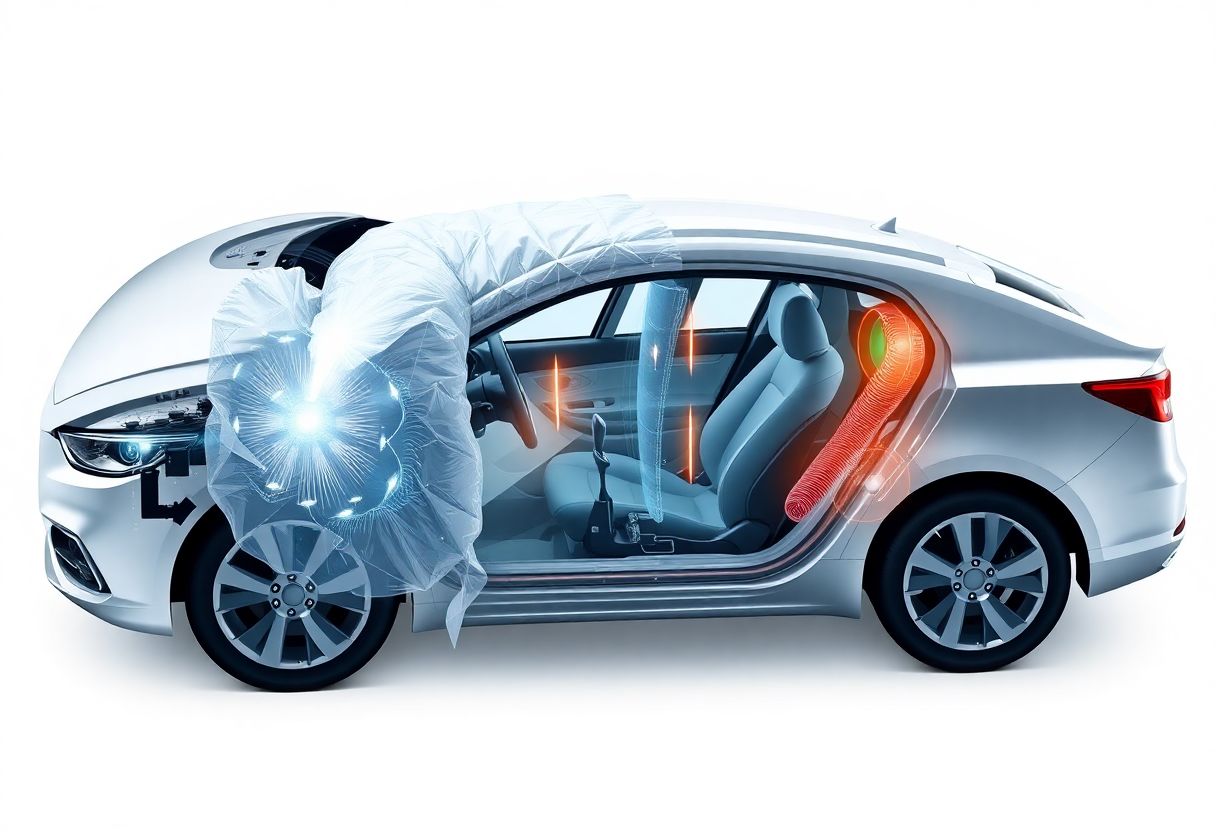
The deployment of an airbag is a complex process that occurs in a fraction of a second. Let's break down the steps involved:
-
Collision detection: Modern vehicles are equipped with an array of sensors, including accelerometers and impact sensors. These constantly monitor the vehicle's motion and can detect sudden deceleration indicative of a crash.
-
Signal processing: When the sensors detect a collision severe enough to warrant airbag deployment, they send a signal to the Airbag Control Unit (ACU).
-
Deployment decision: The ACU processes the incoming data and determines whether to deploy the airbags. This decision is made in milliseconds based on factors such as crash severity, occupant position, and seatbelt use.
-
Ignition: If deployment is deemed necessary, the ACU sends an electrical current to ignite a chemical propellant, typically a mixture of sodium azide (NaN3) and potassium nitrate (KNO3).
-
Gas generation: The ignited propellant undergoes a rapid chemical reaction, producing a large volume of nitrogen gas. This reaction occurs at temperatures reaching 300°C (572°F).
-
Bag inflation: The generated nitrogen gas rapidly fills the nylon or polyamide fabric bag. The bag is typically coated with talcum powder or corn starch to facilitate smooth deployment.
-
Deployment: The expanding bag bursts through its plastic cover in the steering wheel, dashboard, or other locations, inflating fully in front of the occupant.
-
Impact absorption: As the occupant contacts the bag, carefully designed vents allow the gas to escape in a controlled manner, gradually absorbing the impact energy.
This entire process, from collision detection to full deployment, typically occurs within 30-40 milliseconds – faster than you can blink.
The Effectiveness of Airbags: Numbers Don't Lie
The introduction of airbags has had a significant impact on vehicle safety statistics. According to the National Highway Traffic Safety Administration (NHTSA), frontal airbags have saved over 50,000 lives in the United States alone between 1987 and 2017.
Research has consistently shown the effectiveness of airbags in reducing fatalities:
- In frontal crashes, driver airbags reduce fatalities by about 29% for drivers wearing seatbelts, and by about 32% for unbelted drivers.
- Passenger airbags reduce fatalities for front-seat passengers by about 32% for those wearing seatbelts, and by 21% for unbelted passengers.
- Side airbags with head protection have been shown to reduce driver fatalities in near-side impacts by about 37% for SUV and pickup truck drivers, and by about 52% for car drivers.
These statistics underscore the crucial role airbags play in vehicle safety, particularly when used in conjunction with seatbelts.
The Evolution of Airbag Technology: A Brief History
The concept of airbags dates back further than many people realize. The journey from initial concept to widespread implementation spanned several decades:
1951-1953: German inventor Walter Linderer and American John W. Hetrick independently file patents for early airbag concepts. These early designs used compressed air, which proved impractical for rapid inflation.
1967: Allen K. Breed invents a "sensor and safety system" that uses a ball-in-tube mechanism to detect crashes and electronically trigger airbag inflation. This invention is considered a breakthrough in making airbags feasible for automotive use.
1970s: General Motors begins installing airbags in their vehicles for government fleet use. However, reliability issues and high costs prevent widespread adoption.
1980s: Mercedes-Benz introduces airbags as optional equipment in their high-end models, marking the beginning of commercial airbag use.
1990s: Airbags become increasingly common, with many countries mandating their use. In 1998, the United States requires dual front airbags for all passenger cars and light trucks.
2000s onwards: Advanced airbag systems are developed, including side-impact airbags, curtain airbags, and knee airbags. "Smart" airbag systems that adjust deployment based on crash severity and occupant position become more prevalent.
Types of Airbags in Modern Vehicles
As airbag technology has advanced, various types have been developed to provide comprehensive protection in different crash scenarios:
-
Frontal airbags: These are the most common type, deploying from the steering wheel and dashboard to protect the driver and front passenger in head-on collisions.
-
Side airbags: Mounted in the sides of seats or doors, these protect the torso in side-impact collisions.
-
Curtain airbags: These deploy from the roof lining to protect occupants' heads in side impacts or rollovers. They often cover both front and rear side windows.
-
Knee airbags: Deployed from under the dashboard, these prevent leg injuries and help keep occupants in the proper position during a crash.
-
Seat cushion airbags: These lift the front of the seat to prevent "submarining" under the seatbelt during a frontal impact.
-
Center airbags: A recent innovation, these deploy between the driver and front passenger to prevent occupant-to-occupant impacts in side collisions.
-
Pedestrian airbags: Some vehicles now feature external airbags that deploy over the windshield to protect pedestrians in the event of a collision.
The Physics Behind Airbag Protection
The effectiveness of airbags is rooted in fundamental principles of physics. Here's how they work to reduce injury:
-
Extending deceleration time: In a crash, injury occurs when the body decelerates too quickly. Airbags extend the time over which deceleration occurs, reducing the peak force experienced by occupants. This is a direct application of the impulse-momentum theorem from classical mechanics.
-
Force distribution: By providing a large surface area for impact, airbags distribute the force over a greater portion of the body. This reduces the pressure (force per unit area) experienced at any single point, lowering the risk of localized trauma.
-
Energy absorption: As the airbag deflates, it absorbs kinetic energy from the occupant's motion. This energy is converted into heat through the work done in compressing the gas within the airbag.
-
Preventing secondary impacts: By keeping occupants away from hard surfaces inside the vehicle, airbags reduce the risk of secondary impacts that can cause additional injuries.
Advanced Airbag Systems: The Cutting Edge of Safety
Modern airbag systems have evolved far beyond the simple inflatable bags of the past. Today's advanced systems incorporate sophisticated sensors and algorithms to optimize protection:
-
Multi-stage inflators: These allow airbags to deploy with varying levels of force based on the severity of the crash and the position of the occupant.
-
Occupant position detection: Sensors in the seats can detect whether an occupant is present and their approximate size and position, adjusting airbag deployment accordingly.
-
Adaptive venting: Some airbags feature vents that can open or close dynamically during deployment to optimize energy absorption.
-
Belt-integrated airbags: These inflatable seatbelts combine the functions of a seatbelt and an airbag, providing even more distributed protection.
-
Far-side airbags: Designed to protect occupants from impacts on the opposite side of the vehicle, these deploy from the center of the vehicle.
-
External sensors: Some vehicles now use radar and camera systems to detect imminent collisions and pre-arm airbag systems for faster deployment.
The Future of Airbag Technology
As automotive technology continues to advance, so too does airbag innovation. Several exciting developments are on the horizon:
-
Self-driving car airbags: With the advent of autonomous vehicles, new airbag configurations are being developed to protect occupants in novel seating arrangements.
-
Touchscreen airbags: As vehicles incorporate larger touchscreen displays, manufacturers are working on airbags that can deploy through these screens without showering occupants with shards of glass.
-
Motorcycle airbags: While less common, airbag technology is being adapted for use in motorcycles, either integrated into the vehicle or worn as part of the rider's gear.
-
Reusable airbags: Some companies are exploring the possibility of airbags that can be reset after deployment, potentially reducing replacement costs.
-
AI-enhanced deployment: Future airbag systems may use artificial intelligence to predict crash dynamics and optimize deployment in real-time.
Maintenance and Care of Airbag Systems
To ensure airbags function properly when needed, proper maintenance is crucial:
-
Regular inspections: Have your vehicle's airbag system checked during routine maintenance, especially if the airbag warning light illuminates.
-
Avoid interference: Don't place objects in front of airbag deployment zones, and be cautious about using aftermarket seat covers that may interfere with side airbags.
-
Replace as needed: If your vehicle has been in a crash that deployed the airbags, ensure they are replaced by a qualified technician using manufacturer-approved parts.
-
Heed recalls: Pay attention to any recalls related to your vehicle's airbag system and have them addressed promptly.
-
Proper seating: Maintain the recommended distance from airbag deployment zones, typically at least 25 cm (10 inches) from the steering wheel for drivers.
Conclusion: The Ongoing Importance of Airbag Technology
Airbags have revolutionized automotive safety, saving countless lives and preventing numerous serious injuries since their introduction. As we've explored, these devices are marvels of engineering, combining principles of physics, chemistry, and advanced sensor technology to provide crucial protection in the event of a crash.
While airbags are incredibly effective, it's important to remember that they are designed to work in conjunction with seatbelts and other safety features. The best protection comes from using all available safety systems properly and practicing safe driving habits.
As automotive technology continues to evolve, with the rise of electric vehicles and the development of autonomous driving systems, airbag technology will undoubtedly adapt and improve. Future innovations may provide even more comprehensive protection, react faster to imminent collisions, and perhaps even prevent accidents from occurring in the first place.
In the meantime, understanding how airbags work can help us appreciate their importance and use them correctly for maximum safety. By combining the protective power of airbags with responsible driving and proper use of all safety features, we can continue to make our roads safer for everyone.