The Fascinating World of Inkjet Printers: Unraveling the Science Behind Everyday Printing
Introduction: The Ubiquitous Marvels of Modern Technology
In our increasingly digital world, inkjet printers stand as silent heroes, bridging the gap between our virtual creations and tangible reality. These unassuming devices, found in homes and offices worldwide, represent a remarkable fusion of chemistry, physics, and engineering. Despite predictions of a paperless future, inkjet printers have not only persisted but thrived, evolving to meet our ever-changing needs. This article delves deep into the fascinating world of inkjet printers, exploring their inner workings, historical context, and future potential.
A Journey Through Time: The Evolution of Printing Technology
From Gutenberg to Silicon Valley
The story of printing is a testament to human ingenuity. In the 15th century, Johannes Gutenberg's movable metal type revolutionized the dissemination of knowledge, paving the way for the mass production of books and documents. This invention marked the beginning of the printing revolution, democratizing access to information and catalyzing social change.
As we moved into the industrial age, the typewriter emerged as a personal writing machine, using metal letters to stamp ink onto paper. This technology dominated offices and homes for over a century, becoming an icon of the modern workplace.
The advent of computers in the mid-20th century brought about a new era in printing technology. Early computer printers, such as those using golf ball and daisy wheel mechanisms, offered increased speed and efficiency compared to traditional typewriters. However, it was the dot-matrix printer, popular in the 1970s and 1980s, that truly bridged the gap between computers and paper output. These printers used a grid of metal pins to create characters, offering faster printing speeds and the ability to produce graphics, albeit with limited resolution and considerable noise.
The Inkjet Revolution: Microscopic Droplets, Macro Impact
The Birth of Inkjet Technology
The development of inkjet technology in the late 1970s marked a significant leap forward in printing capabilities. Unlike its predecessors, which relied on impact-based methods, inkjet printers introduced a fundamentally different approach: creating images and text by precisely depositing microscopic droplets of ink onto paper.
The first inkjet printers were developed by companies like HP and Canon in the late 1970s and early 1980s. These early models were slow and expensive, but they laid the groundwork for a technology that would soon dominate the consumer and small office printing market.
The Science of Tiny Droplets
At the heart of inkjet printing is the ability to control incredibly small amounts of liquid with extreme precision. Modern inkjet printers can produce droplets as small as 1 picoliter (1 trillionth of a liter), with diameters less than 100 microns – smaller than the width of a human hair. To put this in perspective, a typical period at the end of a sentence printed by an inkjet printer might consist of 5-10 such droplets.
These minuscule droplets are ejected from the print head at astonishing speeds, often exceeding 50,000 droplets per second. This high-speed, high-precision operation allows inkjet printers to create high-quality images and text with remarkable efficiency.
Inside the Print Head: Two Competing Technologies
Thermal Bubble Jet Technology
Developed and popularized by companies like HP and Canon, thermal bubble jet technology, also known as bubble jet printing, relies on the rapid heating and cooling of ink to create droplets. Here's how it works:
- A tiny resistor in each nozzle heats up to temperatures around 300°C (572°F) in just a few microseconds.
- This rapid heating causes a thin film of ink in contact with the resistor to vaporize, forming a bubble.
- As the bubble expands, it forces a droplet of ink out of the nozzle at speeds of up to 50 km/h (31 mph).
- The bubble then collapses, creating a vacuum that draws more ink into the nozzle from the reservoir.
- This entire process occurs in less than 10 microseconds and can be repeated thousands of times per second.
The thermal approach offers the advantage of simpler and less expensive print heads, as the heating elements can be manufactured using processes similar to those used in microchip production.
Piezoelectric Technology
Pioneered by Epson and adopted by several other manufacturers, piezoelectric inkjet technology takes a different approach, harnessing the unique properties of certain crystals:
- Each nozzle contains a tiny piezoelectric crystal, typically made of lead zirconium titanate (PZT).
- When an electric current is applied to the crystal, it changes shape, expanding slightly.
- This deformation creates pressure within the ink chamber, forcing a droplet out of the nozzle.
- When the current is removed, the crystal returns to its original shape, creating a vacuum that draws more ink into the chamber.
Piezoelectric systems offer greater control over droplet size and shape, allowing for more precise ink placement. They also tend to have a longer lifespan, as they don't subject the ink to the extreme temperatures used in thermal systems.
The Anatomy of an Inkjet Printer
Key Components and Their Functions
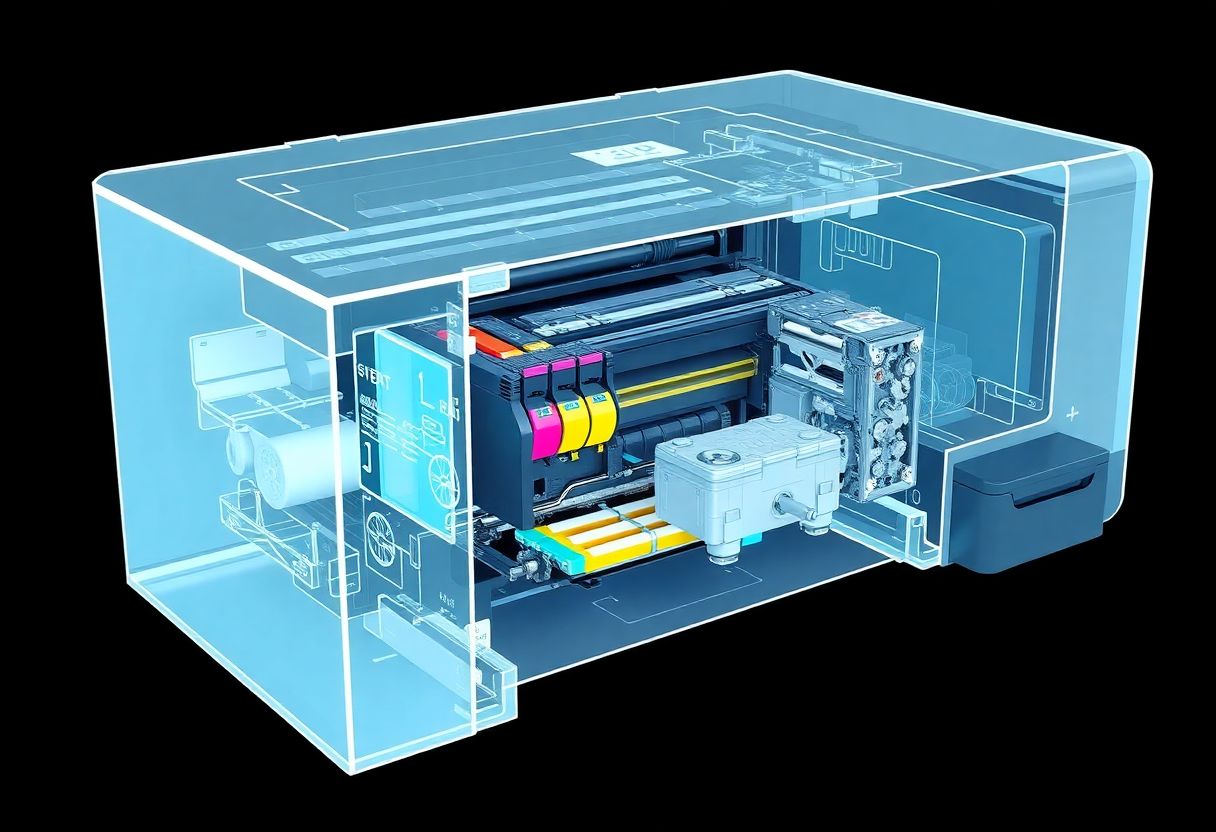
To truly appreciate the complexity of inkjet printing, let's examine the main components that work in concert to produce our documents and photos:
-
Print Head: The heart of the printer, containing hundreds or thousands of nozzles arranged in a precise array. Modern print heads can have nozzle densities exceeding 1,200 per inch.
-
Ink Cartridges: These reservoirs store the liquid ink used for printing. Most consumer printers use separate cartridges for each color (typically cyan, magenta, yellow, and black), while some high-end models use additional colors for enhanced photo quality.
-
Stepper Motor: This precision motor controls the movement of the print head across the page. It can position the print head with accuracies of up to 1/2400 of an inch.
-
Paper Feed Mechanism: A system of rollers and gears that moves the paper through the printer. High-end printers can control paper movement with precision of up to 1/4800 of an inch.
-
Control Circuit: The "brain" of the printer, typically a microprocessor-based system that coordinates all printer functions based on instructions received from the computer.
-
Flexible Cable: A ribbon cable that connects the moving print head to the stationary control circuit, designed to withstand hundreds of thousands of back-and-forth movements.
-
Maintenance Station: A often-overlooked but crucial component that cleans and caps the print head when not in use, preventing ink from drying and clogging the nozzles.
The Printing Process: From Digital to Physical
When you click "Print" on your computer, a complex series of events is set in motion:
-
The printer driver on your computer converts your document into a format the printer can understand, typically a series of commands in a language like PCL (Printer Command Language) or PostScript.
-
This data is sent to the printer's control circuit, which begins to coordinate the printing process.
-
The paper feed mechanism activates, drawing a sheet of paper into the printer.
-
The print head begins to move across the page, typically from left to right. As it moves, it deposits tiny droplets of ink in precise patterns.
-
For color printing, multiple passes may be required to lay down different colors of ink.
-
After each pass, the paper advances slightly, typically by less than a millimeter.
-
This process repeats until the entire page is printed, with the control circuit precisely timing the firing of each nozzle to create the desired image or text.
The Art and Science of Color Printing
CMYK: The Building Blocks of Color
Color inkjet printers typically use a four-color system known as CMYK: Cyan, Magenta, Yellow, and Key (black). This subtractive color model allows the printer to create a wide range of colors by combining these four basic inks:
- Cyan and Yellow combine to create Green
- Magenta and Yellow produce Red
- Cyan and Magenta mix to form Blue
- Black is used for text and to enhance contrast
By varying the proportion and pattern of these ink droplets, the printer can reproduce millions of colors. This is achieved through a process called dithering, where the printer creates the illusion of continuous color tones by varying the density and pattern of ink dots.
Beyond CMYK: Expanding the Color Gamut
While CMYK is sufficient for most printing needs, high-end photo printers often incorporate additional ink colors to expand the range of reproducible colors (known as the color gamut). These might include:
- Light Cyan and Light Magenta for smoother gradients in light areas
- Red and Green for more vivid colors
- Gray for improved black and white photo reproduction
Some professional-grade printers use up to 12 different ink colors to achieve exceptional color accuracy and detail.
Print Quality: The Numbers Behind the Image
Resolution and Dots Per Inch
Print quality is often measured in dots per inch (dpi), which refers to the number of individual ink dots the printer can place within a one-inch line. Higher dpi numbers generally indicate better print quality:
- A typical office document might be printed at 300-600 dpi
- High-quality photo prints can reach 2400 dpi or more
- Some professional printers claim resolutions up to 9600 dpi
However, it's important to note that dpi alone doesn't tell the whole story. Other factors that influence print quality include:
- The size of the ink droplets (smaller droplets allow for finer detail)
- The precision of dot placement
- The quality of the ink and its interaction with the paper
- The sophistication of the printer's color mixing algorithms
Ink and Paper: A Crucial Partnership
The interplay between ink and paper is a critical factor in print quality. Inkjet printers rely on the paper to absorb the liquid ink without allowing it to spread excessively, a property known as "bleed."
Specialized inkjet papers are designed with coatings that control ink absorption, allowing for sharper text and more vivid colors. These papers often have a microporous surface that quickly draws the ink beneath the surface, preventing smudging and allowing for faster drying times.
The Economics of Inkjet Printing: Understanding the True Cost
The Razor and Blades Model
While inkjet printers are often inexpensive to purchase, the ongoing cost of ink can be substantial. This pricing strategy, known as the "razor and blades" model, sees manufacturers selling printers at low margins (or even at a loss) with the expectation of profiting from ongoing ink sales.
Consider these facts:
- Printer ink can cost up to $75 per fluid ounce, making it one of the most expensive liquids consumers regularly purchase.
- A gallon of printer ink can cost over $9,600, compared to about $3 for a gallon of gasoline.
- Some printers use ink for maintenance routines, such as cleaning print heads, even when not actively printing.
Over the lifetime of a printer, ink costs can far exceed the initial purchase price of the device. This has led to a thriving market for third-party and refilled ink cartridges, although printer manufacturers often warn that using non-original inks can damage the printer or void warranties.
Strategies for Managing Ink Costs
To manage the ongoing costs of inkjet printing, consider these strategies:
- Use draft or economy mode for non-critical documents to reduce ink consumption.
- Choose fonts that use less ink. Studies have shown that Century Gothic and Times New Roman are among the most economical.
- Look for printers with separate ink tanks for each color, allowing you to replace only the colors that run out.
- Consider printers with refillable ink tanks, which can dramatically reduce per-page printing costs.
- For high-volume printing, a laser printer might be more economical in the long run, despite higher upfront costs.
Beyond Paper: Innovative Applications of Inkjet Technology
The precision and versatility of inkjet technology have led to its adoption in fields far beyond traditional document printing:
3D Printing
Some 3D printers use inkjet-like technology to deposit materials layer by layer. These printers can create complex three-dimensional objects by precisely depositing tiny droplets of liquid polymers that are then cured with UV light.
Bioprinting
In the field of regenerative medicine, researchers are using modified inkjet printers to print living cells. This technique, known as bioprinting, holds promise for creating tissue constructs and even entire organs for transplantation.
Electronics Manufacturing
Inkjet technology is being used to print electronic circuits on flexible substrates. This approach allows for the creation of thin, flexible electronic devices and could revolutionize the manufacturing of items like displays and solar cells.
Food Decoration
The food industry has adopted inkjet technology for decorating cakes, cookies, and other edible items. Using food-safe inks, these printers can create intricate designs and even print edible photographs.
Textile Printing
Inkjet technology has transformed the textile industry, allowing for detailed, customized printing on fabrics. This has enabled the rise of on-demand clothing production and personalized fashion items.
The Future of Inkjet Printing: Innovations on the Horizon
As technology continues to advance, we can expect to see further innovations in inkjet printing:
Increased Speed and Efficiency
Future printers may incorporate multiple print heads or new nozzle designs to increase printing speeds dramatically. Some prototypes have demonstrated speeds up to 500 pages per minute for high-volume commercial printing.
Improved Ink Formulations
Advancements in ink chemistry could lead to inks with improved color vibrancy, faster drying times, and better resistance to fading. Water-based inks with performance rivaling solvent-based inks could reduce environmental impact.
Integration with Other Technologies
We may see inkjet printing combined with other manufacturing processes, creating hybrid systems capable of producing complex, multi-material objects. This could have applications in fields ranging from consumer electronics to aerospace.
Nanoparticle Printing
The ability to print with nanoparticle-infused inks could enable the creation of functional materials with unique properties, such as conductive fabrics or self-cleaning surfaces.
Conclusion: The Enduring Legacy of Inkjet Technology
From its humble beginnings in the late 1970s to its current status as a ubiquitous technology, inkjet printing has come a long way. Its ability to precisely control microscopic droplets of liquid has not only revolutionized home and office printing but has also opened up new frontiers in manufacturing, medicine, and beyond.
As we look to the future, it's clear that inkjet technology will continue to evolve and find new applications. Whether it's printing living tissue for medical research, creating custom-designed clothing, or producing the next generation of electronic devices, the principles pioneered in inkjet printing will play a crucial role.
The next time you print a document or photo, take a moment to appreciate the complex dance of tiny ink droplets that brings your digital creations into the physical world. The humble inkjet printer, with its blend of precision engineering and cutting-edge chemistry, stands as a testament to human ingenuity and our endless capacity for innovation.